
In Honor of St. Augustine | Hymnus in honorem Sancti Augustini
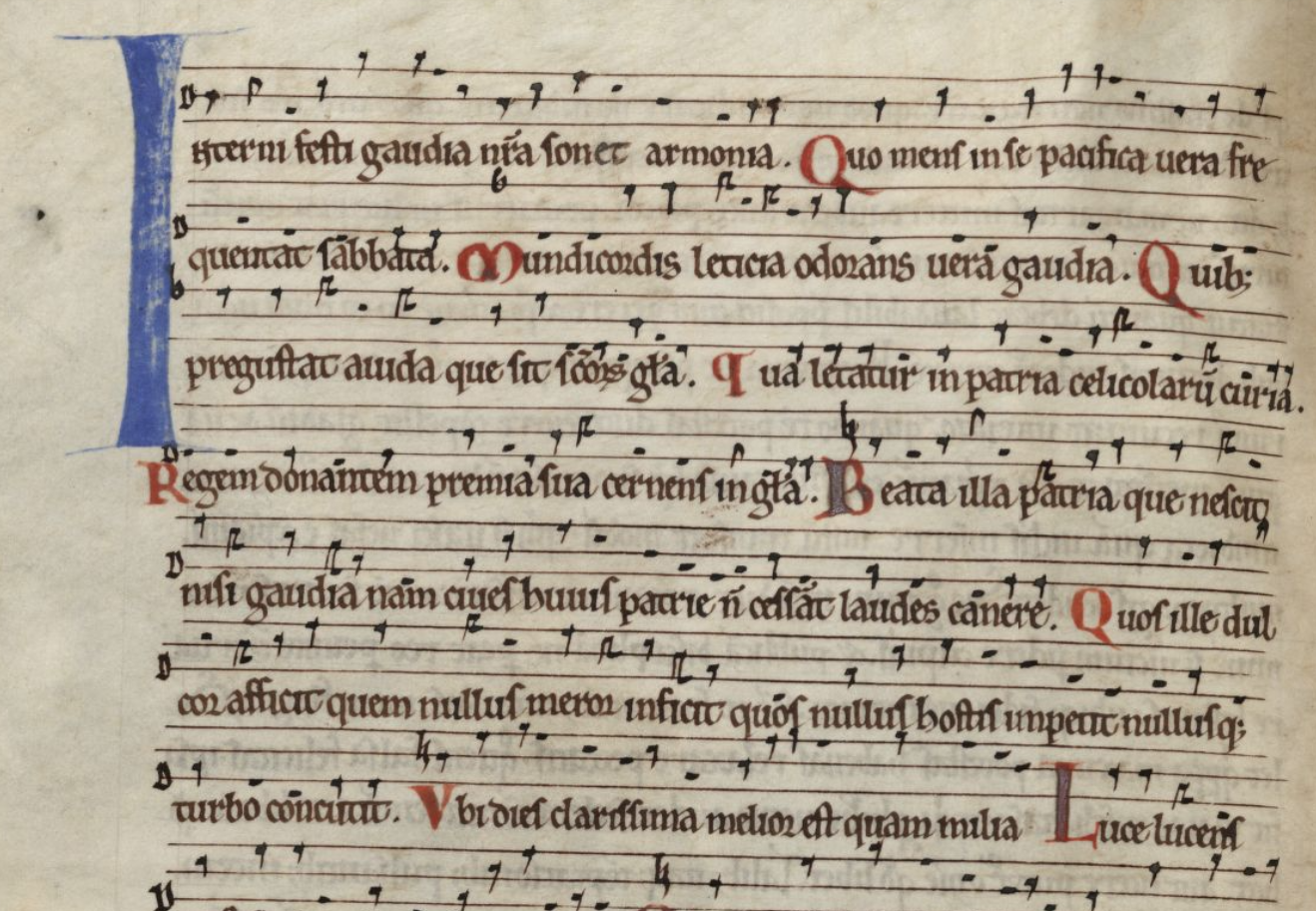
Detail from Cambridge, Corpus Christi College, MS 253, f. 140v [Public Domain]
Read the text (PDF)
Introduction to the Text
“In Honor of St. Augustine” is a 12th-century sequence attributed to Adam of St. Victor (d. 1146), who served at Notre Dame Cathedral in Paris and later at the nearby Abbey of Saint Victor. As one of the most prominent authors of hymns and sequences from this period, he was acquainted with various important theologians at the time, such as Peter Abelard and Hugh of St. Victor.
The central feature of this sequence is the image of heaven that it provides. During its performance, two groups of singers would sing the same text, with the second group starting later than the first group, creating a layered sonic effect. In this way, the images of heaven which are present in the text would be layered over one another, generating a complexity of sound and meaning which would resonate against the walls of the church or cathedral and offer an earthly simulation of heaven’s beauty. One interesting aspect of the text is that it mentions specific worries which will not exist in heaven (“enemy attacks”, “mob strikes”), giving us insight into what people in twelfth century Paris were most concerned about.
This sequence is written to be sung at the feast day of St. Augustine (354-430 CE) on August 28th. St. Augustine was a prolific theologian and philosopher and by the High Middle Ages (c.1000-1250 CE) had become the most important thinker for medieval Christians in Western Europe. Some of his most notable works are The City of God, On Christian Doctrine, and his Confessions. The typical practice on Saints’ Days was for Christians to sing hymns, recite prayers and observe relics, such as fragments of the saint’s clothing or their bodily remains. “In Honor of St. Augustine” would have been incorporated into this kind of celebratory liturgy.
Liturgical music of the medieval church comprised diverse forms which each served different purposes: the antiphon, the responsorium, the sequence, etc. The sequence would be performed directly before the reading of the Gospel and after the singing of “Alleluia”. As a form, it is composed of a series of rhymed, metrical couplets of varying lengths. “In Honor of St. Augustine” was probably sung in both parish churches and monastic settings; its manuscript transmission suggests that it may even have been sung in the Middle East by Christian crusaders. It seems to have been a popular hymn, as it has come down to us in many manuscripts and was translated into several other European languages during the medieval period.
Introduction to the Source
This edition is based on Cambridge, Corpus Christi College, MS 253. Besides “In Honor of St. Augustine”, the manuscript contains selections from Augustine’s theological works, his Confessions, and a guide to living a Christian life for soldiers by Ferrandus, deacon of Carthage (d. 546/7). The works by Augustine are in a fine hand, with exceptional illuminated initials. “In Honor of St. Augustine” is in a twelfth-century hand and appears with musical notation on a threeline stave. There are also some late medieval additions at the end of the manuscript.
About this Edition
The Latin text presented here has been transcribed from Cambridge, Corpus Christi College, MS 253, ff.140v-141r. A digitization of this manuscript can be viewed online here. All occurrences of the letters “u” and “v” are preserved in their original form. Contractions have been expanded (expansions are not indicated). Punctuation follows the original but with modernized punctuation marks. Capitalization follows modern conventions.
Further Reading
Brown, Peter. The Cult of the Saints: Its Rise and Function in Latin Christianity. University of Chicago Press, 1981.
- A foundational work on the worship of saints in the Middle Ages.
Dyer, Joseph. “The Bible in the Medieval Liturgy, c. 600–1300.” The New Cambridge History of the Bible, edited by Richard Marsden and E. Ann Matter, vol. 2, Cambridge University Press, 2012, pp. 659–679.
- An overview of the liturgy in the medieval church, including discussion of the performance of psalms and hymns.
Fassler, Margot E. The Virgin of Chartres: Making History through Liturgy and the Arts. Yale University Press, 2010, pp. 151-154.
- An analysis of the liturgical usage of “In Honor of St. Augustine” and a transcription and translation of the text as transmitted in Chartres BM MS 529. Fassler discusses the presumed association of this text with the rule of St. John in the Valley.
Lyon, Elizabeth Lucia. “Affection, Attention, and the Will: Medieval Models of Devout Chant.” International Review of the Aesthetics and Sociology of Music 49, no. 1 (2018): 3-28.
- Presents three possible interpretations regarding the efficacy of music and chants in medieval liturgy.
In Honor of St. Augustine | Hymnus in honorem Sancti Augustini
Interni festi gaudia nostra sonet armonia.
Quo mens in se pacifica vera frequentat sabbata.
Mundi cordis laetitia odorans uera gaudia.
Quibus praegustat avida quae sit sanctorum gloria.
5 Qua laetatur in patria caelicolarum curia.
Regem donantem praemia sua cernens in gloria.
Beata illa patria quae nescit nisi gaudia
nam cives huius patriae non cessant laudes canere.
Quos ille dulcor afficit quem nullus maeror inficit
10 quos nullus hostis impetit nullusque turbo concutit.
Ubi dies clarissima melior est quam milis.
Luce lucens praefulgida plena Dei notitia.
Quam mens humana capere nec lingua valet promere.
Donec vitae victoria commutet haec mortalia.
15 Quando Deus est omnia: vita virtus scientia.
Victus vestis et cetera quae uelle potest mens pia.
Hoc in hac valle misera meditetur mens sobria.
Hoc per soporem sentiat hoc attendat dum uigolat.
Quo mundi post exsilia coronetur in patria.
20 Ac in decoris gloria regem laudet per saecula.
Harum laudum praeconia imitatur ecclesia.
Cum recensentur annua sanctorum natalitia.
Dum post peracta proelia digna redduntur praemia.
Pro passione rosea pro castitate candida.
25 Datur et torques aurea pro doctrina catholica.
Qua praefulget Augustinus in summi regis curia.
Cuius librorum copia fides firmatur unica.
Hinc et mater ecclesia uitat errorum devia.
Huius sequi vestigia ac praedicare dogmata.
30 Fide recta ac fervida det nobis mater gratia. Amen.
Let the harmony of the feast inside our heart sound our happiness,
Through which our spirit is at peace in itself and keeps the Sabbath truly.
Let the joy of the pure heart spread1 true happiness,
Through which the faithful one shall have a foretaste of the glory of the saints.
5 With this glory, the court of the heavenly beings rejoices in their homeland2,
Beholding the king in glory, who is offering his own prizes:
Blessed is that homeland that knows nothing but happiness,
For the people of that land do not stop singing its praises.
These are the ones whom sweetness affects and no sorrow infects,
10 Whom no enemy attacks, and no mob strikes.
There it is the brightest day, better than a thousand days,
Shining with a shining light, full of knowledge of God
That the human mind may not capture nor the tongue express
Until the victory of life entirely alters these mortal beings,
15 When God is everything: life, virtue, knowledge,
Nourishment, garments, and all other things that a pious mind can wish for.
A sober mind meditates upon this3 in this miserable valley:
So that it4 may sense this through sleep and pay attention to it while awake,
And after periods of exile from the world, may be crowned in the homeland5,
20 And in the glory of beauty, may praise the King6 through all ages.
The Church imitates the proclamation of these praises
When the annual birthdays of the saints are counted7;
While after the battles have been fought, worthy gifts are distributed
For rosy passion and for white chastity8,
25 And a golden wreath is given for the catholic teaching
On account of which Augustine shines forth in the court of the Supreme King9.
Through the abundance of his10 books, the single faith is strengthened
And the Mother Church avoids straying into error.
May our Mother grant that we follow in his footsteps and preach his teachings
30 With grace with righteous and ardent faith11. Amen.
Critical Notes
-
Literal meaning is “spread the scent of”. The use of sensory vocabulary here reinforces the idea that the listeners are intended to experience heaven through all their senses.
-
Here and below, I translated patria as “homeland”, but it could also be translated as “fatherland”.
-
That is, the ideas about heaven and the afterlife presented above.
-
The mind.
-
This refers to heaven.
-
This refers to God.
-
This refers to the celebration of the saints’ lives through liturgies which are repeated annually.
-
This is a deliberate color contrast, indicating that the visual sense is being drawn on here too.
-
This refers to God.
-
This refers to Augustine.
-
The syntax of this line and the penultimate line has been adjusted in the translation for clarity.