
“Were it not that poesy tarnished scholars” | ولو لا الشعر بالعلماء يزري
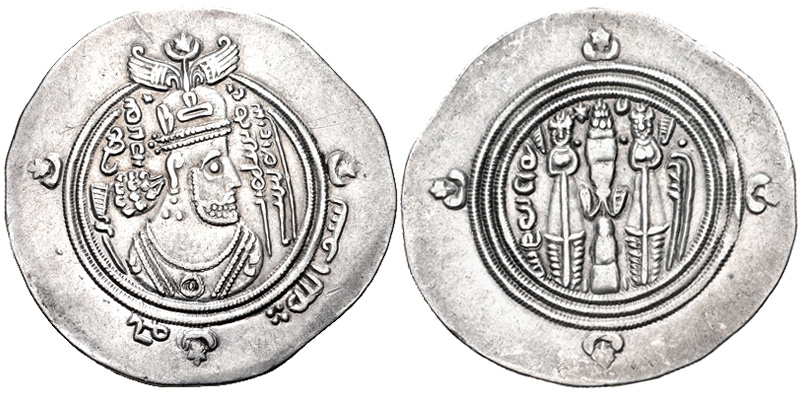
Coin of al-Muhallab ibn Abi Sufra. Zibayrid governor, circa AH 75-79 / AD 694-698, Classical Numismatic Group, Inc. [CC BY-SA]
Read the text (PDF)
Introduction to the Text
“Were it not that poesy tarnished scholars” amounts to some of the most famous lines in Arabic poetry. The poem comes from the collected works ascribed to Muḥammad ibn Idrīs al-Shāfiʿī, better known as al-Imām al-Shāfiʿī (767–820). We have no extant manuscripts from his period that include his poetic works, which appeared in various anthologies since the Middle Ages. Only relatively recently, at the turn of the twentieth century, was the poetry ascribed to him published
in a single dīwān, or poetry collection. These poems were penned by different hands at different points in history. In the preface to his second edition of the dīwān, Dr. Mujāhid Bahjat notes that the majority of poems ascribed to al-Shāfiʿī may be ascribed to other poets or are otherwise unconfirmed as his own; he traces only twelve directly to him, whereas a given edition may include over 160 poems and poetic fragments [Bahjat, 3-4, 19-20].
Although primarily recognized as the namesake to one of the four main jurisprudential schools (or madhāhib, sg. madh’hab) in Sunni Islam, al-Imām al-Shāfiʿī equally distinguished himself as a master of language and adab (belles-lettres). Growing up, this descendant of the prophetic line of the Banū Hāshim tribe lived among the Hudhayl—a clan known for the purity of their Arabic—in order to immerse himself in the study of the language. This training made his reputation as a poet and poetic critic. Years later, in Baghdad, the famed philologist and grammarian al-Aṣmaʿī (d.828) would visit al-Shāfiʿī to take Hudhalī poetry from him. As did all eminent scholars who sought him out (there were many), he marveled at his double command of language and poetry.
al-Imām al-Shāfiʿī was born in Gaza in 767. With the death of his father, he and his mother moved to Mecca two years later. His pursuit of ṭalab al-ʿilm (knowledge) brought him at a young age to Medina, where he studied ḥadīth (prophetic narrations) and fiqh (Islamic law) under al-Imām Mālik ibn Anas until the latter’s death in 795. He then accepted a post in Yemen as governor of Najran, although a revolt in 803 prematurely ended his political career when it led to his arrest and summoning to the court of the Abbasid caliph Hārūn al-Rashīd (d.809) in al-Raqqah, a city in Syria. There, he would meet the jurist Muḥammad al-Shaybānī (d.805), who helped secure his acquittal. Under al-Imām al-Shaybānī’s tutelage, al-Shāfiʿī relocated to Baghdad. Among al-Shāfiʿī’s most important students there was al-Imām Aḥmad ibn Ḥanbal (d.855). al-Shāfiʿī would make one more major move in 814 for Egypt, where he continued to study and teach a variety of subjects, primarily jurisprudence, until his death in 820 at the age of 54.
The verses ascribed to al-Shāfiʿī probably reflect a lifetime’s worth of occasional compositions and pronouncements, and certainly reflect their author’s erudition, fine manners, and familiarity with classical meters. Precise and brief, the poetry employs a range of sophisticated rhetorical strategies nevertheless, from ṭibāq (contrariety) to bayān (eloquence), to jinās (paronomasia), to additional instances of badīʿ (ingenuity)—stylistically unique tropes and schemes [Bahjat, pp. 29-37, 42-43]. Thematically, the poems touch on the matters of wisdom literature, including personal comportment, friendship, the pursuit of knowledge, and the cultivation of virtues.
Further Reading
Bahjat, Mujāhid Muṣṭafā, editor. “Muqaddimat al-Ṭabʿah al-Thāniyah” [“Preface to the Second Edition”]. In Dīwān al-Shāfiʿī: al-Imām al-Faqīh Abū ʿAbd Allāh Muḥammad ibn Idrīs al-Shāfiʿī, Dimashq: Dār al-Qalam, 1999.
Chaumont, E. “al-Shāfiʿī”, In Encyclopaedia of Islam, 2nd ed., edited by P. Bearman, Th. Bianquis, C.E. Bosworth, and E. van Donzel, W.P. Heinrichs, 2012. Consulted online on 25 August 2020 .
Farrin, R. Abundance from the Desert: Classical Arabic Poetry. Syracuse: Syracuse University Press, 2017.
van Gelder, G., editor. Classical Arabic Literature: A Library of Arabic Literature Anthology. New York: New York University Press, 2012.
“Were it not that poesy tarnished scholars” | “يرزي ءاملعلاب رعشلا ال ولو”
ديبل نم رعشأ مويلا تنكل ديزي ينبو بلهم لآو
5 يديبع مهلكسانلا تبسح
يرزي ءاملعلاب رعشلا ال ولو ثيل لكنم ىغولا يف عجشأو يبر نمحرلا ةيشخ الولو
Were it not that poesy tarnished scholars
I would have now Labīd1 outshone,
Shown more courageous than every battle-lion,
The House Muhallab,2 the Banī Yazīd.3
Were it not for fearing al-Raḥmān,4 my Master,
I would have counted the people—all people—my slaves.
Critical Notes
Note 1: The great Arab poet (d.c.660)
Note 2: A powerful Arab family of generals and governors.
Note 3: The storied ruling tribe.
Note 4: A name of Allāh that encompasses the very possession of mercy.