Outside of Rome, crossing Marino | Partiendo de Roma, passando Marino
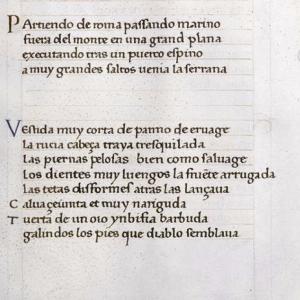
Madrid, Biblioteca Nacional de España MS, VITR/17/7, f.157r [Public domain]
Read the text (PDF)
Introduction to the Text
This poem is a serranilla, an evolution of the Provençal pastorela. Written in short verse ( arte menor), serranillas narrate a courtly poet’s encounter with a mountain woman. This is one of six compositions in the genre by fifteenth-century author Carvajal (or Carvajales). Very little is known about Carvajal’s life. His poetry is linked to the Neapolitan court of Alfonso the Magnanimous in Naples (r. 1442-1458) and to that of Alfonso’s son Ferrante (r. 1459-1494). In addition to his famous serranillas, Carvajal is also known for his literary epistles and ballads.
In this poem, the poet meets a monstrous mountain woman whom he describes in a grotesque fashion. It has been interpreted as a satirical rewriting of one of the serrana episodes of Juan Ruiz’s Libro de buen amor (stanzas 1006-21). The Libro de buen amor (1330/1343) is one of the masterpieces of medieval Castilian literature, a heterogenous, polysemous and oftentimes parodic text in which the narrator gives an account of his love life.
Introduction to the Source
The poem is copied in Madrid, Biblioteca Nacional de España, VITR/17/7, fol. 136v-137r. This manuscript is a copy of the poetry collection known as the Cancionero de Estúñiga , ca. 1465. It has been digitized: http://bdh-rd.bne.es/viewer.vm?id=0000051837. It contains a compilation of mostly Castilian poems, including ballads, as well as a few Italian compositions. Their authors accompanied the King of Aragon, Alfonso the Magnanimous, in Naples in the mid-fifteenth century.
About this Edition
The text has been punctuated. Word separation and capitalization follow modern usage. Elisions have been marked with an apostrophe.
Further Reading
Carvajal. Poesie. Edited by Emma Scoles. Edizioni dell’Ateneo, 1967.
- Critical edition of Carvajal’s poetry.
Gerli, E. Michael. “Chapter 6. The Libro in the Cancioneros.” Reading, Performing, and Imagining the ‘Libro del Arcipreste’. University of North Carolina Press, 2016, esp. pp. 194-203.
- Reassessment of Caravajal’s serranillas in view of their intertextual relationship with the Libro de buen amor.
Marino, Nancy F. La serranilla española: notas para su historia e interpretación. Scripta Humanistica, 1987.
- Study of the serranilla genre, with attention to Carvajal’s poems in chapter 5.
Outside of Rome, crossing Marino | Partiendo de Roma, passando Marino
Partiendo de Roma, passando Marino
fuera del monte, en una grand plana,
executando tras un puerco espino,
a muy grandes saltos uenia la serrana.
5 Vestida muy corta de panno de eruage,
la rucia cabeça traya tresquilada,
las piernas pelosas bien como saluage,
los dientes muy luengos, la fruente arrugada;
las tetas disformes atras las lançaua,
10 calva, çeiunta et muy nariguda,
tuerta de un oio, ynbifia, barbuda,
galindos los pies que diablo semblaua.
Outside of Rome, crossing Marino,
Out of the woods, in a large plain,
Chasing a porcupine,
The mountain woman came [to me] in big leaps.
5 Dressed in a short coarse woolen cloth,
Her gray hair she had sheared,
Her legs were hairy like those of a savage,
Her teeth were very long, her forehead was wrinkled,
Her deformed tits were swinging backwards,
10 Bald, unibrow, with such a big nose,
Blind in one eye, hunchbacked, bearded,
Her feet all twisted, she looked like a devil.