
Traveling through Tuscany | Passando por la Toscana
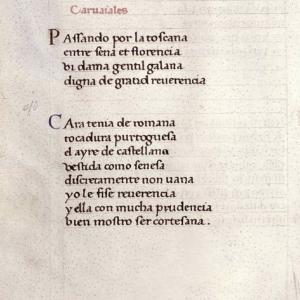
Madrid, Biblioteca Nacional de España MS, VITR/17/7, f.153r [Public domain]
Read the text (PDF)
Introduction to the Text
This poem is a serranilla, an evolution of the Provençal pastorela. Written in short verse ( arte menor), serranillas narrate a courtly poet’s encounter with a mountain woman. This is one of six compositions in the genre by fifteenth-century author Carvajal (or Carvajales). Very little is known about Carvajal’s life. His poetry is linked to the Neapolitan court of Alfonso the Magnanimous in Naples (r. 1442-1458) and to that of Alfonso’s son Ferrante (r. 1459-1494). In addition to his famous serranillas, Carvajal is also known for his literary epistles and ballads.
In this poem, the poet subverts some of the genre’s conventions by meeting not a rustic woman but a beautiful and courteous noble lady in a context in which he would have normally met a serrana. The two of them strike up a conversation as they walk together. The end of the composition reveals that the encounter was a dream vision.
Introduction to the Source
The poem is copied in Madrid, Biblioteca Nacional de España, VITR/17/7, fol. 136v-137r. This manuscript is a copy of the poetry collection known as the Cancionero de Estúñiga , ca. 1465. It has been digitized: http://bdh-rd.bne.es/viewer.vm?id=0000051837. It contains a compilation of mostly Castilian poems, including ballads, as well as a few Italian compositions. Their authors accompanied the King of Aragon, Alfonso the Magnanimous, in Naples in the mid-fifteenth century.
About this Edition
The text has been punctuated. Word separation and capitalization follow modern usage. Elisions have been marked with an apostrophe.
Further Reading
Carvajal. Poesie. Edited by Emma Scoles. Edizioni dell’Ateneo, 1967.
- Critical edition of Carvajal’s poetry.
Gerli, E. Michael. “Chapter 6. The Libro in the Cancioneros.” Reading, Performing, and Imagining the ‘Libro del Arcipreste’.
University of North Carolina Press, 2016, esp. pp. 194-203.
- Reassessment of Caravajal’s serranillas in view of their intertextual relationship with the Libro de buen amor.
Marino, Nancy F. La serranilla española: notas para su historia e interpretación. Scripta Humanistica, 1987.
- Study of the serranilla genre, with attention to Carvajal’s poems in chapter 5.
Traveling through Tuscany | Passando por la Toscana
Passando por la Toscana,
entre Sena et Florencia,
vi dama gentil galana
digna de grand reuerencia.
5 Cara tenia de romana,
tocadura purtoguesa,
el ayre de castellana,
vestida como senesa
discretamente, non uana;
10 yo le fise reuerencia
y ella, con mucha prudencia,
bien mostro ser cortesana.
Assy entramos por Sena,
fablando de compannia,
15 con plaser auiendo pena
del pesar que me plasia.
Sy se dilatara el dia
o la noche nos tomara,
tan grand fuego se encendia
20 que toda la tierra quemara.
Vestia de blancho domasquino,
camurra al touillo cortada,
ençima de un uelud fino
un luto la falda rastrada;
25 ponposa et agraciada,
una inuencion traya
por letras que non entendia,
de perlas la manga bordada.
Item mas, traya un ioyel
30 de richas piedras pesantes,
un balax y entorno d’el
çafis, rubis et dyamantes
firmando sobre la fruente
con muy grande resplandor,
35 pero dauale el fauor
Su gesto lyndo, plasiente.
En su fabla, uestir et ser
non mostraua ser de mandra.
Queriendo su nonbre saber,
40 respondiome que Casandra.
Yo con tal nonbre oyr
muy alegre desperte
e tan solo me falle
que por Dios pense morir.
Traveling through Tuscany,
between Siena and Florence,
I saw an elegant gentle lady
Worthy of great reverence.
5 She had the face of a Roman,
A Portuguese headdress,
And air of a Castilian,
Was dressed like a Sienese,
Discreetly, not vain;
10 I bowed to her
And she, very cautiously,
Did prove to be courteous.
That is how we entered Siena
Conversing in company
15 With pleasure and sorrow
For a grief that pleased me.
If the day had been extended
Or the night had arrived,
Such great fire would have been ignited
20 That it would have burned the earth out.
Dressed in white damask,
Gamurra cut at the ankle
Over a fine velvet,
A mourning skirt down to the floor;
25 Pompous and graceful,
A verse she carried with her
With letters she did not understand,
On the sleeves embroidered with pearls.
In addition, she wore a little jewel
30 Of rich heavy stones,
A purple spinel and, around it,
Sapphires, rubies, and diamonds
Fixed on her forehead
With such a great glow;
35 But what favored her the most
Was her pleasant, beautiful countenance.
In her speech, dress, and demeanor
She did not appear to be rustic,
Wanting to know her name
40 She told me it was Casandra.
At just hearing such a name,
I woke up much delighted.
And I found myself so lonely
That by god I thought I would die.