Walking out of an olive grove | Saliendo de un oliuar
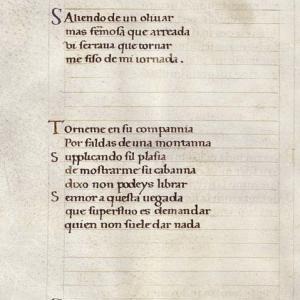
Madrid, Biblioteca Nacional de España MS, VITR/17/7, f.130v [Public domain]
Read the text (PDF)
Introduction to the Text
This poem is a serranilla, an evolution of the Provençal pastorela. Written in short verse ( arte menor), serranillas narrate a courtly poet’s encounter with a mountain woman. This is one of six compositions in the genre by fifteenth-century author Carvajal (or Carvajales). Very little is known about Carvajal’s life. His poetry is linked to the Neapolitan court of Alfonso the Magnanimous in Naples (r. 1442-1458) and to that of Alfonso’s son Ferrante (r. 1459-1494). In addition to his famous serranillas, Carvajal is also known for his literary epistles and ballads.
In this piece the poet clearly followed in the footsteps of the Marquis of Santillana, Íñigo López de Mendoza, who also composed serranillas. As the courtier tries to seduce a most beautiful mountain woman, his interest is met by her resistance and his own reawakened loyalty to his noble beloved back at court.
Introduction to the Source
The poem is copied in Madrid, Biblioteca Nacional de España, VITR/17/7, fol. 136v-137r. This manuscript is a copy of the poetry collection known as the Cancionero de Estúñiga , ca. 1465. It has been digitized: http://bdh-rd.bne.es/viewer.vm?id=0000051837. It contains a compilation of mostly Castilian poems, including ballads, as well as a few Italian compositions. Their authors accompanied the King of Aragon, Alfonso the Magnanimous, in Naples in the mid-fifteenth century.
About this Edition
The text has been punctuated. Word separation and capitalization follow modern usage. Elisions have been marked with an apostrophe.
Further Reading
Carvajal. Poesie. Edited by Emma Scoles. Edizioni dell’Ateneo, 1967.
- Critical edition of Carvajal’s poetry.
Gerli, E. Michael. “Chapter 6. The Libro in the Cancioneros.” Reading, Performing, and Imagining the ‘Libro del Arcipreste’.
University of North Carolina Press, 2016, esp. pp. 194-203.
- Reassessment of Caravajal’s serranillas in view of their intertextual relationship with the Libro de buen amor.
Marino, Nancy F. La serranilla española: notas para su historia e interpretación. Scripta Humanistica, 1987.
- Study of the serranilla genre, with attention to Carvajal’s poems in chapter 5.
Walking out of an olive grove | Saliendo de un oliuar
Saliendo de un oliuar,
mas fermosa que arreada,
vi serrana que tornar
me fiso de mi iornada.
5 Torneme en su compannia
por faldas de una montanna,
supplicando si’l plasia
de mostrarme su cabanna.
Dixo: “Non podeys librar,
10 sennor, aquesta uegada,
que superfluo es demandar
quien non suele dar nada”.
Si lealtad non me acordara
de la mas lynda figura,
15 del todo me enamorara
tanta ui su fermosura.
Dixe: “¿Que quereys mandar,
sennora, pues soys casada?
Que uos non quiero enoiar
20 nin offender mi enamorada”.
Replico: “Yd en buen hora,
non cures de amar uillana
pues seruis a tal sennora,
non troques seda por lana,
25 njn querays de mi burlar
pues sabeys que so enaienada”.
Vi serrana que tornar
me fiso de mi iornada.
Walking out of an olive grove,
Much prettier than dressed up,
I saw a mountain girl who
Made me come back from my travel.
5 I went back to her company
By the slopes of a mountain,
And I begged if it would please her
To show me her hut.
She said, “You will not succeed,
10 Sir, this time around,
For it is useless to demand
To her who never gives anything.”
Had loyalty not awoken me,
With her most beautiful face
15 I would have completely fallen in love,
Such was the beauty I saw in her.
I said, “What can I do for you,
My lady, since you are married?
I do not want to bother you
20 Nor offend my beloved.”
She replied, “May you farewell;
Do not try to love a peasant,
For you love such a lady,
You should not swap silk for wool,
25 Or try to fool me,
For you know well that I am not yours.”
I saw a mountain girl who
Made me come back from my travel.