
The Charcoal-Burner of Nevers | Il Carbonaio di Niversa
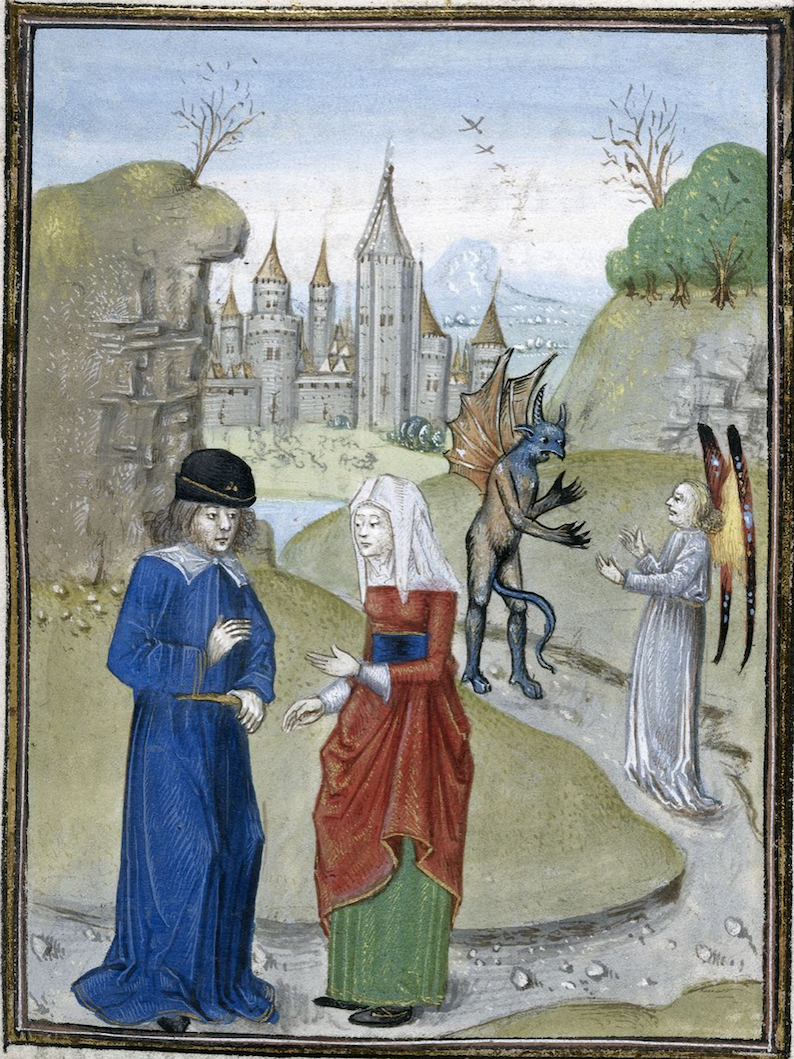
British Library MS Royal 15 E II f.38 [Public Domain]
Read the text (PDF)
Introduction to the Text
Born in Florence around the year 1300, Jacopo Passavanti entered the Dominican order at a young age. After studying theology in Paris, he taught philosophy in Pisa and theology in Siena and Rome. He was then appointed prior at the convent of Santa Maria Novella, and episcopal vicar at the diocese of Florence. He died in Florence in 1357.
In the Specchio di Vera Penitenza he collected his Lenten sermons of 1354: written in Tuscan vernacular, these sermons are divided into five distinctions and four treatises. His writing, directed towards the goals of spiritual meditation and purification, analyzes several topics embracing the religious experience of penance, and the related subjects of pride, humility, boastfulness, science, and dreams.
Passavanti uses several exempla to illustrate his treatise, drawing on a vast oral and written tradition: the episode translated here, widely known as ‘Il Carbonaio di Niversa’ (The Charcoal-Burner of Nevers), exploits the traditional medieval literary topos of the hunt, which is also present in Dante’s Divine Comedy (Inf, XIII, 109-129), and especially in the short story ‘Nastagio degli Onesti’ in Boccaccio’s Decameron (V, 8).
About this Edition
This is a new translation of an episode from Jacopo Passavanti’s 1354 collection of sermons, Lo Specchio della Vera Penitenza. The episode is located in part III, section 2 of the longer text.
Further Reading
Passavanti, Jacopo. Lo Specchio della Vera Penitenza. Ed. Ginetta Auzzas, Florence: Accademia della Crusca, 2014.
- Critical edition in Italian.
Corbari, Eliana. Vernacular Theology: Dominican Sermons and Audience in Late Medieval Italy. Berlin: De Gruyter, 2013 (especially pp. 29-36, 49-55, 107-125).
- Discussion of Passavanti’s vernacular sermons and theology.
Houston, Jason M. Building a Monument to Dante: Boccaccio as Dantista. Toronto: University of Toronto Press, 2010 (especially pp. 109-113).
Kircher, Timothy. The Poet’s Wisdom: The Humanists, the Church, and the Formation of Philosophy in the Early Renaissance. Leiden: Brill, 2006 (especially pp. 148-156, 187-204, 259).
- Both Houston and Kircher discuss Passavanti’s importance for Boccaccio and Petrarch.
Sinocropi, Giovanni. “Chastity and Love in the Decameron,” in The Olde Daunce: Love, Friendship, Sex and Marriage in the Medieval World, edited by Robert Edwards and Stephen Spector, Albany: State University of New York Press, 1991, pp. 104-120.
- Discusses the sources and themes of Boccaccio’s Nastagio degli Onesti and Passavanti’s Carbonaio di Niversa.
The Charcoal-Burner of Nevers | Il Carbonaio di Niversa
Leggesi iscritto da Elinando, che nel contado di Niversa fu uno povero uomo, il quale era buono e temente Iddio, ch’era carbonaio, e di quella arte si vivea. E avendo egli accesa la fossa de’ carboni una volta, e sendo la notte in una sua capannetta a guardia della incesa fossa, sentì in su l’ora della mezzanotte grandi strida. Usci fuori per vedere che fosse, e vide venire in verso la fossa, correndo e stridendo, una femmina iscapigliata e ignuda; e dietro le venta umo cavaliere in su uno cavallo nero correndo, con uno coltello ignudo in mano; e della bocca e degli occhi e del naso del cavaliere e del cavallo uscia fiamma di fuoco ardente. Giugnendo la femmina alla fossa, ch’ardea, non passò più oltre, e nella fossa non ardiva di gittarsi; ma correndo intorno alla fossa, fu so praggiunta dalcavaliere, che dietro le correa; la quale traendo guai, presa per li svolazzanti o capelli, crudelmente la feri per lo mezzo del petto col coltello che tenea in mano. E cadendo in terra, con molto ispargimento di sangue, si la riprese per li insanguinati capelli, e gittòlla nella fossa de’carboni ardenti; dove lasciandola stare per alcuno spazio di tempo, tutta focosa e arsa la ritolse; e ponéndolasi davanti in sul collo del cavallo, correndo se n’andò per la via dond’era venuto.
La seconda e la terza notte vide il carbonaio la simile visione. Donde, essendo egli dimestico del conte di Niversa, tra per l’arte sua de’ carboni, e per la bontà la quale il conte, ch’era uomo d’anima, gradiva, venne al conte, e dissegli la visione che tre notti avea veduta. Venne il conte col carbonaio al luogo della fossa; e vegghiando insieme nella capannetta, nell’ora usata venne la femmina stridendo, e ‘l cavaliere dietro, e feciono tutto ciò che ‘l carbonaio avea veduto. Il conte, avvegna che per lo orribile fatto ch’avea veduto, fosse molto spaventato, prese ardire. E partendosi il cavaliere ispietato colla donna arsa attraversata in su ‘l nero cavallo, gridò iscongiurandolo che dovesse ristare, e sporre la mostrata visione. Volse il cavaliere il cavallo, e fortemente piangendo, si rispose e disse: Da poi, conte, che tu vuoi sapere i mostrio martiri, i quali Iddio t’ha voluto mostrare, sappi ch’io fu’Giuffredi tuo cavaliere, e in tua corte nodrito. Questa femmina, contro a cui io sono tanto crudele e fiero, è dama Beatrice, moglie che fu del tuo caro cavaliere Berlin ghieri. Noi prendendo piacere di disonesto amore l’uno dell’altro, ci conducemmo a consentimento di peccato; il quale a tanto condusse lei, che per potere fare più liberamente il male, uccise il suo marito.
E perseverammo nel peccato in fino alla ‘nfermità della morte; ma nella infermità della morte, in prima ella e poi io tornammo a penitenzia; e confessando il nostro peccato, ricevemmo misericordia da Dio, il quale mutò la pena eterna dello ‘nferno in pena temporale di purgatoro. Onde sappi che noi non siamo dannati, ma facciamo in cotale guisa, com’hai veduto, per nostro purgatoro; e averanno fine, quando che sia, nostre gravi pene. E domandando il conte che gli desse ad intendere le loro pene più specificatamente, rispose con lagrime e sospiri: imperò che questa donna per amore di me uccise il suo marito, l’è data questa penitenzia, che ogni notte, tanto quanto ha istanziato la divina giustizia, patisce per le mie mani duolo di penosa morte di coltello.
E imperò ch’ella ebbe in vero di me ardente amore di carnale concupiscenzia, per le mie mani ogni notte è gittata ad ardere nel fuoco, come nella visione vi fu mostrato. E come già ci vedemmo con grande disio e con piacere di gran diletto, cosi ora ci veggiamo con grande odio e ci perseguitiamo con grande isdegno. E come l’uno fu cagione all’altro d’accendimento di disordinato amore, così l’uno è cagione all’altro di crudele tormento: chè ogni pena ch’io fo patire a lei, sostegno io; chè ‘l coltello di che io la ferisco, tutto è fuoco che non si spegne; e gittandola nel fuoco, e traéndonela e portandola, tutto ardo io di quello medesimo fuoco ch’arde ella. E ‘l cavallo si è uno demonio, al quale siamo dati, che ci ha a tormentare. Molte altre sono le nostre pene. Pregate Iddio per noi; e fate limosine e dire messe, acciò che si alleggierino o i nostri martiri. E, questo detto, spari, come saetta folgore. Non c’incresca adunque, dilettissimi miei, sofferire alquanto di pena qui, acciò che possiamo iscampare da quelle orribili pene e dolorosi tormenti dell’altra vita, alla quale, o vogliamo noi o no, pure ci conviene andare.
The Charcoal-Burner of Nevers
It can be read in Elinando’s writings1, that in the County of Nevers2 there was a poor man, kind and god-fearing, who was a charcoal-burner, and lived from that craft. And once, when he had lit the charcoal pit and was spending the night in a small hut guarding the burning pit, around midnight he heard some loud wailing. He went out to see what it was and he saw, coming towards the pit, running and wailing, a woman disheveled and naked; and behind her, with a naked dagger in his hand, came a knight riding a black horse; and from the mouth, eyes, and nose of the knight and the horse came a flame of blazing fire. Once the woman reached the burning pit, she couldn’t cross it, and she didn’t have the courage to throw herself into the pit; but, running around the pit, she was overtaken by the knight, who was chasing her; he grabbed her by her windswept hair, and while she was wailing, he fiercely wounded her in the center of her chest with the dagger he was holding in his hand. As she fell to the ground, splattering blood everywhere, he grabbed her again by her now bloodied hair and he threw her into the pit of burning charcoal. He left her there for a little while, taking her out once she was smoldering and burnt. Finally, he placed her in front of himself across his horse’s back and he galloped away in the direction from which he had come.
On the second and third night the charcoal-burner saw the same vision. And, since he was acquainted with the Count of Nevers, both because of his charcoal-craft and because of his kindness, which the count - a religious man - appreciated, he went to the count and told him about the vision that he had seen for three nights. The count went with the charcoal-burner to the place where the pit was. While they were keeping watch together in the hut, at the usual hour, the woman came wailing, with the knight following her, and they did everything that the charcoal-burner had seen them do. The count took courage, even though he was terrified by the horrible event that he had seen. As the merciless knight was leaving with the burnt woman lying on the black horse, the count shouted, begging him to stay and to explain the vision that had been shown. The knight turned the horse around and, crying loudly he answered, saying: “Count, since you want to know about our tortures3, which God wanted to show you, know that I was Giuffredi, your knight, raised at your court. This woman, to whom I am so cruel and ferocious, is Lady Beatrice, who was wife to your dear knight Berlinghieri. Taking pleasure in a deceitful love for each other, we drove each other4 to consent to sin. This drove her, in order to commit evil more freely, to go as far as to kill her husband.
We continued in sin until the frailty of death; but in the frailty of death, we repented, she first and then I. Since we confessed our sin, we received mercy from God, who transformed the eternal punishment5 of hell into the temporal punishment of purgatory. You should then know that we are not damned, but we act in this way, as you have seen, for our purgatory, but our severe punishments will come to an end eventuallyˮ. When the count asked him to explain their punishments with more specificity, he answered with tears and sighs: “Since this woman, out of love for me, killed her husband, the following punishment is given to her: every night, for as long as divine justice has established, she suffers by my hands the pain of a dolorous death by dagger.
Because she felt toward me a burning love of carnal concupiscence, by my hands every night she is thrown into the fire to burn, as it was shown to you in the vision. And as before we saw each other with great desire and with the pleasure of great joy, now we see each other with great hatred and we chase each other with great disdain. Just as each caused the other to burn with dishonest6 love, so does each bring the other cruel torment. For, every pain that I make her endure, I bear too; and the dagger with which I wound her is all a fire that cannot be put out; and throwing her in the fire and taking her out and carrying her away, all of it I burn with that same fire that burns her. And the horse is a demon, to whom we are given, and who is charged with tormenting us. We have many more punishments. Pray to God for us, and give alms, and have masses said, so that our tortures may be lightened.” And, having said this, he disappeared like a flash of lightning. We shouldn’t regret then, my dears, suffering a few punishments here, in order to avoid those horrible punishments and painful torments in the other life where, willing or not, we nevertheless must go.
Critical Notes
-
Hélinand of Froidmont, medieval poet and chronicler who lived between the end of the twelfth century and the beginning of the thirteenth. Passavanti refers to a story narrated in Helinand’s moral treatise in Latin De Cognitione Sui (XIII). Hélinand’s story was well known: it was retold, among others, by Vincent of Beauvais ( Speculum Historiale, XXX, 120), John Bromyard (Summa Predicantium, A, XVII, 12), and in the Alphabetum Narrationum (DCXIII).
-
Historic county of Burgundy, in central France, dating from the begininning of the 10th century.
-
“Martirii” in the Italian: it has both the meaning of “tortures” and “martyrdoms”.
-
“Ci conducemmo” in the Italian: this could be interpreted as a reflexive form (“each one of us drove him/herself”) or as a reciprocal reflexive (“we drove each other”).
-
“Pena” in the Italian: it also translates to “pain”.
-
“Disordinato” in the Italian: it literally means “lacking order,” but by extension it came to mean “against the moral order.”