
The Spring – The Hecatomb for Diane, VII | Le Printemps – L’hécatombe à Diane, VII
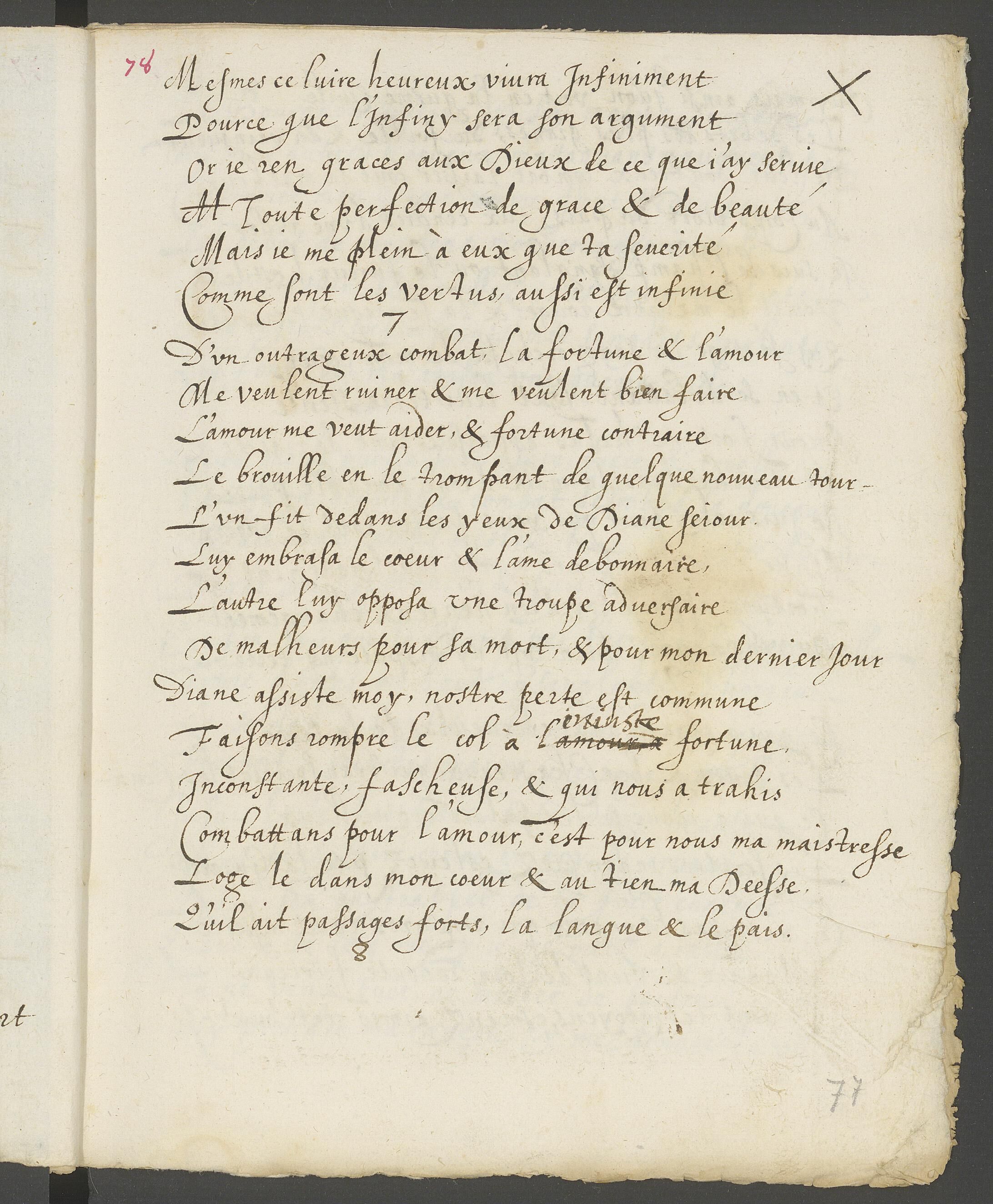
Bibliothèque de Genève, Detail from Le Printemps et divers textes, Bibliothèque de Genève, Archives Tronchin 157
Read the text (PDF)
Introduction to the Text
Best known for his civil war epic Les Tragiques, Théodore Agrippa d’Aubigné (1552–1630) spent his early years in the thrall of Diane Salviati. Salviati was the niece of Cassandra, the muse of the famous French poet Ronsard. D’Aubigné’s work Le Printemps – ‘Spring’ – is composed of two parts. The first is a compilation of one hundred sonnets dedicated to his beloved, entitled L’hécatombe à Diane. The word ‘hecatomb’ evokes a sacrificial practice in Ancient Greece, where one hundred cattle or other livestock would be slaughtered in honour of the gods. Though the goal of d’Aubigné’s sonnets is ostensibly to praise Diane, his imagery is characteristically visceral, flavoured by his experience of the violence of France’s Wars of Religion (1562–1598). Diane’s family sheltered d’Aubigné following the St. Bartholomew’s Day Massacre in 1572, but, as she was Catholic and d’Aubigné Protestant, their love was not to be. The author’s later works express some wistful reflections on the youthful exuberance that led him to idolize this unattainable woman. It is thought that L’hécatombe à Diane and the latter section of Le Printemps, the Stances et Odes, were composed in the early 1570s.
Introduction to the Source
This poem is a unicum copied in Zaragoza, Biblioteca de la Universidad de Zaragoza, MS 210, fol. 98v-99r (the Cançoner de Saragossa). The manuscript has been digitized here. It contains a compilation of Catalan verse dating to 1461–1462. It is the oldest know manuscript to transmit Ausiàs March’s poetry, and an important witness to the transmission of the poetry of several other authors, including Pere Torroella and Lleonard de Sors.
About this Edition
I have reproduced and rendered in English two sonnets from the Hécatombe for which no other translation appears to be available, with notes indicating places in the text where the author has crossed out initial words and added new ones (I follow Henri Weber’s 1960 critical edition of the Printemps in this regard). The present transcription is based on the manuscript holding entitled ‘Théodore Agrippa d’Aubigné. Le Printemps et divers textes’ in the Archives Tronchin 157 at the Geneva Public Library (Bibliothèque de Genève). This manuscript can be consulted here. The folio numbers for the translated sonnets are f.77v-78. Other manuscript exemplars of this work can be found in the Bibliothèque de la Société de l’Histoire du Protestantisme Français (ms.816/12), and in the aforementioned Archives Tronchin 159.
Further Reading
Kuperty-Tsur, Nadine. “The Saint Bartholomew’s Day Massacre and Baroque Tendencies in France: The Impact of Religious Turmoils on the Aesthetics of the French Renaissance.” Poetics Today, translated by Sam W. Bloom, vol. 28, no. 1, (2007): 117–142., doi:10.1215/03335372-2006-017.
- A look at the influence of the Wars of Religion on Early Modern French poetry in general, and on a poem from Le Printemps in particular.
Nazarian, Cynthia Nyree. “Martyrdom, Anatomy, and the Ethics of Metaphor in d’Aubigné’s L’Hécatombe à Diane and Les Tragiques.” Love’s Wounds: Violence and the Politics of Poetry in Early Modern Europe, Cornell University Press, 2016, pp. 117–179.
- An examination of civil war violence reflected in love poetry.
Perry, Kathleen A. “A Re-Evaluation of Agrippa d’Aubigné’s « Printemps »: Youthful Love or Mature Theology?” Bibliothèque d’Humanisme et Renaissance, vol. 51, no. 1 (1989): 107–122.
- Argues for the consideration of the poems of the Printemps as condemnations of the Catholic Church.
Perry, Kathleen A. “Motherhood and Martyrdom in the Poetry of Théodore Agrippa d’Aubigné.” Neophilologus, vol. 76, no. 2 (1992): 198–211, doi:10.1007/bf00210169.
- An analysis of the effects of d’Aubigné’s turbulent childhood on the representation of women in his poetry, with particular reference to the parallels drawn between Diane Salviati and the hunter goddess Diana/Artemis of classical lore.
Perry Long, Kathleen A. “Victim of Love: The Poetics and Politics of Violence in ‘Le Printemps’ of Théodore Agrippa d’Aubigné.” Translating Desire in Medieval and Early Modern Culture, edited by Craig A. Berry and Heather Richardson Hayton, Arizona Center for Medieval and Renaissance Studies Press, 2005, pp. 31–47. Medieval and Renaissance Texts and Studies.
- An exploration of Petrarchan and Catullan aspects of d’Aubigné’s early poetry.
The Spring – The Hecatomb for Diane, VII | Le Printemps – L’hécatombe à Diane, VII
D’un outrageux combat, la fortune & l’amour
Me veulent ruiner & me veulent bien faire
L’amour me veut aider, & fortune contraire
Le brouille ne le trompant de quelque nouveau tour
5 L’un fit dedans les yeux de Diane seiour.
Luy embrasa le cœur & l’ame debonnaire,
L’autre luy opposa une troupe adversaire
De malheurs pour sa mort, & pour mon dernier jour
Diane assiste moy, nostre perte est comune
10 Faisons rompre le col à l’amour, à injuste fortune
Inconstante, fascheuse, & qui nous a trahis
Combattans pour l’amour, c’est pour nous ma maistresse
Loge le dans mon cœur & au tien ma Deesse
Qu’il ait passages forts, la langue & le pais.
The Spring – The Hecatomb for Diane, VII
With* an outrageous combat, fortune and love
Wish to ruin me and wish to do me good.
Love wants to help me, fortune on the contrary
Upturns it with some new trick*.
5 One stays a while in Diane’s eyes,
Sets alight her heart and good-natured soul;
The other opposes him with an enemy troop*
Of misfortunes for his death, and for my last day.
Diane attends me, our loss is mutual;
10 Let us break the neck of unjust fortune—
Inconsistent, adverse, and who has betrayed us.
Fighting* for love, it [love] is for us, my mistress,
Lodge it in my heart, and in yours, my goddess,
So that it may have safe passage, both the language* and the land.
Critical Notes
Line 1: I’ve opted for “with” rather than a more literal “from” or “of” because it sounded more natural to me in English.
Line 4: I’ve chosen to just write “trick” once here, for the sake of the flow of the text, even though “trompant” and “tour” could both be rendered in English as versions of “trick”.
Line 7: The “him” being opposed in this line (and the “his” referred to in the subsequent line) refer to Love; Fortune is bringing an enemy troop against Love.
Line 12: Véronique Ferrer’s 2019 critical edition adds a note to clarify the intention of the word “combattant”, or “fighting”, in this instance: “To be understood in the sense of ‘by fighting for love, we fight for ourselves.’ The poet here subverts the traditional motif of the combat between love and fortune, a common cause for lovers’ separation, by envisaging their loving union as a defensive weapon.” Véronique Ferrer, ed., “Hécatombe à Diane,” Le Printemps, Librairie Droz, 2019, p. 56 (in French).
Line 14: Henri Weber’s 1960 critical edition of the Printemps explains that references to “having the language” were common wartime allusions: “The general sense of the verse is thus: that love may keep the country by possessing its main access points and the complicity of inhabitants who give him all necessary information.” Henri Weber, ed., “L’hécatombe à Diane,” Le Printemps: L’hécatombe à Diane et Les Stances, Presses Universitaires de France, 1960, p. 64, n. 5 (in French).