
The Gosling | Daz Genselin
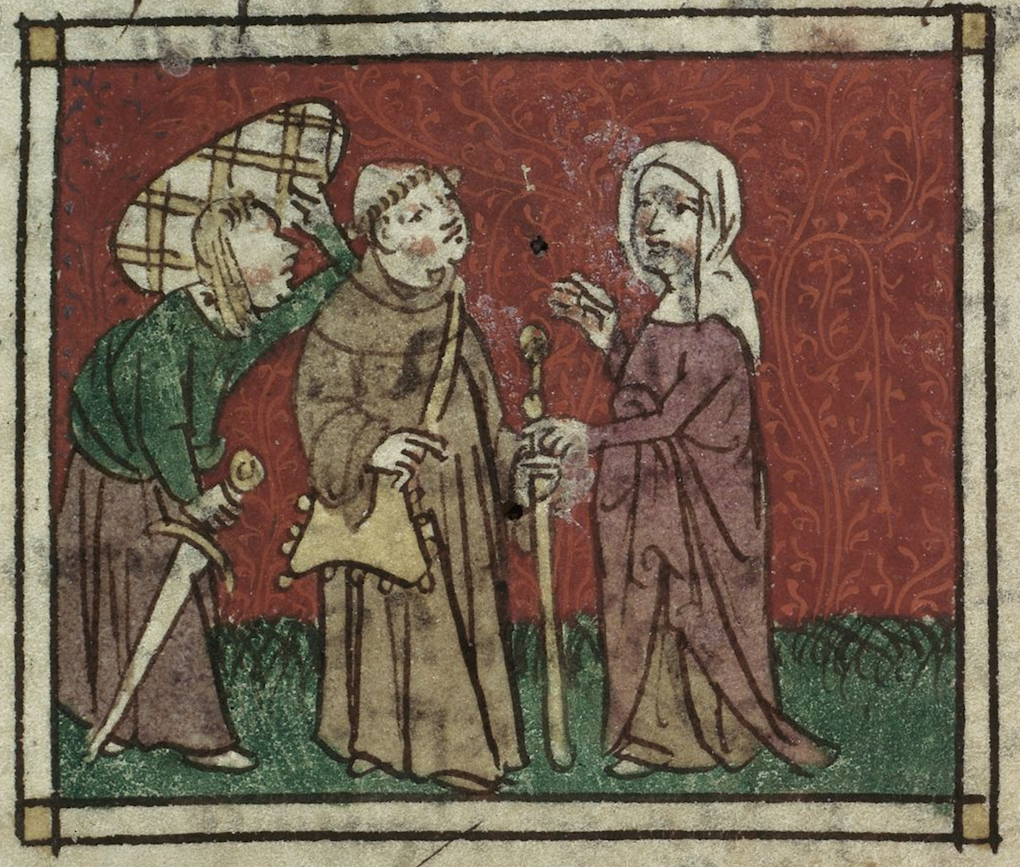
British Library MS Harley 4399 f.37 [Public Domain]
Read the text (PDF)
Introduction to the Text
The Gosling is a typical example of the Middle High German tradition of mären: short narrative texts written in rhyming couplets, often telling humorous stories spiked with sexual jokes and sideswipes against specific social groups, most frequently clerics. In this way, mären are similar to the French fabliaux and the Italian prose novelle.
The Gosling was probably composed in the second half of the thirteenth century CE, and its author is unknown. The text tells the story of a young monk who leaves his monastery for the first time, encountering an outside world about which he is entirely ignorant. Never having seen a woman before, he innocently asks his abbot about those that they meet, and the abbot, trying to suppress the monk’s instant fascination, tells him that these creatures are called “geese”. The abbot’s plan fails as the naive monk is soon seduced by a village girl. Unaware of his wrongdoing, he reveals his sexual encounter to the abbot, who recognizes the calamity caused by his white lie.
The motif of the young man inexperienced in the ways of the world is widespread in European medieval literature. It is central to the various medieval versions of the legend of Barlaam and Josaphat (for example, Rudolf von Ems’s Barlaam und Josaphat, also in Middle High German, composed c.1220/30) and is frequently used as a moral anecdote in sermons and exemplary literature (for example, Jacques de Vitry’s Exempla, no. 82). Although commonly found in texts intended to educate their listener, the motif’s humorous potential did not escape medieval authors and audiences, and there are a large number of burlesque medieval stories about young men who have never seen women before and yet are instantly attracted to them. For example, both the early fourteenth-century Italian text Novellino (specifically story no. 14) and Giovanni Boccaccio’s Decameron (composed in 1358; see specifically the introduction to the fourth day) tell variants of this story.
The Gosling is a relatively early example of this narrative tradition. With regard to its verse form, sexual humor and undertones of anticlericalism, it represents central characteristics of the mären tradition and provides an introduction this literary genre.
Introduction to the Source
Multiple variants of this text are transmitted in six manuscripts that were written between the early fourteenth and mid-fifteenth centuries CE. The manuscript that our translation is based on was composed in Würzberg (in what is now southern Germany) around the year 1350 CE. In the scholarship, it is known as manuscript E.
About this Edition
We have translated The Gosling according to Klaus Grubmüller’s edition of manuscript E (Munich, University Library, 2° Cod. ms. 731, fol. 91v–93v). His edition is published in: Novellistik des Mittelalters. Texte und Kommentare. Deutscher Klassiker-Verlag im Taschenbuch, 2014.
Further Reading
Boccaccio, Giovanni. The Decameron. Translated by Wayne A. Rebhorn. Norton, 2013.
- See the introduction of the fourth day of stories for a variant of The Gosling.
Chinca, Mark. “The Body in some Middle High German Mären: Taming and Maiming.” Framing Medieval Bodies, edited by Sarah Kay and Miri Rubin, Manchester University Press, 1994, pp. 187–210.
The Exempla, or Illustrative Stories from the Sermones Vulgares of Jacques de Vitry, edited by Thomas Frederick Crane. Folk-Lore Society, 1890.
Il Novellino, The Hundred Old Tales. Translated by Edward Storer. George Routledge & Sons, 1925.
- The fourteenth tale is a variant of The Gosling.
- Exemplum no. 84 uses the trope of the inexperienced young man for moral instruction.
- Short lexicon article on the literary genre.
Wailes, Stephen L. “Social Humor in Middle High German Mären.” Amsterdamer Beiträge zur älteren Germanistik, vol. 10, 1976, pp. 119–148.
Wailes, Stephen L. “Mären.” Dictionary of the Middle Ages, edited by Joseph Reese Strayer, vol 8, Charles Scribner’s Sons, 1987, col. 126–133.
Young, Christopher J. “At the End of the Tale. Didacticism, Ideology and the Medieval German Märe.” Mittelalterliche Novellistik im europäischen Kontext: Kulturwissenschaftliche Perspektiven, edited by Mark Chinca, Timo Reuvekamp-Felber, and Christopher J. Young, Erich Schmidt Verlag, 2006, pp. 24–47.
The Gosling | Daz Genselin
Ich hort sagen ein mer
wie ein kloster wer
rich unde erbuwen wol
als von reht ein kloster sol
5 ir gasthus und ir spital
heten niht gesatziu mal
wan zuo welhen ziten der man
geriten oder gende kan
der vant daz ezzen ie bereit
10 minneclich und unverseit
gap man swaz si mohten han.
also solten noch diu klôster stan.
ouch hort ich mer von in sagen
ir kloster daz wer underslagen
15 daz die munich und ir gemach
selten ieman fremder sach
und seit daz selbe mer
das manic munich da wer
der selten fur daz kloster kan
20 Nu was dar inne ein junc man
der het siniu jar vertriben
daz er dar inne was beliben
sit daz er was ein kindelin
des muost im unbekant sin
25 swaz lebt in dem lande
wen daz er ors nach sage erkande
daz man die solde riten
Do kam ez zuo einen ziten
daz der apt solt riten
30 des wolt er nicht biten
und wolt schaffen des klosters dinc
in bat der selbe jüngelinc
daz er in fuort durch daz lant,
daz im würde erkant
35 der site von dem lande
des er vil klein erkande.
der abt der gewert
den münich des er begert,
wan er in einveltigen sach.
40 in disem sinne das geschach:
er gedâht, wirt im erkant
beide liut unde lant,
sô mac man im enpfelhen wol
swes ein man pflegen sol.
45 er wirt uns ein vil nützer man.
alsus fuort er in von dan.
sîn knehte niht vermiten,
mit ir herren sie do riten.
ir pfert giengen schon enzelt.
50 do si komen an daz velt
swaz in vihes wider gie
der münich nimmer verlie
er sprach ie wie ist daz genant
der abbet der seit imz zehant
55 swie sin name sölt sin
ez wer rint schaf oder swin
daz tet er im zuo rehte kunt
Do komen sie in kurzer stunt
zuo einem hove do sie hin wolten
60 und ouch da beliben solten
do sie der meier gesach
er lief gein in unde sprach
got wilkommen lieber herre min
und alle die mit iu hie sin
65 als man in die ors empfie
der abte unt der münich gie
zuo einem fiur an ir gemach
alsô schier daz geschach,
man zôch in abe sa zehant
70 ir schuohe unde ir obergewant.
Nu het der wirt ein schoenez wip
und ein tochter, der lip
was ze wunsche wol gestalt,
sie was wol zweinzic jar alt,
75 die ouch dort her giengen,
der abbet hiez sie sitzen nider.
da warn si niht wider.
sie sazen nider an die stat.
der münich den abbet aber bat
80 daz er in wizzen lieze
wie diu creature hieze
do sprach der abbet zuohant:
“diz sint gense genant.”
dô sprach der münich: “crêde mich,
85 sô sint die gense siuberlich.
wie kumt daz wir niht gense hân?
die möhten sich vil wol begân
an unser klôsterweide.”
des lachten si dô beide
90 des wirtes tohter und sîn wîp.
si wundert sêre daz sîn lîp
was sô rehte minneclich
unt daz er niht verstüende sich
wie ein wîp er genant.
95 den apte vrâgten si zehant
ob der herre sinnic wer.
dô seit er in diu mer,
als ir ê hant vernumen,
wie der münich dar was kumen c
100 und wie er erwahsen wer.
als dô daz selbe mer
des wirtes tohter bevant,
dô gedâhte si zuohant:
”er ist ein sô hêrlich man,
105 dêst wâr, ob ichz gefüegen kan,
ich versuoch ob er diu wîp
erkenne ir namen under ir lîp.”
der rede si gedagt,
ir gedanc si niemen sagt
110 des si gedâht hete.
Nû wart ez alsô spete
daz die herren slâfen solten gân:
nû wolt der meier des niht lân
er hiez in betten nâch irm sît:
115 dô was ouch sîn tohter mit;
si schuof daz disem jungen man
wart gebettet wol hin dan
von den andern verre,
dar umbe daz der herre
120 möht haben sîn gemach.
nâch sînem willen daz geschach.
Dô man die herren geleit,
der wirt hiez gereit
allez daz gesinde slâfen gân,
125 den herren ir gemach lân.
der münich niht slâfen mahte;
er het manige ahte,
wie ieglich dinc wer genant
daz im des tages wart erkant.
130 diu juncfrowe ouch ungeslafen lac
mit gedanken der si pflac
wie daz würde vollebrâht
daz si dâ vor hete gedâht.
dô die liute entsliefen über al,
135 dô stuont si ûf ân allen schal
und sleich zuo sînem bette dar.
als ir der münich wart gewar.
er sprach zuohant: “waz mac daz sîn?”
Si sprach: “Ich binz, daz junge genselîn,
140 und hân vrostes vil erliten:
herre, ich wolt iuch gerne biten
daz ir hin under liezet mich,
in der minne, daz ich
iht ervrüer, wan hie ist ez kalt.”
145 dô waz der münich einvalt
daz er si zuo im hin under lie.
in der minne daz ergie
dô si dar under zuo im kam,
dô konde dirre junge manx
150 mit ir lützel noch vil
daz man do heizzet bettespil.
dô konde siz ein wênic baz.
mit guoter fuoge schuof si daz
daz er in kurzer stunde
155 des selben spiln begunde.
der münech die gans brûht
mit flîze, wan in dûht
im were wol und dennoch baz.
alsô lange treip er daz
160 unz si des tages sich versach.
dô stuont si ûf unde sprach:
“nu sült ir nimmer verjehen
des von uns zweien ist beschehen.
würde ez dem abte kunt,
165 man tet uns beide sâ zestunt
den vil grimmeclîchen tôt.”
vil tiure si im daz gebôt
daz erz geseite nimmer man.
daz lobt er und gie si von dan
170 an ir heimlîch.
ir muot was fröudenrîch
daz si was dannân kumen unt dar
daz ir dâ nieman wart gewar.
Dô si kam an ir gemach,
175 dar nâch vil schier daz geschach
daz ûf begonde gân der tac.
das nâch ouch vil unlange lac
der abte und der münich dâ.
si schuofen ir dinc iesâ
180 durch daz si wârn kumen dar.
dô si daz geschuofen gar,
zuohant si wider heim riten.
die klôsterliute niht vermiten,
dô si heim wârn kumen,
185 der münech wart her genumen
und frâgten in zehant
wie im geviel daz lant.
dô begunde er in verjehen
daz er wol hete gesehen
190 vil dinge in dem lande
des er ê niht erkande.
des gelachten si vil,
sîn rede was ir aller spil.
doch pflac er der kündekeit
195 daz ir keinem wart geseit
wie im des nahtes ûf der vart
diu junge gans ze teil wart.
daz hal er sêre, als si in hiez;
nieman er daz wizzen liez.
200 Nû was ez vor der hôchzît
die in dem winter gelît,
diu wîhennaht ist genant.
der abte besant zuohant
kelner unde koche.
205 er sprach: “uns nâhet ein woche
daz wir singen müezen und lesen.
nû sült ir der herren flîzic wesen
daz ir uns ein wirtschaft gebent.
sô die liute mit arbeit lebent,
210 so sol man ir pflegen dester baz.”
die herren lobten alle daz.
Der junge münich stuont dâ bî.
Er sprach: “sît daz iuwer wille sî,
daz wir vollez ampt süllen hân,
215 sô sült ir nimmer verlân,
müge ez an iuwern staten sîn,
so schaffet, lieber herre mîn,
daz iedem man ein gans werde:
sô wart ûf der erde
220 nie keinen liuten baz.”
der abbet vienc der rede haz:
er hiez in swîgen. daz geschach.
dar nâch er aber schier sprach:
”gense daz ist ein wirtschaft,
225 ob aller wirtschaft ein überkraft
die in der werlt ieman gewan.”
der abt sprach zuo dem jungen man:
“bruoder, tuot die rede hin.
wâ hin haben ir iuwern sin
230 und iuwer witze getân?
nû mügt ir iuch doch wol verstân
daz wir niht fleisches ezzen.
ich will mich des vermezzen
ir müezt der rede buoz enpfân.”
235 er hiez in balde dannan gân.
des getorst der münich lâzen niht.
er sprach iedoch: “waz mir geschiht,
guot weren gense, der sie mac han,
guot unde wolgetan.”
240 hie mit wart er hin vertriben.
die andern alle dâ beliben
und schuofen um ir lîpnar.
dar nâch satzten si gar
beide ir singen unde ir lesen,
245 wer des meister sölt wesen.
dî daz allez wart gesat,
der abt im gewinnen bat
aber disen jungen man.
er fuort in von den liuten dan
250 an sîn heimlîch.
er bat in flîziclîch
daz er im verjehe
dâ von diu rede geschehe
daz er der gense begert.
255 der münich in des gewert.
dô er sô tiur wart gemant,
dô verjach er im zehant
reht der gense wârheit,
als ich iu ê hân geseit,
260 wie er die gans hin under lie
und sich die naht mit ir begie.
dô daz der abbet bevant,
trûreclichen er sprach zehant:
”leider mir, ir sît betrogen:
265 ich hân iu selbe verlogen.
crêde mich ez was ein wîp.
iuwer sinnelôser lîp
hât bî wîben gelegen.
ich solt iuwer baz hân gepflegen,
270 sô het ich reht getân.”
buoze hier er in empfân.
daz geschach nâch siner bet.
doch wen ich er im unreht tet:
wan swaz er sünden dâ gewan,
275 dâ was der apt schuldic an.
het er im die wârheit
ungelogen und âne spot geseit,
er het sich lîhte baz behuot.
spot und lüge ist selten guot:
280 si sint sünde und ouch ân êre.
waz sol ich dâ von sagen mêre
denne ich hân alhie getân?
ez ist mîn geloube und hân den wân
daz ze Swâben noch der münich sî
285 vil lîht zwên oder drî
die diu wîp erkennent baz.
gedienten die ir meister haz,
die büezen ouch, daz ist mîn rât.
hie mit die rede ein ende hât.
I heard a story told
of a splendid
and well-built monastery,
as a monastery should be.
5 Their lodgings and their infirmary
did not have limited meal times
for whenever someone arrived
on horseback or on foot
he always found a meal prepared.
10 Charitably and willingly
they gave whatever they had.1
Would that monasteries were still this way!
I also heard something more about them:
that their monastery was isolated
15 so that strangers seldom saw
the monks and their quarters.
The same story also tells that
there were many monks
that seldom left the monastery.
20 As it happened, a young man lived there.
He had spent all his years there.
since he was a child,
staying inside the monastery.
He couldn’t have known
25 what dwelled in the land.
He had only heard tell of horses:
that one could ride them.
There came a time
when the abbot needed to ride out.
30 Without delay,
he wanted to attend to the monastery’s affairs.
The same lad asked him
to take him along through the countryside
so that he would learn about
35 the land’s customs
of which he knew very little.T
he abbot granted
the monk what he desired
as he saw that he was ignorant.
40 That transpired for this reason:
he thought: “Should the lad learn
about both land and people,
one could trust him with
the duties that need to be fulfilled.
45 Then he will become a very useful man for us.”
With that he led him from there.
His pages didn’t hesitate
to ride with their master.
Their horses cantered nicely along.
50 Once they reached the countryside,
the monk never neglected to ask about
whatever animal crossed his path.
“What’s that called?” he would ask.
The abbot readily told him
55 what its name was.
Whether cattle or sheep or swine,
he informed him correctly.
After a short while they came
to a farmstead to which they were headed
60 and intended to stay.
When the reeve saw them,
he approached them and said:
“God bid you welcome, my dear Sir,
and all those here with you.”
65 After the horses had been taken care of,
the abbot and the monks went
to rest by the fire.
Right away,
someone promptly took
70 their shoes and coats.
Now, the host had a beautiful wife
and a daughter whose body
was everything one could wish for.
She was about twenty years old.
75 The two women also came there and welcomed the gentlemen.
The abbot asked them to be seated.
They were not averse to this.
They sat down on the spot.
But the monk asked the abbot
80 to tell him
what these creatures were called.
The abbot replied readily:
“These are called geese.”
The monk said: “My goodness!
85 Geese are lovely.
Why don’t we have geese?
They would fit in nicely
on the pasture at the monastery.”
Both the host’s wife and daughter
90 laughed at that.
They were very surprised that he
was so handsome,
yet didn’t know
what a woman was called.
95 Straight away, they asked the abbot
whether the gentleman was right in the head.
Then he told them the story
that you have just heard
about how the monk had come to the monastery2
100 and grown up there.
When the host’s daughter had listened
to this story,
she immediately thought:
”He’s such a gorgeous man.
105 Truly, if I can make it happen
I will test whether he knows women
in name and in the flesh.”
She kept her musing to herself;
she told no one of the thoughts
110 that she had formed.
It was now so late
that it was time for the gentlemen to go to bed.
The reeve now insisted
that beds be prepared for them as was befitting.
115 His daughter was also present.
She arranged it so that the young man
had his bed
far from the others
so that his master
120 could be comfortable.
It was done according to his wishes.
Right after the gentlemen had been shown to their beds
the host commanded
that all of his household should go to sleep
125 so that the gentlemen would be left in piece and quiet.
The monk was not able to sleep.
He had many thoughts
about what each thing was called
that he had encountered that day.
130 She also lay awake
turning over in her mind
how to accomplish
what she had thought of earlier.
After all the people around them had fallen asleep,
135 she got up without a sound
and snuck over to his bed.
When the monk noticed her,
he said straight away, “What might that be?”
She said: “It’s me, the little gosling.
140 I’ve been suffering dreadfully from the cold.
Sir, I would really like to ask you,
to permit me to slip under the covers
out of the kindness of your heart,
so that I don’t freeze to death.”
145 The monk was so naive
that he let her slip under the covers.
That was done out of kindness.
When she joined him under the blanket,
this young man knew
150 next to nothing
about how to play so-called bed games with her.
She knew a little bit more.
With great skill she
quickly got him
155 playing the same game.
The monk dealt with the goose
eagerly, because it seemed to him
that he was feeling good and would soon feel even better.
He carried on with it
160 until she noticed the break of day.
Then she got up and said:
“You must never tell anyone
what has happened between the two of us.
If the abbot ever found out,
165 we would both immediately suffer
a gruesome death.”
With great urgency she commanded
that he never tell anyone about it.
He swore to that and she then retired
170 to her chamber.
She was full of joy
that she had gone there and back
without anyone noticing.
Soon after
175 she came to her chamber,
the day began to dawn.
The abbot and the monk
did not stay in bed much longer.
They dealt with the affairs
180 for which they had come there.
As soon as they had done this
they rode home again.
Once they had arrived home,
the brothers could not resist
185 taking the monk aside
and eagerly asking him
how he had liked the country.
He began to tell them
that he had actually seen
190 many things in the country
that he hadn’t known before.
They laughed a lot at that.
His tale entertained them greatly.
He was clever enough
195 that he didn’t tell any one of them
during the night while on the trip.
how he had partaken of the goose.
He didn’t say a word, as she had told him.
He let no one know about that.
200 Now at that time, it was before the feast day
which takes place in winter
and which is called Christmas.
The abbot immediately summoned
cooks and cellarers.
205 He said: “There is a week approaching
when we must sing and read.
Now, you should be attentive to the gentlemen
by preparing a banquet for us.
The more tedium in people’s lives,
210 the better they should be taken care of.”
The gentlemen all praised that.
The young monk stood there with them
and said: “Since you wish us
to hold full high mass, my dear master
215 you should not fail
if it is in your power
to provide
every man with a goose.
Then no one on earth
220 will ever have had it better.”
The abbot became angry at these words.
He bade him to be silent, and the monk was silent.
But a second later he said:
”Geese! That’s a feast!
225 The most almighty of feasts
that anyone in the world has ever enjoyed.”
The abbot said to the young man:
“Brother, be silent!
Where have you left your sense
230 and your reason?
Now, you should know
that we don’t eat meat.
I will demand
that you do penance for your words.”
235 Immediately after that, he ordered him to leave.
The monk didn’t dare to object,
but he spoke: “No matter what happens to me,
geese would be good. For him who is able to have them,
they are good and fine.”
240 At these words, he was thrown out.
The others all stayed there
and busied themselves with their nourishment.
Afterwards they agreed on
their chanting and readings
245 and who should be responsible for them.
When this was all agreed upon,
the abbot asked for
the young man to be brought to him.
He took him away from the others
250 to his room.
He asked him fervently
to tell him
the reason why he said
that he desired geese.
255 The monk granted him that.
When he was so strongly urged,
he told him without hesitation
the whole truth about geese
as I have told you before:
260 how he lay with the goose
and spent the night with her.
When the abbot discovered this
he replied right away with sadness:
”Alas, you have been betrayed.
265 I myself have deceived you.
Believe me, that was a woman.
Your ignorant body
has lain with a woman.
I should have taken better care of you,
270 then I would have behaved dutifully.”
He commanded him to do a penance.
The monk did as he was ordered,
but I think he was treated unfairly.
For, whatever sins he committed there,
275 the abbot was to blame for them.
If he had told him the truth
honestly and without lies,
the monk would have guarded himself better.
Mockery and lying are seldom good;
280 they are sins and they are also without honour.
What more shall I say about this
than what I have already said?
It is my belief and my assumption
that in Swabia there might still
285 easily be two or three monks
who have a better understanding of women.
If they annoy their superiors,
they should also do penance. This is my advice.
Here the story ends.
Critical Notes
Line 11: ”Milte” (roughly: “generosity”) is regularly portrayed as a key virtue in medieval German courtly literature. Here it is related to the Christian ideal of caritas (“charity”).
Line 100: The literal translation of the Middle High German would be: “how the monk had come there.” This refers to his youth at the monastery. To clarify the reference, we specified the “there” in our translation.