The Chastity of Mr. Wu’s Wife | 譚氏節操
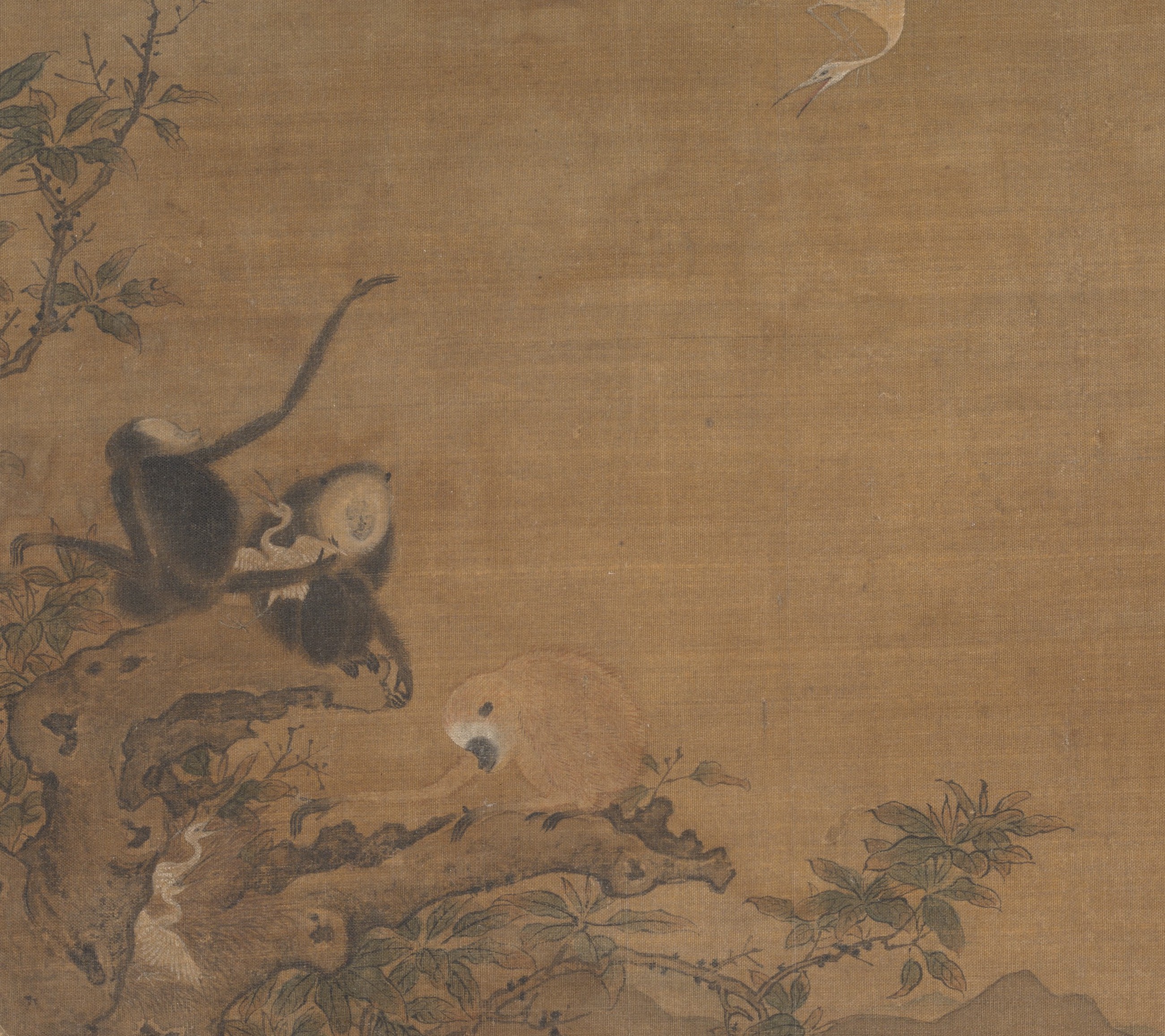
Detail from 南宋 佚名 “三元得祿”圖扇頁 (Gibbons Raiding an Egret’s Nest), Artist Unknown, late 12th century, Metropolitan Museum of Art, Accession Number: 13.100.104 [Public Domain]
Read the text (PDF)
Introduction to the Text
This story is one of five in the Global Medieval Sourcebook to have been selected from the Yijian Zhi (or, Record of the Listener, hereafter the Record) by Hong Mai (1123-1202). Like many well-educated men in the Southern Song Dynasty (1127-1279), Hong Mai grew up in a prominent family, passed the civil service examination, and obtained a post in the imperial government. However, due to misconduct during a diplomatic mission, his career came to an abrupt end. From then on, he retreated to his study and devoted himself to writing the Record.
The corpus of the Record originally consisted of 420 chapters. What we have today, however, is but a small fraction of the original text. The Record shows a remarkable degree of accuracy when we compare it with the official documents and other texts of the same period. Nevertheless, many stories in the Record are outright fictitious or based on highly unreliable sources. The Record preserved much information about the society, culture, and religion of the Southern Song Dynasty and was a source of inspiration for generations of writers after Hong Mai. Writers in late imperial China, for instance, took up many stories in the Record and refashioned them into stories that met the demands and expectations of their own times.
Further Reading
Allen, Sarah M. Shifting Stories : History, Gossip, and Lore in Narratives from Tang Dynasty China. Harvard-Yenching Institute Monograph Series. Cambridge, Massachusetts: Harvard University Asia Center, 2014.
- Explores the tale literature of eighth- and ninth-century China to show how the written tales we have today grew out of a fluid culture of hearsay that circulated within elite society. Contains a chapter that explains the modern (mis)understanding of the tale as a genre.
Hansen, Valerie. Changing Gods in Medieval China, 1127-1276. Princeton, N.J.: Princeton University Press, 1990.
- Uses the Yi Jian Zhi tales as historical documents and shows that social and economic developments underlay religious changes in the Southern Song (1127 - 1276).
Inglis, Alister David. Hong Mai’s Record of the Listener and Its Song Dynasty Context. SUNY Series in Chinese Philosophy and Culture. Albany: State University of New York Press, 2006.
- A comprehensive survey of the scholarship on Yi Jian Zhi.
Luo, Manling. Literati Storytelling in Late Medieval China. The Modern Language Initiative. Seattle: University of Washington Press, 2015.
- Shows how the tales offer crucial insights into the reconfiguration of the Chinese elite, which monopoligzed literacy, social prestige, and political participation in tenth-century China.
The Chastity of Mr. Wu’s Wife | 譚氏節操
英州真陽縣曲江村人吳琦, 略知書。其妻譚氏。 紹興五年閏二月, 本邑觀音山盜起, 攻剽鄉 落。琪竄去。譚氏與其女被執,並鄰社村婦數人偕行。 譚在眾中頗潔白,盜欲妻之。詬曰: “爾輩賊也。官軍旦夕且至。將為齏粉。我良家女。何肯為汝婦。”強之不已, 至於捶擊。愈極口肆罵, 竟斃於毒手。後盜平, 鄰婦同執者皆還, 曰: “使吳秀才妻不罵賊。今日亦歸矣。” 因備言其死狀, 吳生始知之。聞者高其節, 予嘗為之傳云。
The Chastity of Mr. Wu’s Wife
In the Qujiang Village of the Zhenyang County under the Yingzhou Prefecture, there was a man named Wu Qi who had received some education and had a wife from the Tan family. In the second month of the fifth year of the Shaoxing era, some bandits emerged from the Guanying Mountain in the area and plundered many villages and counties. Wu Qi ran away. His wife and their daughter were captured and joined other women captured from the same village. Among this group of women, Wu’s wife was one of the more attractive, so one of the bandits wanted to have sex with her. Wu’s wife scolded him, saying: “People like you are nothing but bandits. The military will arrive in no time and you all will be crushed. I am from a reputable family. How can I become your woman?” The bandit tried to force her into it but failed, and then he hit her. Wu’s wife started shouting and ranting but in the end was killed by the bandit. After the bandits were suppressed, the other captured women all returned home. They said: “If Mr. Wu’s wife had not scolded the bandit, she could have returned home too.” When they described her death in great detail, Mr. Wu understood what happened. All those who heard this story praised her chastity, and I therefore write this piece to spread her fame.