
Chen Wangyou’s Daughter-in-Law | 陳王猷子妇
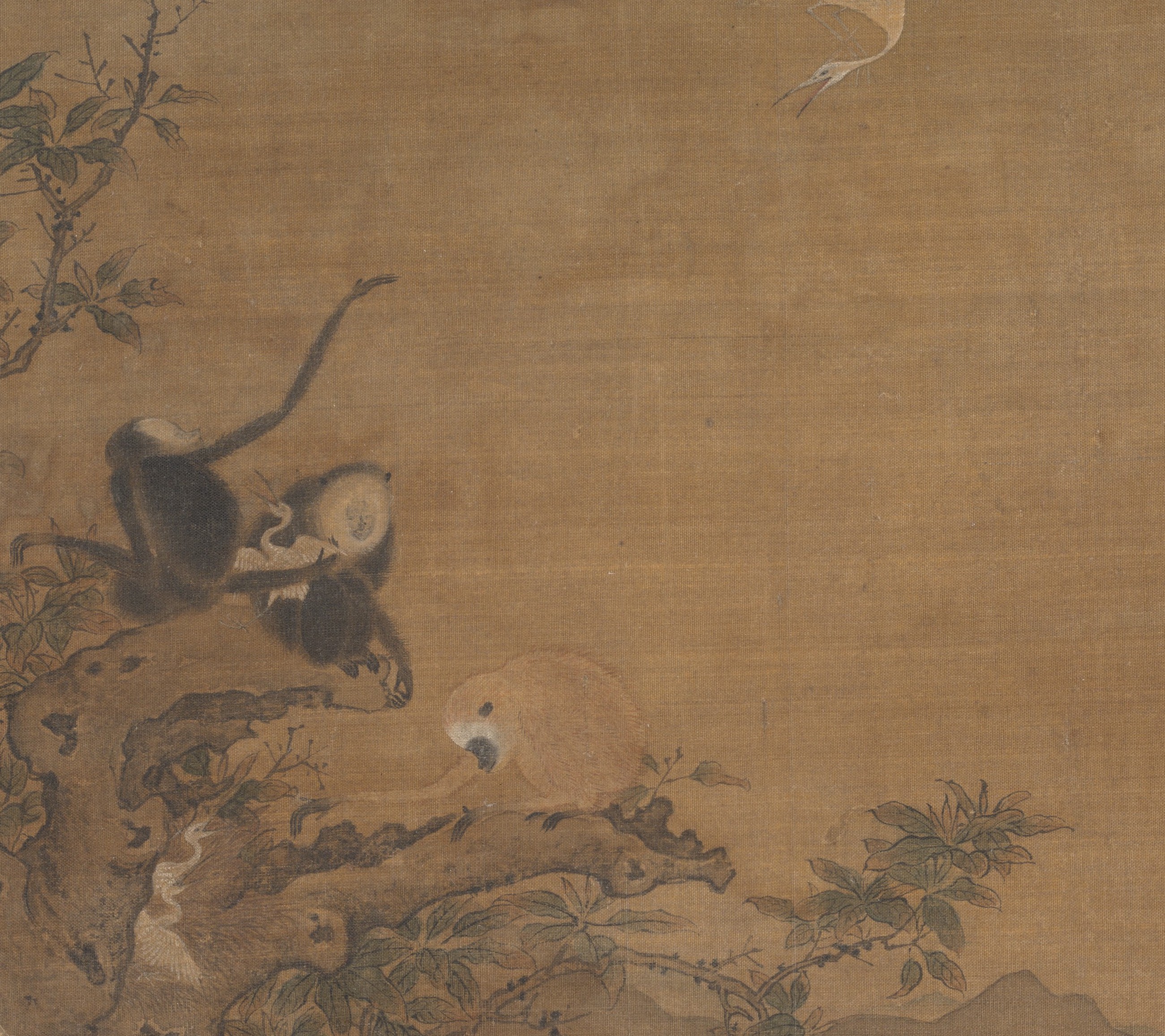
Detail from 南宋 佚名 “三元得祿”圖扇頁 (Gibbons Raiding an Egret’s Nest), Artist Unknown, late 12th century, Metropolitan Museum of Art, Accession Number: 13.100.104 [Public Domain]
Read the text (PDF)
Introduction to the Text
This story is one of five in the Global Medieval Sourcebook to have been selected from the Yijian Zhi (or, Record of the Listener, hereafter the Record) by Hong Mai (1123-1202). Like many well-educated men in the Southern Song Dynasty (1127-1279), Hong Mai grew up in a prominent family, passed the civil service examination, and obtained a post in the imperial government. However, due to misconduct during a diplomatic mission, his career came to an abrupt end. From then on, he retreated to his study and devoted himself to writing the Record.
The corpus of the Record originally consisted of 420 chapters. What we have today, however, is but a small fraction of the original text. The Record shows a remarkable degree of accuracy when we compare it with the official documents and other texts of the same period. Nevertheless, many stories in the Record are outright fictitious or based on highly unreliable sources. The Record preserved much information about the society, culture, and religion of the Southern Song Dynasty and was a source of inspiration for generations of writers after Hong Mai. Writers in late imperial China, for instance, took up many stories in the Record and refashioned them into stories that met the demands and expectations of their own times.
Further Reading
Allen, Sarah M. Shifting Stories : History, Gossip, and Lore in Narratives from Tang Dynasty China. Harvard-Yenching Institute Monograph Series. Cambridge, Massachusetts: Harvard University Asia Center, 2014.
- Explores the tale literature of eighth- and ninth-century China to show how the written tales we have today grew out of a fluid culture of hearsay that circulated within elite society. Contains a chapter that explains the modern (mis)understanding of the tale as a genre.
Hansen, Valerie. Changing Gods in Medieval China, 1127-1276. Princeton, N.J.: Princeton University Press, 1990.
- Uses the Yi Jian Zhi tales as historical documents and shows that social and economic developments underlay religious changes in the Southern Song (1127 - 1276).
Inglis, Alister David. Hong Mai’s Record of the Listener and Its Song Dynasty Context. SUNY Series in Chinese Philosophy and Culture. Albany: State University of New York Press, 2006.
- A comprehensive survey of the scholarship on Yi Jian Zhi.
Luo, Manling. Literati Storytelling in Late Medieval China. The Modern Language Initiative. Seattle: University of Washington Press, 2015.
- Shows how the tales offer crucial insights into the reconfiguration of the Chinese elite, which monopoligzed literacy, social prestige, and political participation in tenth-century China.
Chen Wangyou’s Daughter-in-Law | 陳王猷子妇
潮州人陳王猷為梅州守。子婦死焉, 葬之於郡北山之上。 其魂每夕歸與夫共寢。夫懼宿於母榻。婦複來即之, 不可卻, 雖家人相見無所避。 一子數歲矣, 韶秀可愛, 每欲取以去, 舉家爭而奪之。婦出入自若, 陳氏甚懼, 乃召道士醮設及禱於神, 皆不能遣。時紹興庚午三月也。又三月, 陳守卒於郡。
Chen Wangyou’s Daughter-in-Law
Chen Wangyou from Chaozhou was the magistrate of Meizhou. When his daughter-in-law died, the Chen family buried her in the mountain north of the county. Every evening, her spirit would come back home to sleep with her husband. Her husband was scared and slept in his mother’s bed. But the woman came back again and could not be turned away. Even when she saw the [other members of the] Chen family, she would not avoid them. Her son was a few years old, cute and good-looking. Every time she tried to take him away, the entire Chen family would fight to get him back. However the woman went in and out of the Chen family home like there was no one around. The Chen family was so scared that they hired a Daoist to set up a religious ceremony and pray to God on their behalf – neither [action] could dispel the spirit. At the time, it was the third month of the Shaoxing era. After three months, the magistrate Chen died in the county.