The Concubine of Mr. Yao | 姚氏妾
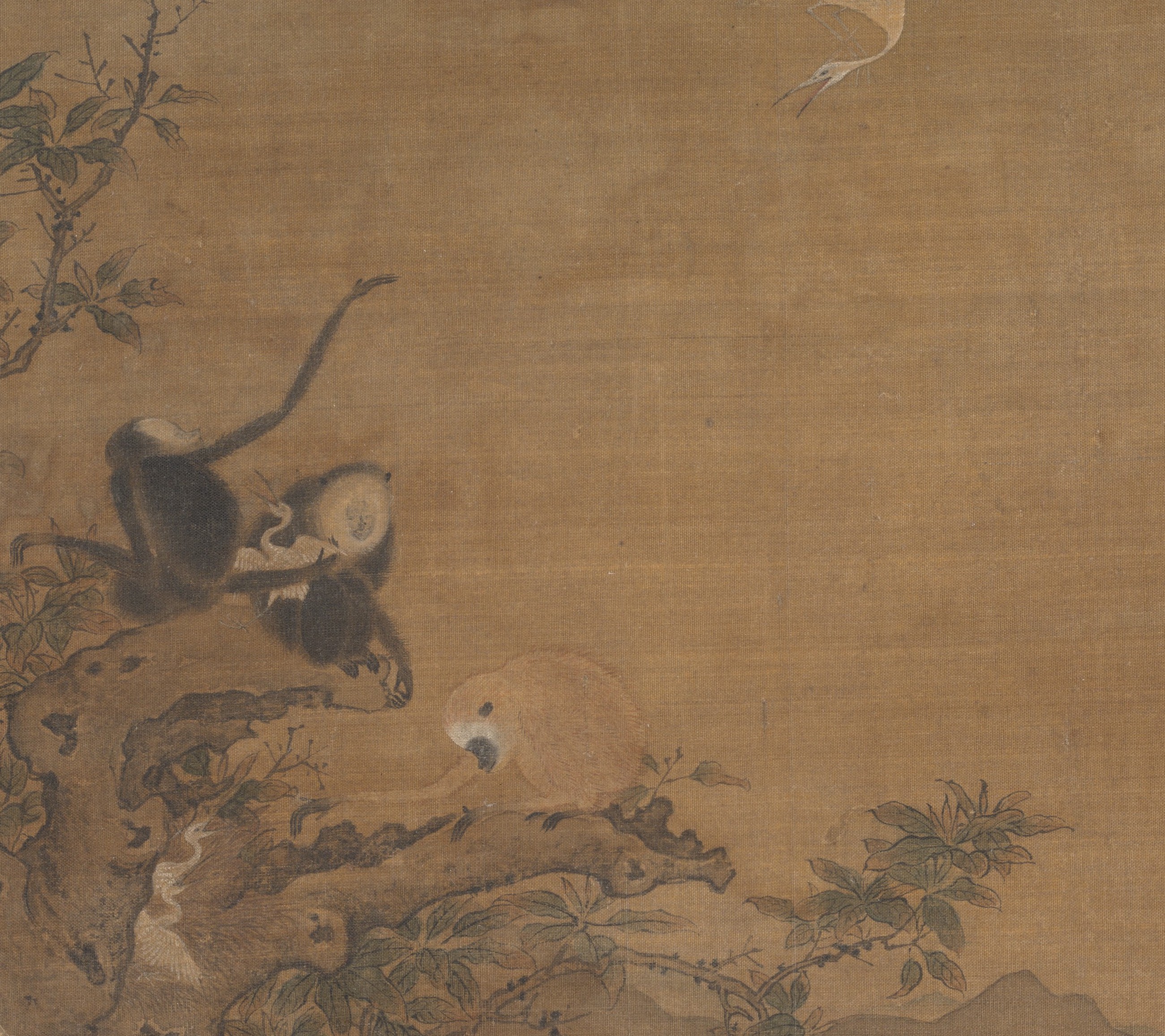
Detail from 南宋 佚名 “三元得祿”圖扇頁 (Gibbons Raiding an Egret’s Nest), Artist Unknown, late 12th century, Metropolitan Museum of Art, Accession Number: 13.100.104 [Public Domain]
Read the text (PDF)
Introduction to the Text
This story is one of five in the Global Medieval Sourcebook to have been selected from the Yijian Zhi (or, Record of the Listener, hereafter the Record) by Hong Mai (1123-1202). Like many well-educated men in the Southern Song Dynasty (1127-1279), Hong Mai grew up in a prominent family, passed the civil service examination, and obtained a post in the imperial government. However, due to misconduct during a diplomatic mission, his career came to an abrupt end. From then on, he retreated to his study and devoted himself to writing the Record.
The corpus of the Record originally consisted of 420 chapters. What we have today, however, is but a small fraction of the original text. The Record shows a remarkable degree of accuracy when we compare it with the official documents and other texts of the same period. Nevertheless, many stories in the Record are outright fictitious or based on highly unreliable sources. The Record preserved much information about the society, culture, and religion of the Southern Song Dynasty and was a source of inspiration for generations of writers after Hong Mai. Writers in late imperial China, for instance, took up many stories in the Record and refashioned them into stories that met the demands and expectations of their own times.
Further Reading
Allen, Sarah M. Shifting Stories : History, Gossip, and Lore in Narratives from Tang Dynasty China. Harvard-Yenching Institute Monograph Series. Cambridge, Massachusetts: Harvard University Asia Center, 2014.
- Explores the tale literature of eighth- and ninth-century China to show how the written tales we have today grew out of a fluid culture of hearsay that circulated within elite society. Contains a chapter that explains the modern (mis)understanding of the tale as a genre.
Hansen, Valerie. Changing Gods in Medieval China, 1127-1276. Princeton, N.J.: Princeton University Press, 1990.
- Uses the Yi Jian Zhi tales as historical documents and shows that social and economic developments underlay religious changes in the Southern Song (1127 - 1276).
Inglis, Alister David. Hong Mai’s Record of the Listener and Its Song Dynasty Context. SUNY Series in Chinese Philosophy and Culture. Albany: State University of New York Press, 2006.
- A comprehensive survey of the scholarship on Yi Jian Zhi.
Luo, Manling. Literati Storytelling in Late Medieval China. The Modern Language Initiative. Seattle: University of Washington Press, 2015.
- Shows how the tales offer crucial insights into the reconfiguration of the Chinese elite, which monopoligzed literacy, social prestige, and political participation in tenth-century China.
The Concubine of Mr. Yao | 姚氏妾
會稽姚宏買一妾, 善女工庖廚, 且有姿色, 又慧黠謹飭, 能承迎人, 自主母以下皆愛之。居數月久, 一夕, 姚氏舉家覺寒氣滿室, 切切逼人, 巳而聞鬼哨一聲, 從窗間出。家人驚怖,稍定, 方舉燭相存問, 獨此妾不見。視其榻,衣裘皆在焉。窗紙上小竅如錢大, 不知何怪也。郭堂老說。
Yao Hong from Kuaiji bought a concubine. She was adept at embroidery and culinary matters. Moreover, she was attractive, smart, perspicacious and rule-following. She had a sweet mouth, and as a result, from her mother-in-law to those under her, all liked her very much. One evening, after several months, the entire Yao family felt a cold air in the room which pressed every single one of them. Suddenly they heard a shriek of a ghost, which issued from the windows. The Yao family was shocked and scared. When they calmed down, they held candles and checked on each other. Only the concubine was missing. They examined her bed and found her clothes on it. In the window paper there was a small opening the size of a coin. We do not know what kind of monster this was. This was reported by Guo Tanglao.