The Dream of Gong Yu | 龔輿夢
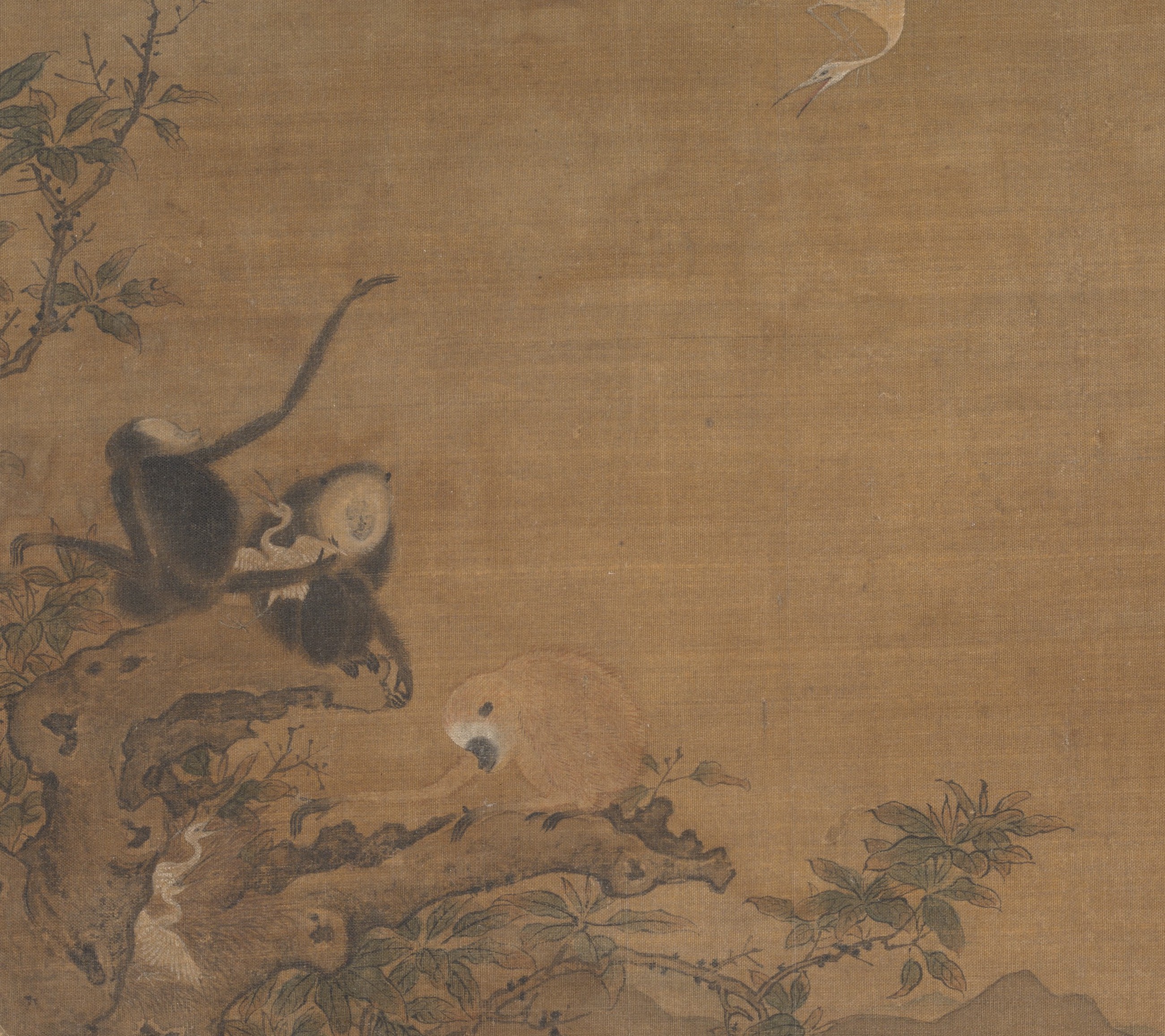
Detail from 南宋 佚名 “三元得祿”圖扇頁 (Gibbons Raiding an Egret’s Nest), Artist Unknown, late 12th century, Metropolitan Museum of Art, Accession Number: 13.100.104 [Public Domain]
Read the text (PDF)
Introduction to the Text
This story is one of five in the Global Medieval Sourcebook to have been selected from the Yijian Zhi (or, Record of the Listener, hereafter the Record) by Hong Mai (1123-1202). Like many well-educated men in the Southern Song Dynasty (1127-1279), Hong Mai grew up in a prominent family, passed the civil service examination, and obtained a post in the imperial government. However, due to misconduct during a diplomatic mission, his career came to an abrupt end. From then on, he retreated to his study and devoted himself to writing the Record.
The corpus of the Record originally consisted of 420 chapters. What we have today, however, is but a small fraction of the original text. The Record shows a remarkable degree of accuracy when we compare it with the official documents and other texts of the same period. Nevertheless, many stories in the Record are outright fictitious or based on highly unreliable sources. The Record preserved much information about the society, culture, and religion of the Southern Song Dynasty and was a source of inspiration for generations of writers after Hong Mai. Writers in late imperial China, for instance, took up many stories in the Record and refashioned them into stories that met the demands and expectations of their own times.
Further Reading
Allen, Sarah M. Shifting Stories : History, Gossip, and Lore in Narratives from Tang Dynasty China. Harvard-Yenching Institute Monograph Series. Cambridge, Massachusetts: Harvard University Asia Center, 2014.
- Explores the tale literature of eighth- and ninth-century China to show how the written tales we have today grew out of a fluid culture of hearsay that circulated within elite society. Contains a chapter that explains the modern (mis)understanding of the tale as a genre.
Hansen, Valerie. Changing Gods in Medieval China, 1127-1276. Princeton, N.J.: Princeton University Press, 1990.
- Uses the Yi Jian Zhi tales as historical documents and shows that social and economic developments underlay religious changes in the Southern Song (1127 - 1276).
Inglis, Alister David. Hong Mai’s Record of the Listener and Its Song Dynasty Context. SUNY Series in Chinese Philosophy and Culture. Albany: State University of New York Press, 2006.
- A comprehensive survey of the scholarship on Yi Jian Zhi.
Luo, Manling. Literati Storytelling in Late Medieval China. The Modern Language Initiative. Seattle: University of Washington Press, 2015.
- Shows how the tales offer crucial insights into the reconfiguration of the Chinese elite, which monopoligzed literacy, social prestige, and political participation in tenth-century China.
The Dream of Gong Yu | 龔輿夢
潭州士人龔輿, 乾道四年冬, 與鄉 里六七人偕赴省試. 過宜春, 謁仰山廟祈夢。輿夢至官府, 見柱上掲紙一片, 書[龔輿不得]四字,而[不]字上下稍不聨接。既覺, 殊不樂, 自意必下第。及春榜至, 輿中選, 餘人盡黜, 始以語人, 謂夢不驗。好事者曰: “不字斷續如此,乃一个也. 神言龔輿一个得耳, 豈不昭然?”
The Dream of Gong Yu
There is a literatus from Tanzhou named Gong Yu. In the winter of the fourth year of the Dao Qian reign, he went with six or seven people from his hometown to participate in the provincial exam. When they passed Yi Chun, they paid their respects to the Yangshan Monastery and prayed for dreams. Gong Yu dreamt that he went into the government building and saw a piece of paper on the pillar of the building. On the paper were the four characters: “Gong Yu Bu De”1 were written. But the upper part and the lower part of the character “Bu” were not connected. When Gong Yu woke up, he was quite unhappy and thought he would fail the exam. When the results came out in the spring, Gong Yu was selected and the rest of his group were rejected. Gong Yu began to tell people [what had happened], saying that the dream was not accurate. His acquaintances said: “When the character ‘Bu’ is disconnected like that, it should be read as two characters ‘Yi Ge.’ The deity was saying that only Gong Yu himself could do it, isn’t that obvious?”
Critical Notes
1 Meaning: “Gong Yu will not get it.”