The Lay of Ludwig | Das Ludwigslied
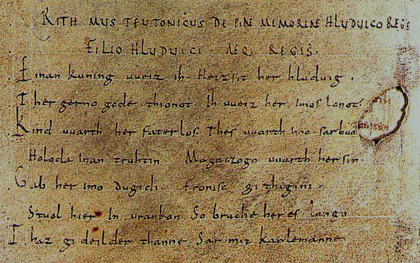
Image in Public Domain
Read the text (PDF)
Introduction to the Text
Das Ludwigslied (or the Lay of Ludwig) is a historical narrative poem consisting of 59 rhyming couplets. It chronicles the life of Ludwig (Louis III of France), and his personal relationship with God, culminating in the victory of the Franks over the Vikings at the Battle of Saucourt-en-Vimeu, which took place in August of 881 CE. The poem has prominent Christian themes, and portrays God as playing an active role in human events, both sending the Vikings to punish the Franks and convincing Ludwig to lead the Frankish army against the invaders. The author of the text is unknown, but was likely a monk at the Frankish monastery of Saint-Amand, in what is now Belgium. Another text in the same manuscript was written by the same scribe in Old French, implying that he may have come from Germany and been multilingual. Ludwig died only one year after the battle chronicled in the poem, yet the poem makes no mention of his death and refers to him as though he is still alive, leading many scholars to conclude that the poem was written in the intervening year (881-882 CE).
The poem is written in Old High German, and scholars speculate that it may be the only surviving text written in West Franconian dialect that was spoken by the Carolingian Court. It was transmitted in only one manuscript and has been of interest to scholars since its discovery in the 18th century, before it was lost and rediscovered in the 19th century, making it one of the first Old High German texts to be studied by scholars of medieval vernacular literature.
Scholars have been fascinated by the poem’s portrayal of God, as he plays a much more active role than in most medieval Christian texts. Some have argued that his personal guardianship of Ludwig is a trace of pagan polytheism in an otherwise Christian context.
Further Reading
Murdoch, Brian. Old High German Literature. Boston: Twayne Publishers, 1983. Print.
Bostock, John K, K C. King, and D R. McLintock. A Handbook on Old High German Literature. Oxford: Clarendon Press, 1976. Print.
Schwarz, W. “The ‘Ludwigslied’, a Ninth-Century Poem.” The Modern Language Review, vol. 42, no. 4, 1947, pp. 467–473. JSTOR, www.jstor.org/stable/3716800.
The Lay of Ludwig | Das Ludwigslied
Einan kuning uueiz ih, Heizsit her Hluduig,
Ther gerno gode thionot: Ih uueiz her imos lonot.
Kind uuarth her faterlos, Thes uuarth imo sar buoz:
Holoda Inan truhtin, Magaczogo uuarth her sin.
5 Gab her imo dugidi, Fronisc githigini,
Stuol hier in Urankon. So bruche her es lango!
Thaz gideilder thanne Sar mit karlemanne,
Bruoder sinemo. Thia czala uuunniono.
So thaz uuarth al gendiot, Koron uuolda sin god,
10 Ob her arbeidi So iung tholon mahti.
Lietz her heidine man Ober seo lidan,
Thiot Urankono Manon sundiono.
Sume sar uerlorane Uuurdun sum erkorane.
Haranskara tholota Ther er misselebeta.
15 Ther ther thanne thiob uuas, Ind er thanana ginas,
Nam sina uaston. Sidh uuarth her guot man.
Sum uuas luginari, Sum skachari,
Sum fol loses, Ind er gibuozta sih thes.
Kuning uuas eruirrit, thaz richi al girrit,
20 Uuas erbolgan Krist: Leidhor thes ingald iz!
Thoh erbarmedes got, Uuisser alla thia not,
Hiez her Hluduigan. Tharot sar ritan:
“Hluduig, kuning min, Hilph minan liutin!
Heigun sa Northman* Harto bi-duuungan.”
25 Thanne sprah Hluduig: “Herro, so duon ih,
Dot ni rette mir iz, Al thaz du gibiudist.”
Tho nam her godes urlub, Huob her gundfanon uf,
Reit her thara in Urankon Ingagan Northmannon.
Gode thancodun, The sin beidodun,
30 Quadhun al: “fro min, So lango beidon uuir thin.”
Thanne sprah luto Hluduig ther guoto:
“Trostet hiu, gisellion, Mine notstallon!
Hera santa mih god Ioh mir selbo gibod,
Ob hiu rat thuhti, Thaz ih hier geuuhti.
35 Mih selbon ni sparoti. Un-c ih hiu gi-neriti.
Nu uuillih, thaz mir uolgon Alle godes holdon.
Giskerit ist thiu hieruuist So lango so uuili krist.
Uuili her unsa hinauarth, Thero habet her giuualt.
So uuer so hier in ellian, Giduot godes uuillion,
40 Quimit her gisund uz, Ih gilonon imoz,
Bilibit her thar inne, Sinemo kunnie.”
Tho nam her skild indi sper, Ellianlicho reit her
Uuolder uuar errahchon Sinan uuidarsahchon.
Tho ni uuas iz burolang, Fand her thia Northman.
45 Gode lob sageda, Her sihit thes her gereda.
Ther kuning reit kuono, Sang lioth frono,
Ioh alle saman sungun: “Kyrrieleison.”
Sang uuas gisungan, Uuig uuas bigunnan.
Bluot skein In uuangon, Spilodun ther urankon.
50 Thar uaht thegeno gelih, Nichein soso Hluduig:
Snel indi kuoni, thaz uuas imo gekunni.
Suman thuruhskluog her, Suman thuruhstah her.
Her skancta cehanton Sinan fianton
Bitteres lides. So uue hin hio thes libes.
55 Gilobot si thiu godes kraft: Hluduig uuarth sigihaft;
Ioh allen heiligon thanc! Sin uuarth ther sigikamf.
Uuolar abur Hluduig, Kuning uuigsalig!
So garo soser hio uuas, So uuar soses thurft uuas.
Gihalde inan thruhtin Bi sinan ergrehtin.
The Lay of Ludwig
I know a king, Ludwig is his name,
who gladly serves God: I know that he will reward him for this.
He lost his father when he was a child but soon was compensated for it:
The Lord himself adopted him and became his guardian.
5 He gave Ludwig virtues, a royal entourage,
the throne here in Francia. May he enjoy these gifts for a long time!
He soon shared all this with Karlmann,
his brother, the sum of pleasures.
After this was done, God wanted to test him [to see]
10 If he, who was still so young, could endure hardship.
He let heathens come from across the sea,
To admonish the Franks for their sins.
Some were lost immediately, others were chosen for eternal salvation.
Severe punishments now were endured by those who earlier on had lived sinfully.
15 Who previously had been a thief and had survived, now began to fast:
Thus he saved himself and became a good man.
One man was a liar, the other a bandit,
The third lived without any control, and he did penance for it.
The king was far away, the realm was beset by troubles,
20 Christ was full of wrath: woe, it [i.e. the realm] had to atone for it!
But God was also full of mercy. He knew of all the danger,
And so he commanded Ludwig to ride there immediately:
“Ludwig, my king, help my people!
The Northmen have subdued them viciously!”
25 Ludwig then replied: “Lord,
if death does not hinder me, I will do all that you command.”
He obtained permission from God, he raised the war banner,
and rode out to Francia against the Northmen.
Those who had waited for him thanked God.
30 All said: “Lord, we have waited so long for you!”
But in a loud voice the noble Ludwig said:
“Compose yourself, my friends and companions in arms!
God sent me and commanded me himself
to fight here if it would help you
35 and not to spare myself till I have saved you.
Now it is my wish that all of you who stand in God’s grace shall follow me.
Our earthly existence is measured according to the will of holy Christ.
If he wants our death, he has that power.
I will reward whoever bravely fulfills God’s will,
40 Should they survive the battle. But if they fall in battle,
I shall give the reward to their relatives.”
With this he took up shield and spear.
He rode bravely ahead of everyone: he wanted to get a good look at his enemies.
After a short time he came across the northmen.
45 He praised God, now he shall see what he had desired!
The King bravely burst forth, a pious song on his lips,
and his men all together joined in singing “Kyrie Eleison”.
The song was sung, the battle was begun.
The blood shone in their cheeks, the Franks chased [the enemy].
50 Every warrior fought, but none like Ludwig,
so skillful and so bold: he was born for this.
He smote one, he stabbed another.
Without rest he poured out bitter drink to his enemies.
Woe forever to their lives!
55 God Almighty be praised: Ludwig was victorious.
Thanks be also to all saints! His fight led to victory.
But hail to Ludwig, our king who is full of good fortune in battle!
He was always where his help was needed.
May God the Lord always keep him in his grace!
Critical Notes
Line 24: Northman can be translated as Normans or northmen, but in this case it is a reference to the Vikings (who came from the north).