To the tune “Midnight Tune”—“Frozen clouds dim the sky” | 夜半樂 · 凍雲黯淡天氣
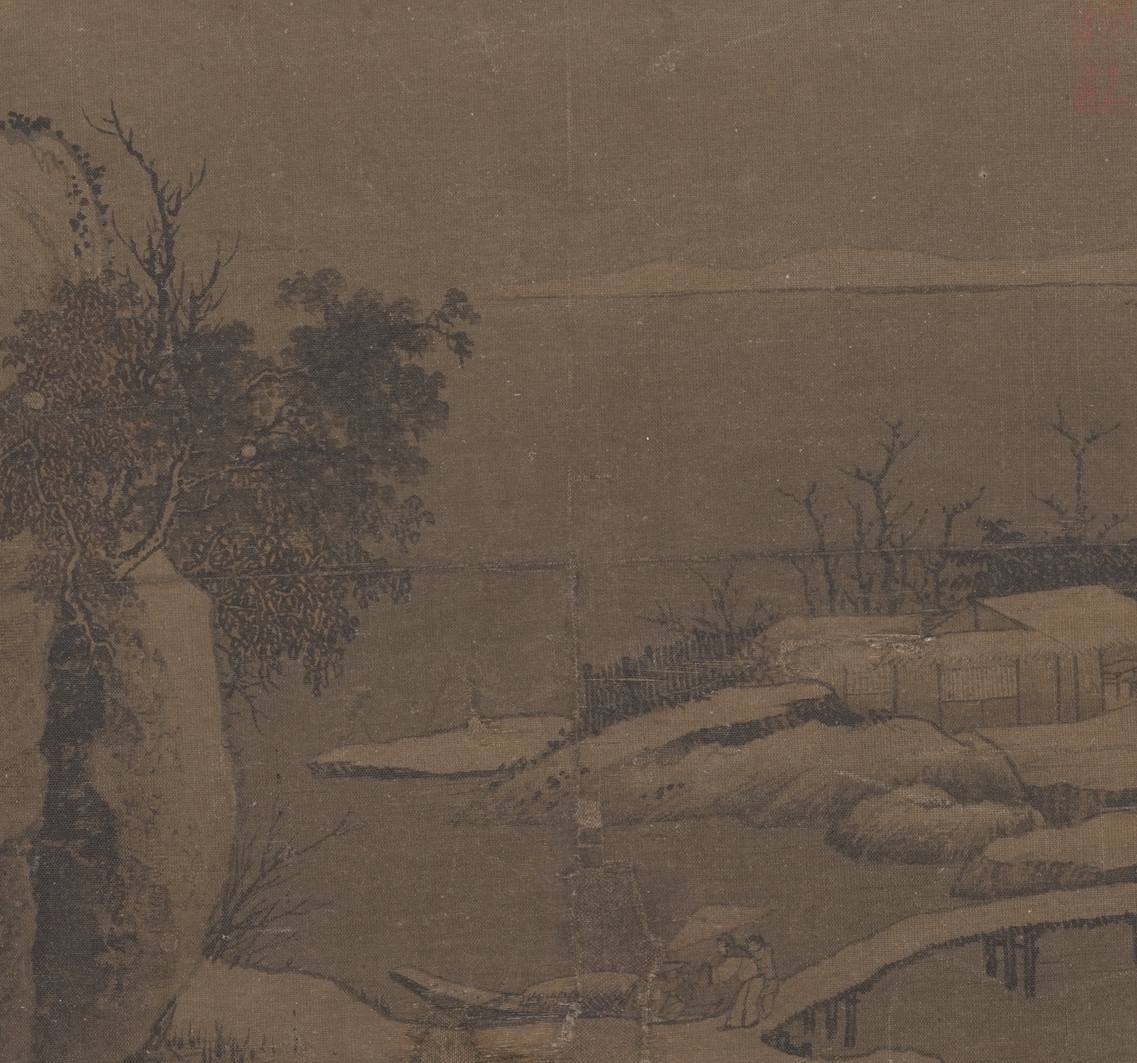
Detail from _Bridge in Snow_. Late 10th century. China. Ink and color on silk. 9 3/4 x 10 1/4 in. (24.8 x 26.0 cm). The Metropolitan Museum of Art, New York. Object Number 13.100.116. https://www.metmuseum.org/art/collection/search/51399. [Public Domain]
Read the text (PDF)
Introduction to the Text
Unlike most ci, this one is composed of three stanzas (as are several others by Liu Yong). The first two stanzas concern what the speaker sees while travelling across the country by boat; in the third stanza, prompted by these sights, he reflects on his own life choices.
The ci genre of Chinese poetry first emerged in the Sui dynasty (581-619), was further developed in the Tang dynasty (618-907) and matured in the Northern Song dynasty (960-1127). Ci is usually translated into English as “song lyrics”. This is because ci were composed by poets to fit pre-existing tunes. The number of lines, the line lengths, and the tonal and rhythmic patterns of ci vary with the tunes, which number in the hundreds. One common occasion for composing ci would be a banquet: song lyrics would be scribbled down by guests and then sung by musical performers as entertainment. Other occasions for composing and enjoying ci would be more casual: the poet might sing the lyrics to himself at home or while travelling (many ci poets were civil servants of the Imperial Court and often had to travel great distances to carry out their work). Sometimes the lyrics would be sung by ordinary people in the same way as folk songs. This oral and musical quality sets it apart from other genres of poetry in China during the same period, which were largely written texts with more elevated objectives. There are two main types of ci : wǎnyuē (婉 约, “graceful”) and háofàng (豪放, “bold”). The wǎnyuē subgenre primarily focuses on emotion and many of its lyrics are about courtship and love, while the háofàng subgenre often deals with themes that were considered more profound by contemporary audiences, such as ageing and mortality, or the rewards and disappointments of public service.
Liu Yong was possibly the most widely-read ci writer in the Northern Song period, with fans ranging from courtesans to officials and critics. He excelled in writing love songs, portraying the emotions of lovelorn individuals in unprecedented detail and depth. Despite being born into a family of officials, he did not lead a successful professional life. After he failed keju, the Imperial Chinese civil service examination, he wrote the song “To the tune ‘Crane Soaring in the Sky’”,
in which he claimed that ci poets are as important as prime ministers. This led the Ren Emperor of Song 宋仁宗 to
personally deem him unfit for imperial service. The emperor suggested that if he really thought that way, he should just be a ci poet instead of pursuing the career of an official. The emperor went so far as to deliberately fail Liu Yong in his following attempt at the exams.
Liu Yong’s continued output of poetry, deemed frivolous, trivial and vulgar by court officials, had a lasting impact on his professional life. He did not pass the civil service exam until he was 48 years old; before that, he spent much of his time with singers and courtesans, writing ci and living a hedonistic existence. After he finally passed keju, he worked as a low rank official in several areas and sought to advance his career through the assistance of the prime minister of that time, Yan Shu, who was also a famous ci poet (and is featured in this collection). Yan Shu mocked the frivolity of Liu Yong’s lyrics and refused to assist him, and the emperor, upon learning of his attempt, commented that Liu Yong, as a ci composer, should stick to composing ci. In response to the emperor’s comment, Liu Yong, in typically rebellious fashion, began signing his ci “composer of ci by imperial decree”. He made a final attempt to salvage his career by writing a complimentary ci to the emperor, but this was regarded as offensive and the emperor stripped him of his official titles
and stated that he would never be accepted back at court. From then on, he returned to his previous lifestyle, indulging in the company of singers and courtesans.
Because of his unique life experience, the sentiments expressed in Liu Yong’s ci are often very different from the views typically expressed in Chinese society at that time, with an especially cynical attitude towards serving the empire and a pronounced defense of hedonism. Nevertheless, Liu Yong’s ci were extremely popular throughout the empire, giving rise to the frequently repeated observation that “if you can see a well in a place, you can hear Liu Yong’s ci being sung there”. As every tiny town had a well, this indicates the wide reach of Liu’s lyrics.
Liu Yong is also notable for his many formal innovations to ci poetry. Before Liu, most ci were written to accompany short tunes, but he initiated a trend of writing lyrics for longer tunes, which allowed for more complex portrayals of human psychology. He was also less restrained by the tune, and often modified the traditional rhyme as well as the line breaks. For example, even when he wrote two ci to the same tune, they might sound very different from one another, with different rhymes, line lengths or numbers of lines. The tunes that Liu Yong used were also more diverse than those of his contemporaries: some were folk songs, and some he composed himself. Many of Liu Yong’s ci have a stronger narrative element, probably due to the influence of storytellers whose street performances he would have watched. Liu received considerable criticism for his focus on love and for his use of commonplace language rather than a refined poetic vocabulary, but this did little to curtail his popularity or his influence on the development of the ci genre.
About this Edition
The original text of this ci is based on the edition by Tang Guizhang 唐圭璋 ( Quan Song Ci 全宋詞, vol 1. Beijing: Zhonghua shu ju, 1965). Punctuation follows the edition. Since ci poetry rarely includes personal pronouns, and gender-differentiated pronouns did not exist in Classical Chinese of this period, the gender of the speaker as well as their perspective (e.g. first-, second- or third-person) must often be deduced by the translator from context.
Further Reading
Chang, Kang-i Sun. The Evolution of Tz’u Poetry: from Late Tang to Northern Sung. Princeton UP, 1980.
- A standard survey of the early history of Chinese song lyrics (romanized as both ci and tz’u).
Egan, Ronald. “The Song Lyric”. The Cambridge History of Chinese Literature, vol. 1, edited by Stephen Owen, Cambridge UP, 2010, pp. 434-452.
- An overview of the genre.
Owen, Stephen. Just a Song: Chinese Lyrics from the Eleventh and Early Twelfth Centuries. Asia Center, Harvard UP, 2019.
- A recent new history of the genre.
Tang, Guizhang 唐圭璋, editor. Quan Song Ci 全宋詞. Zhonghua shu ju, 1965. 5 vols.
- A comprehensive edition of ci from the Song dynasty and the source text for the ci in this collection (introductions and annotations are in Chinese).
To the tune “Midnight Tune”—“Frozen clouds dim the sky” | 夜半樂 · 凍雲黯淡天氣
夜半樂
凍雲黯淡天氣,
扁舟一葉,
乘興離江渚。
渡萬壑千巖,
5 越溪深處。
怒濤漸息,
樵風乍起,
更聞商旅相呼。
片帆高舉。
10 泛畫鷁、
翩翩過南浦。
望中酒旆閃閃,
一簇煙村,
數行霜樹。
15 殘日下,
漁人鳴榔歸去。
敗荷零落,
衰楊掩映,
岸邊兩兩三三,
20 浣沙遊女。
避行客、
含羞笑相語。
到此因念,
繡閣輕抛,
25 浪萍難駐。
嘆後約
丁寧竟何據。
慘離懷,
空恨歲晚歸期阻。
30 凝淚眼、
杳杳神京路。
斷鴻聲遠長天暮。
To the tune “Midnight Tune”
Frozen clouds dim the sky,
a thin boat
departs the riverside on a whim,
crosses a thousand valleys and a thousand canyons,
5 into the depth of Yue streams.1
Raging waves gradually die down,
a favorable wind suddenly rises.
Then I hear the traveling tradesmen calling to each other.2
The lone sail hangs high;
10 on the painted bird,3
I swiftly pass the southern bank.
Before my eyes, the wine shop banner swings,
a small village wreathed in smoke,
and rows of frosty trees.
15 The setting sun retreats,
the fishermen strike the side of the boat4 and return.
Withered lotuses fall apart,
fading willows cover and reveal.
On the bank, in groups of two or three,
20 girls are doing laundry.5
Avoiding the travelers,
shy, they smile, chatting to each other.
Being here brings back my thoughts.
I have abandoned the embroidered chamber.6
25 Like a duckweed in the waves, I have nowhere to stay.
I sigh at the thought of reunion—
who can now believe in the earnest words that were said back then?
Wretched is the parting heart,
vainly regretting that the year has come to an end and the time to return home7 has been delayed.
30 I let my watery eyes gaze
at the long, distant road to the capital.
The cry of the wild goose resounds, lingering in the vast evening sky.
Critical Notes
-
In Chinese folklore, this river is associated with a beautiful woman named Xi Shi, whose name has become synonymous with female beauty. According to the tale, she often washed her clothes in this river.
-
A common way for tradesmen to communicate with each other at that time.
-
“鷁 ” is a legendary bird that was often painted on boats. It was believed to be a lucky charm for sailors because it could fly over water during storms. Here, “the painted bird” refers to the boat that the speak er is on.
-
The fishermen strike the boat to give themselves a beat to sing along to.
-
A typical scene for women at that time, but it could also be associated with the story of Xi Shi (see note above).
-
Refers to a bedroom. It implies that the poet has left behind the wealthy, domestic life that he could otherwise have led.
-
In the Lunar calendar, the end of the year means the coming of Spring Festival, the most important festival for the reunion of families.