To the tune “Crane Soaring in the Sky”—“On the golden title board” | 鶴沖天 · 黃金榜上
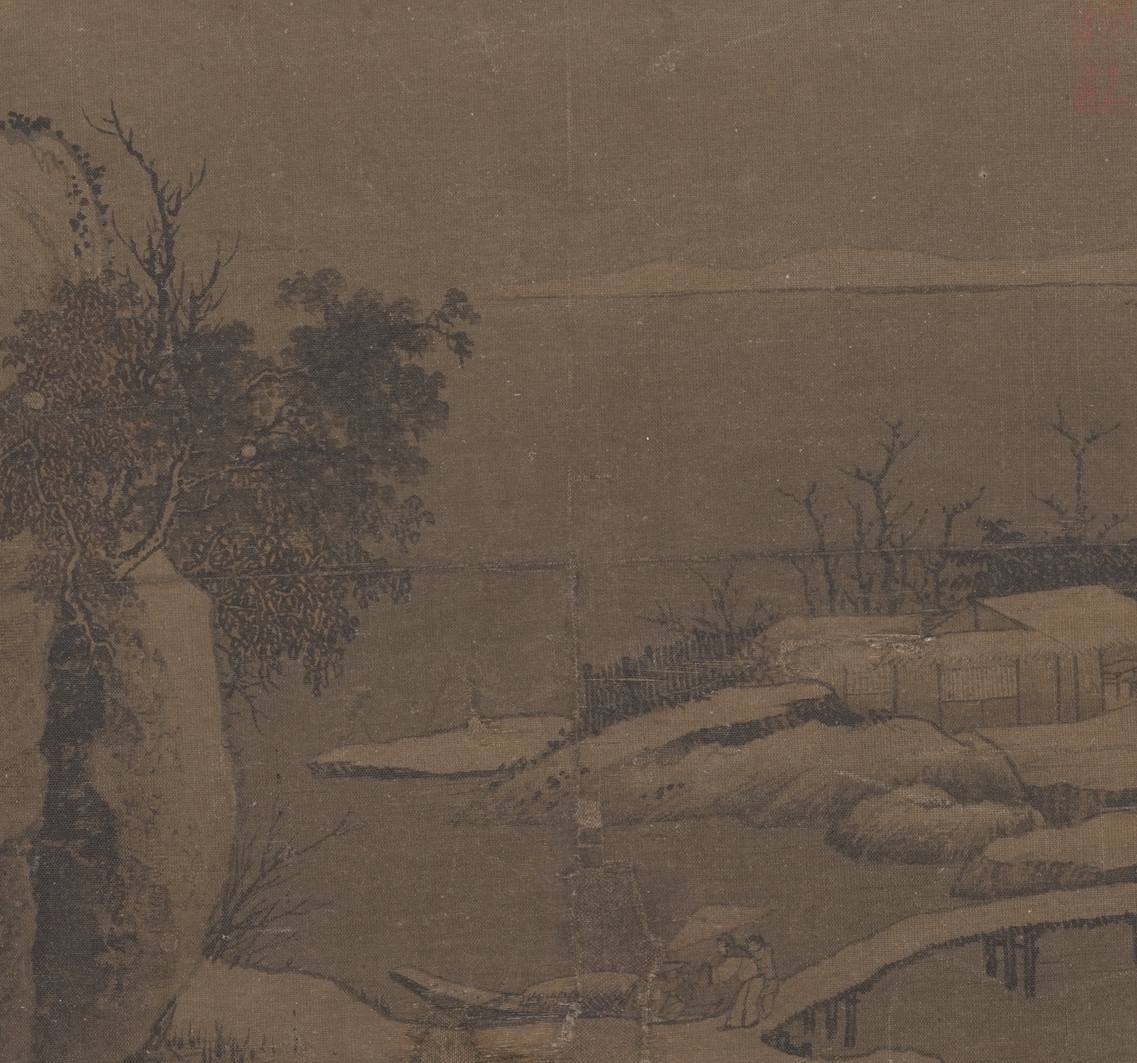
Detail from _Bridge in Snow_. Late 10th century. China. Ink and color on silk. 9 3/4 x 10 1/4 in. (24.8 x 26.0 cm). The Metropolitan Museum of Art, New York. Object Number 13.100.116. https://www.metmuseum.org/art/collection/search/51399. [Public Domain]
Read the text (PDF)
Introduction to the Text
This ci was written by Liu Yong after he failed keju, the Imperial Chinese civil service examination, and it is this ci that leads the Ren Emperor of Song 宋仁宗 to personally deem him unfit for imperial service, which further impedes his political career. In the first stanza of this ci, the poet explains his failing in keju as the emperor “miss[ing] out on the talented ones”, and makes the unconventional claim that being the ci poet is a profession that is as important and praiseworthy as being a state bureaucrat. In the second stanza, the poet envisions a future filled with “romantic affairs and pleasures”. This hedonistic outlook and cynicism towards the empire are very different from the views typically expressed in Chinese society at that time, which are largely influenced by Confucianism and propose a positive attitude towards making contribution to the empire and the people through becoming state officials and taking up responsibilities of different social roles. Compared to other ci featured in the Liu Yong collection, this piece is composed earlier, and is often considered as the starting point of Liu Yong’s rebelliousness.
The ci genre of Chinese poetry first emerged in the Sui dynasty (581-619), was further developed in the Tang dynasty (618-907) and matured in the Northern Song dynasty (960-1127). Ci is usually translated into English as “song lyrics”. This is because ci were composed by poets to fit pre-existing tunes. The number of lines, the line lengths, and the tonal and rhythmic patterns of ci vary with the tunes, which number in the hundreds. One common occasion for composing ci would be a banquet: song lyrics would be scribbled down by guests and then sung by musical performers as entertainment. Other occasions for composing and enjoying ci would be more casual: the poet might sing the lyrics to himself at home or while travelling (many ci poets were civil servants of the Imperial Court and often had to travel great distances to carry out their work). Sometimes the lyrics would be sung by ordinary people in the same way as folk songs. This oral and musical quality sets it apart from other genres of poetry in China during the same period, which were largely written texts with more elevated objectives. There are two main types of ci : wǎnyuē (婉 约, “graceful”) and háofàng (豪放, “bold”). The wǎnyuē subgenre primarily focuses on emotion and many of its lyrics are about courtship and love, while the háofàng subgenre often deals with themes that were considered more profound by contemporary audiences, such as ageing and mortality, or the rewards and disappointments of public service.
Liu Yong was possibly the most widely-read ci writer in the Northern Song period, with fans ranging from courtesans to officials and critics. He excelled in writing love songs, portraying the emotions of lovelorn individuals in unprecedented detail and depth. Despite being born into a family of officials, he did not lead a successful professional life. After he failed keju, he wrote the song “To the tune ‘Crane Soaring in the Sky’”, in which he claimed that ci poets are as important as prime ministers. This led the Ren Emperor of Song 宋仁宗 to personally deem him unfit for imperial service. The emperor suggested that if he really thought that way, he should just be a ci poet instead of pursuing the career of an official. The emperor went so far as to deliberately fail Liu Yong in his following attempt at the exams.
Liu Yong’s continued output of poetry, deemed frivolous, trivial and vulgar by court officials, had a lasting impact on his professional life. He did not pass the civil service exam until he was 48 years old; before that, he spent much of his time with singers and courtesans, writing ci and living a hedonistic existence. After he finally passed keju, he worked as a
low rank official in several areas and sought to advance his career through the assistance of the prime minister of that time, Yan Shu, who was also a famous ci poet (and is featured in this collection). Yan Shu mocked the frivolity of Liu Yong’s lyrics and refused to assist him, and the emperor, upon learning of his attempt, commented that Liu Yong, as a ci composer, should stick to composing ci. In response to the emperor’s comment, Liu Yong, in typically rebellious fashion, began signing his ci “composer of ci by imperial decree”. He made a final attempt to salvage his career by writing a complimentary ci to the emperor, but this was regarded as offensive and the emperor stripped him of his official titles and stated that he would never be accepted back at court. From then on, he returned to his previous lifestyle, indulging in the company of singers and courtesans.
Because of his unique life experience, the sentiments expressed in Liu Yong’s ci are often very different from the views typically expressed in Chinese society at that time, with an especially cynical attitude towards serving the empire and a pronounced defense of hedonism. Nevertheless, Liu Yong’s ci were extremely popular throughout the empire, giving rise to the frequently repeated observation that “if you can see a well in a place, you can hear Liu Yong’s ci being sung there”. As every tiny town had a well, this indicates the wide reach of Liu’s lyrics.
Liu Yong is also notable for his many formal innovations to ci poetry. Before Liu, most ci were written to accompany short tunes, but he initiated a trend of writing lyrics for longer tunes, which allowed for more complex portrayals of human psychology. He was also less restrained by the tune, and often modified the traditional rhyme as well as the line breaks. For example, even when he wrote two ci to the same tune, they might sound very different from one another, with different rhymes, line lengths or numbers of lines. The tunes that Liu Yong used were also more diverse than those of his contemporaries: some were folk songs, and some he composed himself. Many of Liu Yong’s ci have a stronger narrative element, probably due to the influence of storytellers whose street performances he would have watched. Liu received considerable criticism for his focus on love and for his use of commonplace language rather than a refined poetic vocabulary, but this did little to curtail his popularity or his influence on the development of the ci genre.
About this Edition
The original text of this ci is based on the edition by Tang Guizhang 唐圭璋 ( Quan Song Ci 全宋詞, vol 1. Beijing: Zhonghua shu ju, 1965). Punctuation follows the edition. Since ci poetry rarely includes personal pronouns, and gender-differentiated pronouns did not exist in Classical Chinese of this period, the gender of the speaker as well as their perspective (e.g. first-, second- or third-person) must often be deduced by the translator from context.
Further Reading
Chang, Kang-i Sun. The Evolution of Tz’u Poetry: from Late Tang to Northern Sung. Princeton UP, 1980.
- A standard survey of the early history of Chinese song lyrics (romanized as both ci and tz’u).
Egan, Ronald. “The Song Lyric”. The Cambridge History of Chinese Literature, vol. 1, edited by Stephen Owen, Cambridge UP, 2010, pp. 434-452.
- An overview of the genre.
Owen, Stephen. Just a Song: Chinese Lyrics from the Eleventh and Early Twelfth Centuries. Asia Center, Harvard UP, 2019.
- A recent new history of the genre.
Tang, Guizhang 唐圭璋, editor. Quan Song Ci 全宋詞. Zhonghua shu ju, 1965. 5 vols.
- A comprehensive edition of ci from the Song dynasty and the source text for the ci in this collection (introductions and annotations are in Chinese).
To the tune “Crane Soaring in the Sky”—“On the golden title board” | 鶴沖天 · 黃金榜上
鶴沖天
黃金榜上。
偶失龍頭望。
明代暫遺賢,
如何向。
5 未遂風雲便,
爭不恣狂蕩。
何須論得喪。
才子詞人,
自是白衣卿相。
10 煙花巷陌,
依約丹青屏障。
幸有意中人,
堪尋訪。
且恁偎紅倚翠,
15 風流事、
平生暢。
青春都一餉。
忍把浮名,
換了淺斟低唱。
To the tune “Crane Soaring in the Sky”
On the golden title board,1
I fortuitously lost my chance to be the top-ranked scholar.2
Even in the era of wise emperors and judicious state bureaucracy, the emperors sometimes miss out on the talented ones.
What should I do now?
5 Given that I didn’t get my opportunity3,
how about indulging myself in travel and fun?
Why do I need to reflect upon gain and loss?
A talented ci composer,
despite wearing white,4 is himself a prime minister.
10 On the streets of smoke and flowers5
there are painted6 screens.
Luckily, behind those live my lovers,
whom I can visit.
Let me lie beside these beauties7—
15 romantic affairs and pleasures
are the joy of my life.
Youth is just a fleeting moment.
I would rather exchange meaningless fame
to drink wine and hum tunes.8
Critical Notes
-
The “golden title board” refers to the pass list for keju, a civil service examination system in Imperial China for selecting candidates for the state bureaucracy. The pass list was called the “golden title board” because the names of successful candidates were written in the color gold. When the list was published, the names of all those who passed were read aloud in the presence of the emperor and recorded in the dynasty’s archive.
-
The literal translation for “龍頭 ” is “the head of the dragon”. Here, it refers to the title given to the scholar with the highest ranking in the exam, whose name would be at the top of the golden title board. This line indicates that Liu Yong has failed keju.
-
The literal translation for “風雲 ” is “the wind and the cloud” and it is an expression meaning “the good opportunity”. Here, it refers to the chance of becoming a state official.
-
In Imperial China, wearing white means someone is not in the state bureaucracy.
-
“Smoke and flowers” refers to prostitutes and female singers. “The streets of smoke and flowers” refers to where brothels and song houses are located.
-
“丹青 ” is the ink used for painting. Here, using it to describe the screens means that the screens are painted.
-
The literal translation for “紅翠 ” is “the red and the green”, which refers to prostitutes. This comes from a selfdescription by Li Yu 李煜 (c. 937 – 978) the last ruler of the Southern Tang state during imperial China’s Five Dynasties and Ten Kingdoms period. Despite being an unsuccessful ruler, Li Yu was known as the “first true master” of the ci form, and he described himself as “the one who drinks wine and hums tunes, the master of lying beside the beauties (the red and the green), and the king of the temple of mandarin ducks” (“浅斟低唱,偎紅倚翠大師,鴛鴦寺主 ”). Note that the mandarin duck is also a symbol for marriage or romance. Liu Yong here is trying to compare himself to Li Yu.
-
This line also borrows from Li Yu’s self-description (see previous note).