To the tune “The Lost Soul”—“On a thin boat, the light sail is furled” | 迷神引 · 一葉扁舟輕帆卷
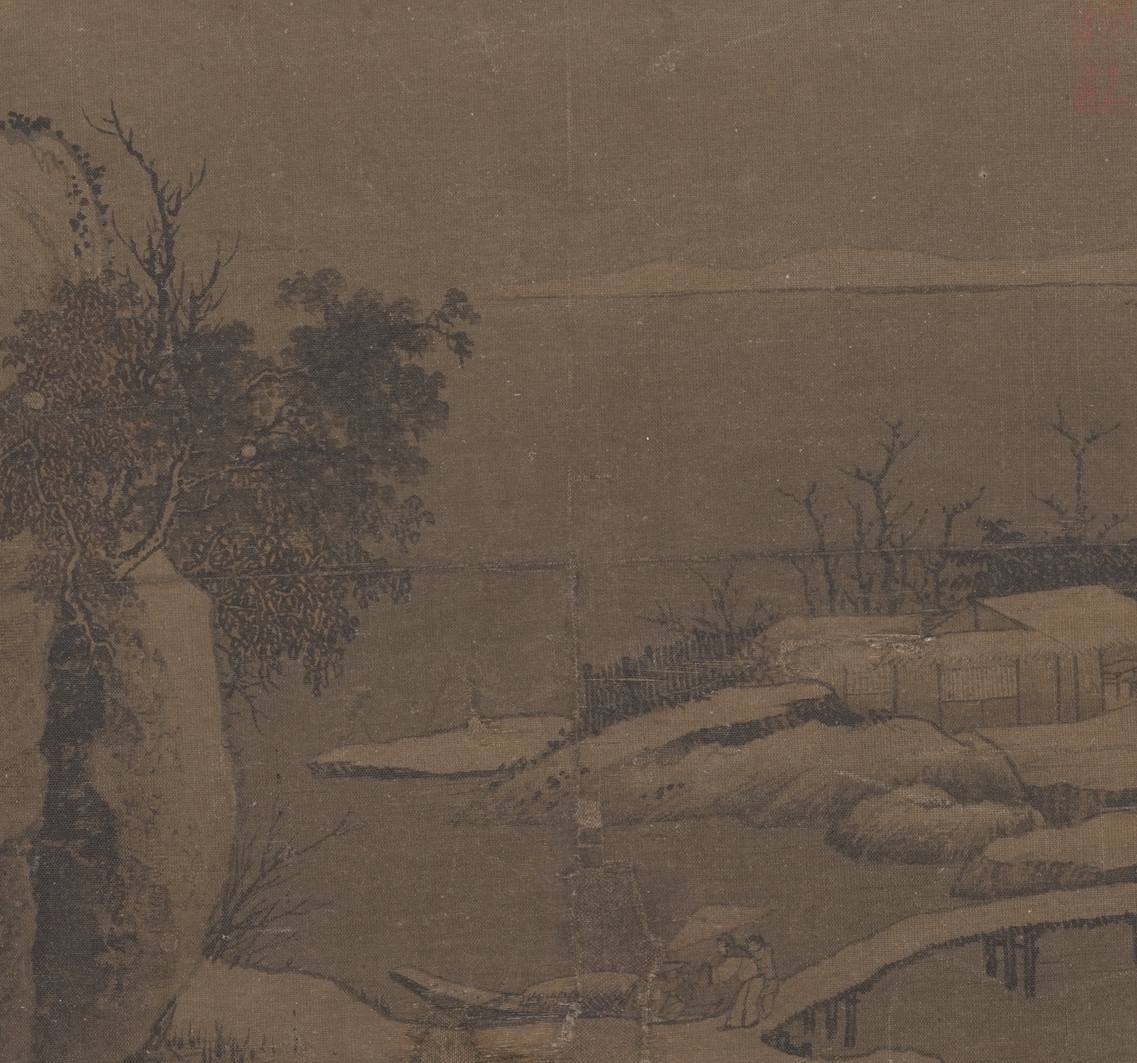
Detail from _Bridge in Snow_. Late 10th century. China. Ink and color on silk. 9 3/4 x 10 1/4 in. (24.8 x 26.0 cm). The Metropolitan Museum of Art, New York. Object Number 13.100.116. https://www.metmuseum.org/art/collection/search/51399. [Public Domain]
Read the text (PDF)
Introduction to the Text
Liu Yong composed this song late in his life when he was sent to the border as a governor. Through a series of vivid im- ages, it expresses his negative attitude towards the life of a governor and his fondness for earlier times. The first stanza focuses on description, conveying the desolation of the border region. In the second stanza, he expresses regret for his earlier choices, both romantic and professional.
The ci genre of Chinese poetry first emerged in the Sui dynasty (581-619), was further developed in the Tang dynasty (618-907) and matured in the Northern Song dynasty (960-1127). Ci is usually translated into English as “song lyrics”. This is because ci were composed by poets to fit pre-existing tunes. The number of lines, the line lengths, and the tonal and rhythmic patterns of ci vary with the tunes, which number in the hundreds. One common occasion for composing ci would be a banquet: song lyrics would be scribbled down by guests and then sung by musical performers as entertain- ment. Other occasions for composing and enjoying ci would be more casual: the poet might sing the lyrics to himself at home or while travelling (many ci poets were civil servants of the Imperial Court and often had to travel great distances to carry out their work). Sometimes the lyrics would be sung by ordinary people in the same way as folk songs. This oral and musical quality sets it apart from other genres of poetry in China during the same period, which were largely written texts with more elevated objectives. There are two main types of ci : wǎnyuē (婉 约, “graceful”) and háofàng (豪放, “bold”). The wǎnyuē subgenre primarily focuses on emotion and many of its lyrics are about courtship and love, while the háofàng subgenre often deals with themes that were considered more profound by contemporary audiences, such as ageing and mortality, or the rewards and disappointments of public service.
Liu Yong was possibly the most widely-read ci writer in the Northern Song period, with fans ranging from courtesans to officials and critics. He excelled in writing love songs, portraying the emotions of lovelorn individuals in unprecedented detail and depth. Despite being born into a family of officials, he did not lead a successful professional life. After he failed keju, the Imperial Chinese civil service examination, he wrote the song “To the tune ‘Crane Soaring in the Sky’”,
in which he claimed that ci poets are as important as prime ministers. This led the Ren Emperor of Song 宋仁宗 to
personally deem him unfit for imperial service. The emperor suggested that if he really thought that way, he should just be a ci poet instead of pursuing the career of an official. The emperor went so far as to deliberately fail Liu Yong in his following attempt at the exams.
Liu Yong’s continued output of poetry, deemed frivolous, trivial and vulgar by court officials, had a lasting impact on his professional life. He did not pass the civil service exam until he was 48 years old; before that, he spent much of his time with singers and courtesans, writing ci and living a hedonistic existence. After he finally passed keju, he worked as a low rank official in several areas and sought to advance his career through the assistance of the prime minister of that time, Yan Shu, who was also a famous ci poet (and is featured in this collection). Yan Shu mocked the frivolity of Liu Yong’s lyrics and refused to assist him, and the emperor, upon learning of his attempt, commented that Liu Yong, as a ci composer, should stick to composing ci. In response to the emperor’s comment, Liu Yong, in typically rebellious fashion,
began signing his ci “composer of ci by imperial decree”. He made a final attempt to salvage his career by writing a complimentary ci to the emperor, but this was regarded as offensive and the emperor stripped him of his official titles and stated that he would never be accepted back at court. From then on, he returned to his previous lifestyle, indulging in the company of singers and courtesans.
Because of his unique life experience, the sentiments expressed in Liu Yong’s ci are often very different from the views typically expressed in Chinese society at that time, with an especially cynical attitude towards serving the empire and a pronounced defense of hedonism. Nevertheless, Liu Yong’s ci were extremely popular throughout the empire, giving rise to the frequently repeated observation that “if you can see a well in a place, you can hear Liu Yong’s ci being sung there”. As every tiny town had a well, this indicates the wide reach of Liu’s lyrics.
Liu Yong is also notable for his many formal innovations to ci poetry. Before Liu, most ci were written to accompany short tunes, but he initiated a trend of writing lyrics for longer tunes, which allowed for more complex portrayals of human psychology. He was also less restrained by the tune, and often modified the traditional rhyme as well as the line breaks. For example, even when he wrote two ci to the same tune, they might sound very different from one another, with different rhymes, line lengths or numbers of lines. The tunes that Liu Yong used were also more diverse than those of his contemporaries: some were folk songs, and some he composed himself. Many of Liu Yong’s ci have a stronger narrative element, probably due to the influence of storytellers whose street performances he would have watched. Liu received considerable criticism for his focus on love and for his use of commonplace language rather than a refined poetic vocabulary, but this did little to curtail his popularity or his influence on the development of the ci genre.
About this Edition
The original text of this ci is based on the edition by Tang Guizhang 唐圭璋 ( Quan Song Ci 全宋詞, vol 1. Beijing: Zhonghua shu ju, 1965). Punctuation follows the edition. Since ci poetry rarely includes personal pronouns, and gender-differentiated pronouns did not exist in Classical Chinese of this period, the gender of the speaker as well as their perspective (e.g. first-, second- or third-person) must often be deduced by the translator from context.
Further Reading
Chang, Kang-i Sun. The Evolution of Tz’u Poetry: from Late Tang to Northern Sung. Princeton UP, 1980.
- A standard survey of the early history of Chinese song lyrics (romanized as both ci and tz’u).
Egan, Ronald. “The Song Lyric”. The Cambridge History of Chinese Literature, vol. 1, edited by Stephen Owen, Cambridge UP, 2010, pp. 434-452.
- An overview of the genre.
Owen, Stephen. Just a Song: Chinese Lyrics from the Eleventh and Early Twelfth Centuries. Asia Center, Harvard UP, 2019.
- A recent new history of the genre.
Tang, Guizhang 唐圭璋, editor. Quan Song Ci 全宋詞. Zhonghua shu ju, 1965. 5 vols.
- A comprehensive edition of ci from the Song dynasty and the source text for the ci in this collection (introductions and annotations are in Chinese).
To the tune “The Lost Soul”—“On a thin boat, the light sail is furled” | 迷神引 · 一葉扁舟輕帆卷
迷神引
一葉扁舟輕帆卷。
暫泊楚江南岸。
孤城暮角,
引胡笳怨。
5 水茫茫,
平沙雁、
旋驚散。
煙斂寒林簇,
畫屏展。
10 天際遙山小,
黛眉淺。
舊賞輕抛,
到此成遊宦。
覺客程勞,
15 年光晚。
異鄉風物,
忍蕭索、
當愁眼。
帝城賒,
20 秦樓阻,
旅魂亂。
芳草連空闊,
殘照滿。
佳人無消息,
25 斷雲遠。
To the tune “The Lost Soul”
On a thin boat, the light sail is furled,
temporarily stopped by the southern bank of the Chu River.1
On the lonesome city walls, the evening horn blows,
followed by the regretful barbarian lute.2
5 The water is vast and hazy.
The wild geese lie on the plain;
suddenly startled, they scatter into the air.
The mist disperses and the cold forest emerges—
a painted screen unfolds:
10 at the distant edge of the sky, the mountains are small,
(like) her lightly-drawn black eyebrows. 3
I have thrown away my old happiness too hastily,
and come here as a drifting official.
I realize the weariness of the traveler’s journey.
15 The year is late,
the scenery is of a strange town.
How could I bear the desolation
before my sorrowful eyes?
The capital is far away,
20 and the way to the Qin building is blocked.4
Souls in travel are muddled.
Fragrant grass blends into the spacious sky;
the setting sun shines on all of them.5
There is no message from the fair one;
25 the solitary patch of cloud is distant.
Critical Notes
-
Refers to the segment of the Yangtze River by Chu.
-
The barbarian lute is a traditional Chinese instrument with two strings.
-
In Chinese poetry, beautiful women’s eyebrows are often compared with mountains because of their shape.
-
The “Qin building” is a place for men to have sex with courtesans. According to legend, the original Qin building was built by the Qinmu King as a palace for his daughter and son-in-law. They were both so good at playing the vertical bamboo flute that their music attracted phoenixes, and the building where they played became famous. The meaning of the Qin building changed over time, and was later used to refer to brothels.
-
That is, the souls in travel mentioned in the previous line.