Between hill and valley deep | Zwischen perg und tieffe tal
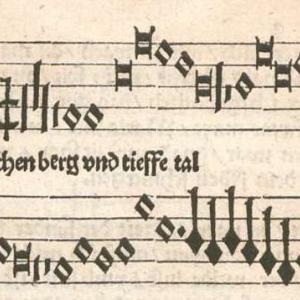
Bayerische Staatsbibliothek München 00082229 Rar.27 Stimme T f.6v [Public Domain]
Read the text (PDF)
Introduction to the Text
The first printed songbook with songs primarily in German was printed in July 1512 by the Augsburg printer Erhard Oeglin (ca.1470-1520). The songbook consists of four partbooks (it is the first German song collection to have four voices throughout) and contains 49 songs with a mixture of spiritual and secular content, 43 of which are in German and 6 in Latin. Oeglin was an innovative printer, credited as one of the first printers to print musical notation with movable type and as one of the first printers of Zeitungen (news-sheets, the forerunners of newspapers). Oeglin does not attribute any of the songs to particular composers but some of these songs do appear in other songbooks of this period where they are attributed to various composers active at the Imperial court, including Ludwig Senfl, Paul Hofhaimer, and Heinrich Isaac. These songs are collectively known as tenor lieder, as the melody is usually carried by the tenor line. This was the prototypical song type in Germany at the turn of the sixteenth century and enjoyed particular prominence at the court of the Emperor Maximilian.
Introduction to the Source
Digitized copies of these partbooks are available online from the Bayerische StaatsBibliothek in Munich: https:// stimmbuecher.digitale-sammlungen.de//view?id=bsb00082229.
Further Reading
Keyl, Stephen. “Tenorlied, Discantlied, Polyphonic lied: Voices and instruments in German secular polyphony of the Renaissance.” Early Music, vol. 20, no. 3, 1992, pp. 434–445.
Saunders, Steven. “Music in Early Modern Germany.” Early Modern German Literature 1350-1700, edited by Max Reinhart, Rochester: Camden House, 2007.
Between hill and valley deep | Zwischen perg und tieffe tal
Zwischen perg und tieffe tal / da ligt ain freie strassen / wer seinen půll nit haben mag / der můß yn faren lassen.
Far hin, far hin, du hast die wal / ich kann mich dein wol maßen / im jar sind noch vil langer tag / glück ist in allen gassen.
Between hill and valley deep
Between hill and valley deep there runs a public road, whoever can’t keep her lover must let him ride away.
Ride on, ride on, the choice is yours, I can measure up to you; there is many a long day left in the year, and fortune waits at every turn.