
Farewell! It hurts | Ade mit layd
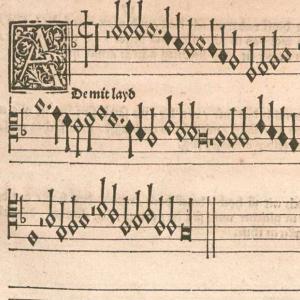
Bayerische Staatsbibliothek München 00082229 Rar.27 Stimme T f.22r [Public Domain]
Read the text (PDF)
Introduction to the Text
The first printed songbook with songs primarily in German was printed in July 1512 by the Augsburg printer Erhard Oeglin (ca.1470-1520). The songbook consists of four partbooks (it is the first German song collection to have four voices throughout) and contains 49 songs with a mixture of spiritual and secular content, 43 of which are in German and 6 in Latin. Oeglin was an innovative printer, credited as one of the first printers to print musical notation with movable type and as one of the first printers of Zeitungen (news-sheets, the forerunners of newspapers). Oeglin does not attribute any of the songs to particular composers but some of these songs do appear in other songbooks of this period where they are attributed to various composers active at the Imperial court, including Ludwig Senfl, Paul Hofhaimer, and Heinrich Isaac. These songs are collectively known as tenor lieder, as the melody is usually carried by the tenor line. This was the prototypical song type in Germany at the turn of the sixteenth century and enjoyed particular prominence at the court of the Emperor Maximilian.
Introduction to the Source
Digitized copies of these partbooks are available online from the Bayerische StaatsBibliothek in Munich: https:// stimmbuecher.digitale-sammlungen.de//view?id=bsb00082229.
Further Reading
Keyl, Stephen. “Tenorlied, Discantlied, Polyphonic lied: Voices and instruments in German secular polyphony of the Renaissance.” Early Music, vol. 20, no. 3, 1992, pp. 434–445.
Saunders, Steven. “Music in Early Modern Germany.” Early Modern German Literature 1350-1700, edited by Max Reinhart, Rochester: Camden House, 2007.
Farewell! It hurts | Ade mit layd
Ade mit layd / ich von dir schayd / dardurch mein hertz / unseglich schmertz / all stund empfind / und ist entzynd / in jamers wee / ade ade / on dich lusst mich kaynr frewden me.
Ade mein freyd / der ich kayn zeit / zů sechen an / verdriess möcht han / das ist mir gwenndt / und bin ellendt / in layd ich stee / ade ade / on dich lusst mich kaynr frewden me.
Ade / gedenck dein trew nit krenck / und hallt recht maß / vergiß nit das / als du wol waist / dein trew mir laist / hinfür als ee ade ade / on dich lusst mich kaynr frewden me.
Farewell! It hurts
Farewell! It hurts to part from you; my heart feels unspeakable torment constantly and burns with sorrow’s woe. Farewell, farewell! Without you, no joy can amuse me.
Goodbye to you, my joy, whom I could never look at with revulsion. Things have changed for me and I’m a wretch: I live in pain. Farewell, farewell! Without you no joy can amuse me.
Farewell! Consider this: don’t let your loyalty waver and continue to live in upstanding modesty. Don’t forget what you well know. Lend me your loyalty from now on as before. Farewell, farewell! Without you no joy can amuse me.