
Fortune grants me comfort and hope | Gelück mir trost und hoffnug geit
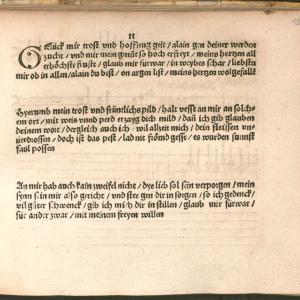
Bayerische Staatsbibliothek München 00082229 Rar.27 Stimme T f.15r
Read the text (PDF)
Introduction to the Text
The first printed songbook with songs primarily in German was printed in July 1512 by the Augsburg printer Erhard Oeglin (ca.1470-1520). The songbook consists of four partbooks (it is the first German song collection to have four voices throughout) and contains 49 songs with a mixture of spiritual and secular content, 43 of which are in German and 6 in Latin. Oeglin was an innovative printer, credited as one of the first printers to print musical notation with movable type and as one of the first printers of Zeitungen (news-sheets, the forerunners of newspapers). Oeglin does not attribute any of the songs to particular composers but some of these songs do appear in other songbooks of this period where they are attributed to various composers active at the Imperial court, including Ludwig Senfl, Paul Hofhaimer, and Heinrich Isaac. These songs are collectively known as tenor lieder, as the melody is usually carried by the tenor line. This was the prototypical song type in Germany at the turn of the sixteenth century and enjoyed particular prominence at the court of the Emperor Maximilian.
Introduction to the Source
Digitized copies of these partbooks are available online from the Bayerische StaatsBibliothek in Munich: https:// stimmbuecher.digitale-sammlungen.de//view?id=bsb00082229.
Further Reading
Keyl, Stephen. “Tenorlied, Discantlied, Polyphonic lied: Voices and instruments in German secular polyphony of the Renaissance.” Early Music, vol. 20, no. 3, 1992, pp. 434–445.
Saunders, Steven. “Music in Early Modern Germany.” Early Modern German Literature 1350-1700, edited by Max Reinhart, Rochester: Camden House, 2007.
Fortune grants me comfort and hope | Gelück mir trost und hoffnug geit
Gelück mir trost und hoffnug geit / alain gen deiner werden zucht / und mit mein gmüt so hoch erfreyt / meins hertzen all erhöchste frustt / glaub mir fürwar / in weybes schar / liebstu mir obin allen / alain du bist / on argen list / meins hertzen wolgefallen.
Hyerumb mein trost und früntlichs pild / halt vesst an mir an solchem ort / mit weis unnd perd erzayg dich mild / dann ich gib glauben deinem wort / dergleich auch ich / will allzeit mich dein fleissen unverdrossen / doch ist das pest / lad nit frömd gesst / es wurden sunnst faul possen.
An mir hab auch kain zweifel nicht / dye lieb sol sein verporgen / mein synn sein mir also gericht / und stee gen dir in sorgen / so ich gedenck / vil gůter schwenck / gib ich mich dir in stillen / glaub mir fürwar / für ander zwar / mit meinem freyen willen.
Fortune grants me comfort and hope
Fortune grants me comfort and hope of alone being granted your worthy favor and it brings cheer to my senses; you are the highest fruit of my heart. Believe me, I truly love you above all others in the ranks of women; you are, without any deceit, the joy of my heart.
For that reason, you, my comfort and beloved sight, stay here with me in this place, show yourself to be generous in manner and deed, so I can trust your word. As I too will always and untiringly care for you; but it’s best if you don’t have strangers round, otherwise it might lead to sordid antics.
Don’t doubt me either, our love will be hidden, I am minded like this and I care deeply for you. And so I can think of many good games, I’ll give myself to you in secret; believe me, truly, once again, truly, I’ll do it of my own free will.