
Grace, honor and praise are her domain | Zucht er und lob ir wonet bey
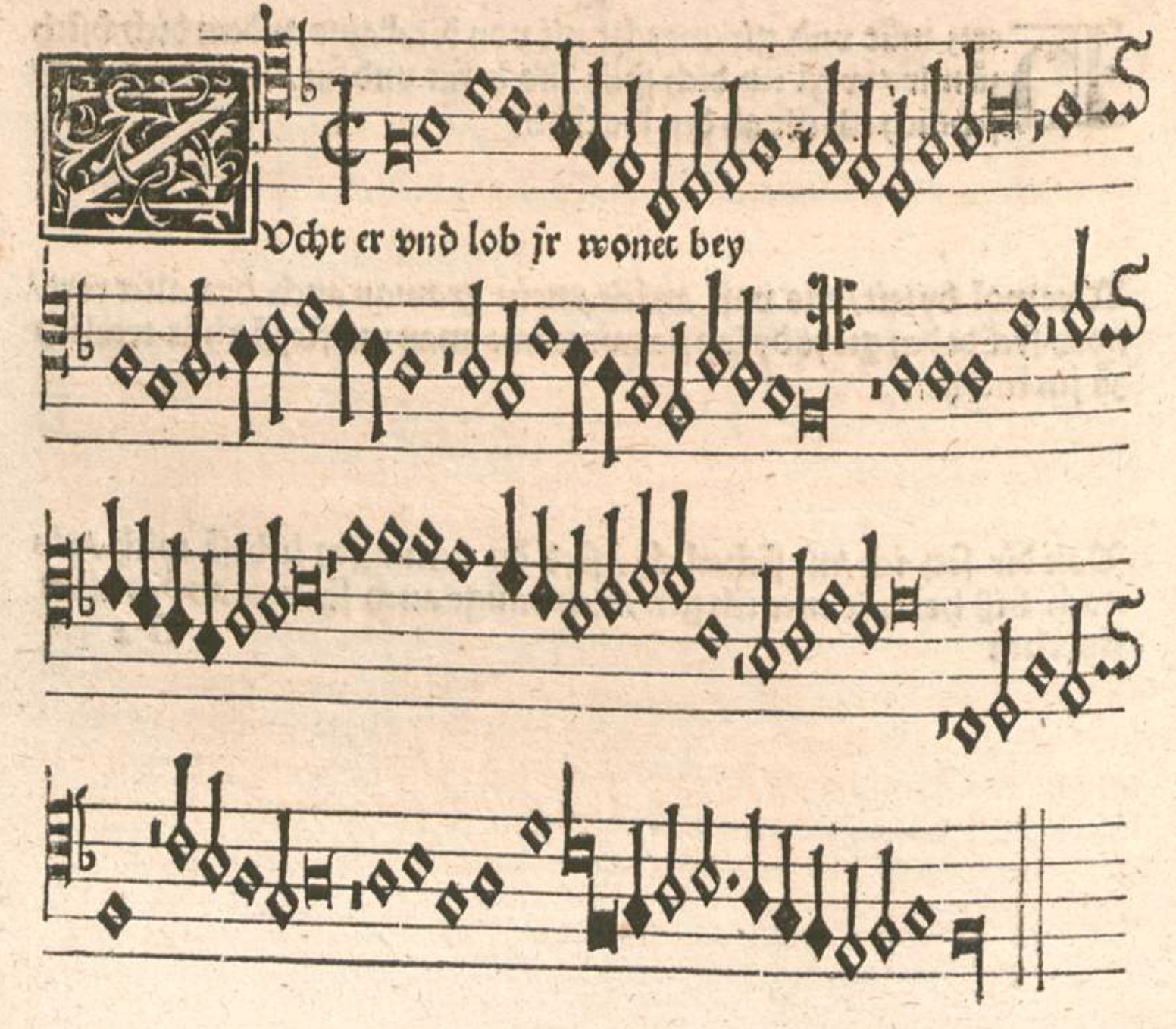
Bayerische Staatsbibliothek München 00082229 Rar.27 Stimme T f.42v [Public Domain]
Read the text (PDF)
Introduction to the Text
The first printed songbook with songs primarily in German was printed in July 1512 by the Augsburg printer Erhard Oeglin (ca.1470-1520). The songbook consists of four partbooks (it is the first German song collection to have four voices throughout) and contains 49 songs with a mixture of spiritual and secular content, 43 of which are in German and 6 in Latin. Oeglin was an innovative printer, credited as one of the first printers to print musical notation with movable type and as one of the first printers of Zeitungen (news-sheets, the forerunners of newspapers). Oeglin does not attribute any of the songs to particular composers but some of these songs do appear in other songbooks of this period where they are attributed to various composers active at the Imperial court, including Ludwig Senfl, Paul Hofhaimer, and Heinrich Isaac. These songs are collectively known as tenor lieder, as the melody is usually carried by the tenor line. This was the prototypical song type in Germany at the turn of the sixteenth century and enjoyed particular prominence at the court of the Emperor Maximilian.
Introduction to the Source
Digitized copies of these partbooks are available online from the Bayerische StaatsBibliothek in Munich: https:// stimmbuecher.digitale-sammlungen.de//view?id=bsb00082229.
Further Reading
Keyl, Stephen. “Tenorlied, Discantlied, Polyphonic lied: Voices and instruments in German secular polyphony of the Renaissance.” Early Music, vol. 20, no. 3, 1992, pp. 434–445.
Saunders, Steven. “Music in Early Modern Germany.” Early Modern German Literature 1350-1700, edited by Max Reinhart, Rochester: Camden House, 2007.
Grace, honor and praise are her domain | Zucht er und lob ir wonet bey
Thüe was ich wil so ist mein gunst / umb sunst / dye grosse prünst / der trewen lieb myet mich schwerlich / mir gschicht unrecht bey meinem aydt / mein zeyt / on alle freyt / vertreiben můß den lon hab ich / mein allte trew bedenck gsell pass / und lass mich bleyben ewig dein / in güet erschein / vertreib mein peyn / und laß mich sein / bevolhen dyr erbarmb dich mein.
Ja fraw dein red mein hertz vast yebt / nw liebt / und unmass tryebt / dein tugend groß mich armen brůder / du waist das ich an argen won / lieb hon / dich hösten kron / und stätz bewar dein zucht und er / dan all mein frewd in ewr giet / ich pitt / verstet mich ewen recht / ich bin gantz schlecht / darum an secht / getrewen knecht / und uns bayde nit weitter schwecht.
Nicht lass mich gen dir verhetzen / letzen / auch nit setzen / kan mich von dir kayns menschen list / ach werden glück erbarmb dich mein / vereyn solch schwere pein / durch deine gůt als frumb du bist / o mein hertz aller liebster gsell / ich stell / mein trost und hayl in dich / ich mayns treylich / mein lieb an sich / bit hertziklich / deyn aygen bin glaub sicherlich.
Ach gsell nit glaub ir trew sich an / ob schon / sein gwonlich lon / traurige lieb erzaygen thůt / rumb laß nit ab deyn gmůt hyn lenck / bedenck / on not nicht krenck / dich selber han ayn gůten můt / der gleychen dw zart schöne fraw / an schaw / sein klag und schmertzlich peyn / den hertz verzeyn / kein frömbden scheyn / nit lass darein / trew ist seltzam drumb hallt dich sein.
Grace, honor and praise are her Domain
Whatever I do, my favor is in vain; the great ardor of faithful love torments me grievously; I’m being wronged, I swear! I have to pass the time with no joy; that’s my reward. Sweetheart, think hard about how faithful I have always been, and let me remain yours forevermore; come to me in good cheer, take away my pain and let me be bound to you: have mercy on me!
Yes, my lady, your words move my heart deeply; now your virtue beguiles and [at the same time] saddens, me, poor brother that I am, without measure. You know that I love you and trust you, my dearest treasure, and always maintain your favor and grace: For all my joy lies in your goodness. I ask and understand me right: I’m being completely honest; so look at me, your faithful servant, and don’t weaken us both anymore.
Don’t let me defy you or stand in your way, no human deception can take me away from you. Oh, dear fortune, have mercy on me; alleviate this grievous pain with your goodness, for you are gracious. Oh, my heart’s dearest companion, I place my comfort and salvation in your hands; I mean it in good faith; I ask you from the bottom of my heart, see my devotion: I am yours for sure, believe me.
Oh, my lad, don’t believe [the slanderer], see her faithfulness, in case sorrowful love should give its usual reward, don’t give up, set your mind to it, think about it, don’t hurt yourself unnecessarily: Be in good cheer. Likewise, you, gentle, beautiful lady, see his sorrow and grievous pain. Lock your heart and don’t let any strange pretence enter it. Loyalty is rare: therefore, stay with him.