
Help, our lady of Aachen! | Hilf fraw von Ach
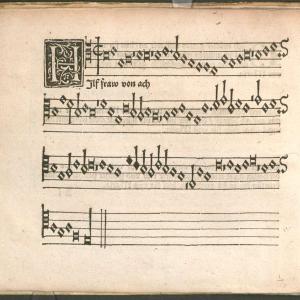
Bayerische Staatsbibliothek München 00082229 Rar.27 Stimme T f.5v [http://stimmbuecher.digitale-sammlungen.de/view?id=bsb00082229]
Read the text (PDF)
Introduction to the Text
The first printed songbook with songs primarily in German was printed in July 1512 by the Augsburg printer Erhard Oeglin (ca.1470-1520). The songbook consists of four partbooks (it is the first German song collection to have four voices throughout) and contains 49 songs with a mixture of spiritual and secular content, 43 of which are in German and 6 in Latin. Oeglin was an innovative printer, credited as one of the first printers to print musical notation with movable type and as one of the first printers of Zeitungen (news-sheets, the forerunners of newspapers). Oeglin does not attribute any of the songs to particular composers but some of these songs do appear in other songbooks of this period where they are attributed to various composers active at the Imperial court, including Ludwig Senfl, Paul Hofhaimer, and Heinrich Isaac. These songs are collectively known as tenor lieder, as the melody is usually carried by the tenor line. This was the prototypical song type in Germany at the turn of the sixteenth century and enjoyed particular prominence at the court of the Emperor Maximilian.
Introduction to the Source
Digitized copies of these partbooks are available online from the Bayerische StaatsBibliothek in Munich: https:// stimmbuecher.digitale-sammlungen.de//view?id=bsb00082229.
Further Reading
Keyl, Stephen. “Tenorlied, Discantlied, Polyphonic lied: Voices and instruments in German secular polyphony of the Renaissance.” Early Music, vol. 20, no. 3, 1992, pp. 434–445.
Saunders, Steven. “Music in Early Modern Germany.” Early Modern German Literature 1350-1700, edited by Max Reinhart, Rochester: Camden House, 2007.
Help, our lady of Aachen! | Hilf fraw von Ach
Hilf fraw von Ach / wie schwach / on masz ich armer sünder bin / und pald ist hyn / mein syn / on gwyn / zů verfüren / spüren / mag ich grüntlich / das got misfelt / der welt / undanckparkait / O rayne mayt / Maria zart / wie hart / mir das zů hertzen / will dringen zwar / gnad mir nit spar / vnnd nymb meinn war / fraw durch dein syben schmertzen.
O iungkgfraw rayn / on nayn / alzeit der sunder trösterinn / was ich begynn / dennck synn / von hynn / müß ich mich wenden / enden sol sich / umb mich / der welde lust / umb sust / ist aller můt / unnd hilfft kain gůt / ich muß daran / unnd kann / den tod nit fliechenn / dan das ich bitt / versag mit nit / und tayl mir mit / dein gnad on alls verziechen.
Der welde hayl / on mayl bistu Maria ewiklich / und frew auch mich / der täglich dich / mit fleiß thůt eren / geren / ertzaygst / und naygst / dich gottes arch / und sarch / dem sünder zůe / O fraw das thůe / ytz in der nott / zum todt / vill kranckhait schweben / erwirb mir huld / das ich mein schuld / mit rew und duld / müg püssen hye in leben.
Help, our lady of Aachen!
Help, our lady of Aachen! How immeasurably weak I, poor sinner, am! Soon I will lose my senses in vain, I’m being led astray. I can definitely tell that God is displeased at the world’s ingratitude. Oh, immaculate maiden, tender Mary! How hard this weighs on my heart. Don’t spare me your mercy and hear me, My Lady, by your seven sorrows!
Oh, immaculate virgin, who without doubt always consoles sinners. Whatever I start, think or come up with, I have to turn myself away from it; around me the world’s pleasure has to come to an end. All bravery is in vain, no wealth can help, I must face it and I can’t flee from death, so I ask you: don’t deny me, and impart on me your grace without delay.
You, Mary, are forever the immaculate salvation of the world, and bring joy to me, who diligently honors you each day. You, the ark and casket of God gladly appear and tend to the sinner. Oh, my lady, do this now in my distress, for illness will hover over death. Grant me favor, so that I might atone for my guilt with repentance and forbearance while I’m alive.