My heart has made a pact with love | Mein hertz hat sich mit lieb verpflicht
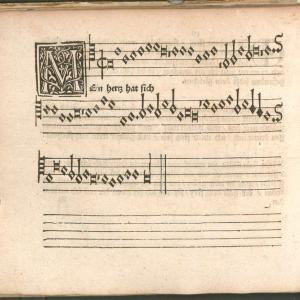
Bayerische Staatsbibliothek München 00082229 Rar.27 Stimme T f.24r [Public Domain]
Read the text (PDF)
Introduction to the Text
The first printed songbook with songs primarily in German was printed in July 1512 by the Augsburg printer Erhard Oeglin (ca.1470-1520). The songbook consists of four partbooks (it is the first German song collection to have four voices throughout) and contains 49 songs with a mixture of spiritual and secular content, 43 of which are in German and 6 in Latin. Oeglin was an innovative printer, credited as one of the first printers to print musical notation with movable type and as one of the first printers of Zeitungen (news-sheets, the forerunners of newspapers). Oeglin does not attribute any of the songs to particular composers but some of these songs do appear in other songbooks of this period where they are attributed to various composers active at the Imperial court, including Ludwig Senfl, Paul Hofhaimer, and Heinrich Isaac. These songs are collectively known as tenor lieder, as the melody is usually carried by the tenor line. This was the prototypical song type in Germany at the turn of the sixteenth century and enjoyed particular prominence at the court of the Emperor Maximilian.
Introduction to the Source
Digitized copies of these partbooks are available online from the Bayerische StaatsBibliothek in Munich: https:// stimmbuecher.digitale-sammlungen.de//view?id=bsb00082229.
Further Reading
Keyl, Stephen. “Tenorlied, Discantlied, Polyphonic lied: Voices and instruments in German secular polyphony of the Renaissance.” Early Music, vol. 20, no. 3, 1992, pp. 434–445.
Saunders, Steven. “Music in Early Modern Germany.” Early Modern German Literature 1350-1700, edited by Max Reinhart, Rochester: Camden House, 2007.
My heart has made a pact with love | Mein hertz hat sich mit lieb verpflicht
Mein hertz hat sich mit lieb verpflicht / zů dir mich irrt auch nicht / des klaffers dicht / ob jm sein hals zerpricht / durch falschen has auch bösen neyd / sein gifftig schneyd / glaub das jch dich darumb nit meyd / kayn unmůt leid / und wer er noch so gescheyd.
Du bist meins gfallens uberal / nach wunsch unnd rechter wal / frewd one zal / han ich von dir zumal / an die doch gar kayn mangel ist / falsch red ist mist / deshalb nicht schafft des klaffers list / zů kayner frist / man ways wol wer er ist.
Was glücks ich im wünsch und gan / das gee den schwetzer an / sein untrew kann / nit unvergolten stan / erscheinen wird in kurtzer zeit / wye vast er schreit / an seinem plerr mir gar nichtz leyt / es felt im weit / mein hertz sich dir ergeit.
My heart has made a pact with love for you
My heart has made a pact with love for you. The slanderer’s lies won’t lead me astray; even if he broke his neck because of his false hate and the poisoned blade of his base envy: Believe me, I will not avoid you because of this and won’t tolerate any trouble however sly he may be.
I’ve fallen for you above all things following my desire and true choice. You above all bring me infinite joy. You are completely flawless, the deceitful talk is garbage, that’s why the trickery of a slanderer never achieves anything; his ways are well known to everybody.
However much fortune I wish and grant him, the windbag may enjoy, his faithlessness cannot go unrepaid. We’ll find out soon how loud he screams, none of his blabbering will distract me; he’s way off the mark. I commend my heart to you.