Now the depths of my heart | Yetz schaydens wee ist worden kund
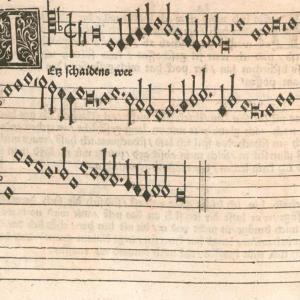
Bayerische Staatsbibliothek München 00082229 Rar.27 Stimme T f.28v [Public Domain]
Read the text (PDF)
Introduction to the Text
The first printed songbook with songs primarily in German was printed in July 1512 by the Augsburg printer Erhard Oeglin (ca.1470-1520). The songbook consists of four partbooks (it is the first German song collection to have four voices throughout) and contains 49 songs with a mixture of spiritual and secular content, 43 of which are in German and 6 in Latin. Oeglin was an innovative printer, credited as one of the first printers to print musical notation with movable type and as one of the first printers of Zeitungen (news-sheets, the forerunners of newspapers). Oeglin does not attribute any of the songs to particular composers but some of these songs do appear in other songbooks of this period where they are attributed to various composers active at the Imperial court, including Ludwig Senfl, Paul Hofhaimer, and Heinrich Isaac. These songs are collectively known as tenor lieder, as the melody is usually carried by the tenor line. This was the prototypical song type in Germany at the turn of the sixteenth century and enjoyed particular prominence at the court of the Emperor Maximilian.
Introduction to the Source
Digitized copies of these partbooks are available online from the Bayerische StaatsBibliothek in Munich: https:// stimmbuecher.digitale-sammlungen.de//view?id=bsb00082229.
Further Reading
Keyl, Stephen. “Tenorlied, Discantlied, Polyphonic lied: Voices and instruments in German secular polyphony of the Renaissance.” Early Music, vol. 20, no. 3, 1992, pp. 434–445.
Saunders, Steven. “Music in Early Modern Germany.” Early Modern German Literature 1350-1700, edited by Max Reinhart, Rochester: Camden House, 2007.
Now the depths of my heart | Yetz schaydens wee ist worden kund
Yetz schaydens wee ist worden kund / meins hertzen grund / des ich vor nye / dan erst durch dye / bin worden inn / hertz mut und synn / ward mir zerstrayt / gantz weit und prayt / ich dacht ich stürb vor hertyenlayd.
Nun hat sich glück herwider kert / und mich ernert / vor schaydens pein / dardurch al mein / plut was betrübt / glück hat geübt / in disem spil / darin ich vil / frewd lust und gnad erwerben wil.
Sölch frewd ytz niemer widerfart / ist mir gar hart / verkert in laid ich wider schayd / macht newes wee / noch mer dan ee / mein hertz erkant / recht lieb befandt / erst thut mir schayden angstlich andt.
Now the depths of my heart
Now the depths of my heart have discovered separation’s sorrow, my heart, spirit and senses, which I have only experienced because of her, were scattered far and wide: I thought I’d die of a broken heart.
Now fortune has returned and saved me from separation’s pain, through which all my blood was dulled. Fortune has played its part in this game, in which I will gain much joy, pleasure and favor.
Now it’s very hard for me that such joy is gone forever. Turned to pain, I leave again; this brings new sorrow, even greater than before: my heart had come to know and had felt joy: only now separation brings me to despair.