
Our vicar is away | Unser pfarrer ist auf der pan
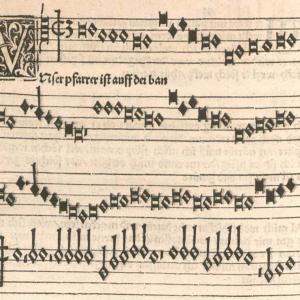
Bayerische Staatsbibliothek München 00082229 Rar.27 Stimme T f.46v [Public Domain]
Read the text (PDF)
Introduction to the Text
The first printed songbook with songs primarily in German was printed in July 1512 by the Augsburg printer Erhard Oeglin (ca.1470-1520). The songbook consists of four partbooks (it is the first German song collection to have four voices throughout) and contains 49 songs with a mixture of spiritual and secular content, 43 of which are in German and 6 in Latin. Oeglin was an innovative printer, credited as one of the first printers to print musical notation with movable type and as one of the first printers of Zeitungen (news-sheets, the forerunners of newspapers). Oeglin does not attribute any of the songs to particular composers but some of these songs do appear in other songbooks of this period where they are attributed to various composers active at the Imperial court, including Ludwig Senfl, Paul Hofhaimer, and Heinrich Isaac. These songs are collectively known as tenor lieder, as the melody is usually carried by the tenor line. This was the prototypical song type in Germany at the turn of the sixteenth century and enjoyed particular prominence at the court of the Emperor Maximilian.
Introduction to the Source
Digitized copies of these partbooks are available online from the Bayerische StaatsBibliothek in Munich: https:// stimmbuecher.digitale-sammlungen.de//view?id=bsb00082229.
Further Reading
Keyl, Stephen. “Tenorlied, Discantlied, Polyphonic lied: Voices and instruments in German secular polyphony of the Renaissance.” Early Music, vol. 20, no. 3, 1992, pp. 434–445.
Saunders, Steven. “Music in Early Modern Germany.” Early Modern German Literature 1350-1700, edited by Max Reinhart, Rochester: Camden House, 2007.
Our vicar is away | Unser pfarrer ist auf der pan
Unser pfarrer ist auf der pan / was getz dich an / ich wais und kan / dy junngen feilel müstern über gan / es fleügt do her ein weisser schwan / wil kurtzweil han / er prangt gar schan / do můsst ich armer půb gar pald dar von / ich gyeng durch ayn zerrissens haus / still was dy maus / sy ruckt her aus / ayn flügel mein gans / gyng gang / gyng gang / also laut unser gsang / schaubhůt der ist fürd sunnen gůt / das pferd ist wild kumbt aus der stůt / das pferd ist will kumpt aus der stůt.
Our vicar is away
Our vicar is away. What’s it to you? I can and know how to ogle the young violets as I go. A white swan flies by, it wants to have fun; it shows off nicely: thus I, poor lad that I am, soon had to leave. I walked through a tumbled-down house; the mouse was quiet, my goose spread apart her wings: gyng gang, gyng gang—so our song goes. A straw hat, it’s good for the sun. The horse is wild, it comes from the mare. The horse is wild, it comes from the mare.