Whoever repays loyalty with falsehood | Wer trew mit valsch vergelten wil
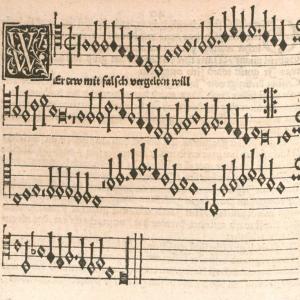
Bayerische Staatsbibliothek München 00082229 Rar.27 Stimme T f.45v [Public Domain]
Read the text (PDF)
Introduction to the Text
The first printed songbook with songs primarily in German was printed in July 1512 by the Augsburg printer Erhard Oeglin (ca.1470-1520). The songbook consists of four partbooks (it is the first German song collection to have four voices throughout) and contains 49 songs with a mixture of spiritual and secular content, 43 of which are in German and 6 in Latin. Oeglin was an innovative printer, credited as one of the first printers to print musical notation with movable type and as one of the first printers of Zeitungen (news-sheets, the forerunners of newspapers). Oeglin does not attribute any of the songs to particular composers but some of these songs do appear in other songbooks of this period where they are attributed to various composers active at the Imperial court, including Ludwig Senfl, Paul Hofhaimer, and Heinrich Isaac. These songs are collectively known as tenor lieder, as the melody is usually carried by the tenor line. This was the prototypical song type in Germany at the turn of the sixteenth century and enjoyed particular prominence at the court of the Emperor Maximilian.
Introduction to the Source
Digitized copies of these partbooks are available online from the Bayerische StaatsBibliothek in Munich: https:// stimmbuecher.digitale-sammlungen.de//view?id=bsb00082229.
Further Reading
Keyl, Stephen. “Tenorlied, Discantlied, Polyphonic lied: Voices and instruments in German secular polyphony of the Renaissance.” Early Music, vol. 20, no. 3, 1992, pp. 434–445.
Saunders, Steven. “Music in Early Modern Germany.” Early Modern German Literature 1350-1700, edited by Max Reinhart, Rochester: Camden House, 2007.
Whoever repays loyalty with falsehood | Wer trew mit valsch vergelten wil
Wer trew mit valsch vergelten wil / der hat das spil / in aller wellt mit recht verloren / und kündt er schiessen noch sovil / er trifft kayn zil / ich wolt es gult im seine oren / prauch allen fleis / er wird mit solcher weys / der khegel nit vil scheiben / er hat kain glückh / weyl er solch tückh thůt treyben.
Ich hann zwar lanng auff das gewart / ob er ayn fart / trew gůttat wurd noch recht erkennen / die mich můß ewig rewen hart / hyetz woll erspart / ein närrin můß ich mich selbs nennen / will suchen weg / damit ich füran pfleg / der rue unnd mich verhüte / vor solchem gwin / das ist mein sin und gmüte.
Will mich wol schicken recht darein / und mercken feyn / wie er sich than hat gen mir halten / verschlossen ist das hertze mein / recht wye ayn schreyn / vor im wil mein selbs walten / ob kem ayn not / das ich nit fall in spot / von im wer ich verlassen / verstee gantz wol / das ich mich sol / sein massen.
Whoever repays loyalty with falsehood
Whoever repays loyalty with falsehood, has lost the game for all to see, and with good reason, and if he could shoot even more, he still wouldn’t hit a target: I’d hope that it costs him his ears. No matter how hard he tries, he won’t hit many pins because he acts so wickedly.
I’ve indeed waited a long time for him to someday correctly understand loyalty and integrity, which will pain me sorely forever. Now spared this I must call myself a foolish woman. I want to find a way to ensure a quiet life from now on and keep myself away from such a reward; this is my mind and intention.
I will resign myself to this and remember how he acted towards me; my heart is closed off from him just like a chest; I’ll take care of myself, in case I risk being ridiculed; [in the case] that people say it was him who left me! I truly know that I should stay away from him.