
Regarding Sister Agnes Waller of Blessed Memory | Item de sorore sancte memorie Agnete, Wallaria cognomento
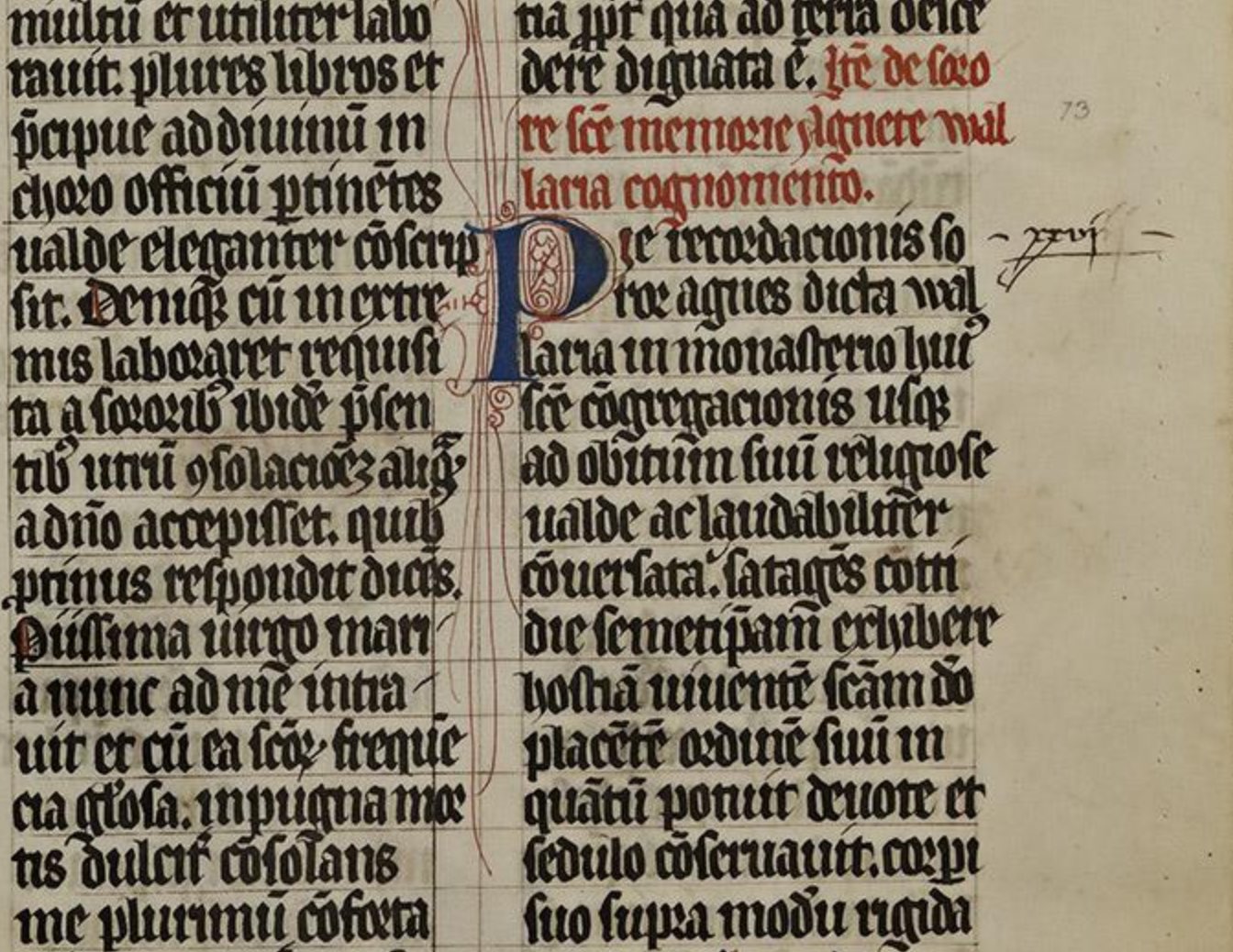
Detail from BVMM Colmar, Bibliothèque municipale, 0926 (508) f.61r (CC BY-NC 3.0)
Read the text (PDF)
Introduction to the Text
“Regarding Sister Agnes Waller of Blessed Memory” is one of several spiritual biographies written by, for, and about the late-medieval nuns of the Dominican monastery of Unterlinden (or Sub tilia in Latin) in their book of Vitae sororum (“Lives of sisters”). The monastery of Unterlinden was founded in the mid-13th century, in the town of Colmar, Alsace (today’s France; a German-speaking region in the Middle Ages).
The Unterlinden Vitae sororum belongs to the late-medieval genre of Sisterbooks (also known as Schwesternbücher, Nonnenbücher, or Convent Chronicles). These are collections of spiritual biographies, similar to saints’ lives (a.k.a. vitae), recording the lives and devotions of the community’s sisters. They were usually collectively authored by the nuns, in either Latin or a Middle High German dialect regional to the monastery, and updated over subsequent generations. The Unterlinden Vitae sororum was probably composed between the late 13th and early 14th centuries.
The entry concerning Sister Agnes Waller is typical of this genre, and particularly notable for its focus on affective piety and the Eucharist. The author of Sister Agnes’s entry praises her holy way of living, calls her a “living sacrifice” and “devoted servant” of the divine, and describes her as “betrothed to God” even before she enters the monastery. At the point of taking her vows, Sister Agnes renounces the secular world and experiences a divine feeling so overwhelming that she begins spontaneously bleeding from her mouth and nostrils. Another miracle happens to Sister Agnes in the monastery: during the celebration of the Mass, she receives a vision of Christ as a beautiful child, white in body and surrounded by red “like an infant newly born.” The author presents Sister Agnes as an example of complete renunciation of the world in favour of a life dedicated to God. Both of the visions attributed to her show the focus on the Eucharist and the humanity of Christ which was common in late-medieval women’s devotion across Europe.
Introduction to the Source
The Unterlinden Vitae sororum was produced at the monastery of Unterlinden (Colmar, Alsace), between the late 13th and early 14th centuries. It comes down to us in a 15th-century copy held at the Bibliothèque municipale in Colmar (MS. 508). There is also a fragmentary copy held in Paris (Cod. lat. 5642 in the Bibliothèque nationale de France) and a translation of the Vitae sororum into Middle High German, dated to the 15th century, which exists in at least two copies (Cod. 164.1 Extravagantes in the Wolfenbüttel Herzog-August-Bibliothek; MS. MA59 in the archive of St Katherine’s Dominican monastery at Zöffingen). The existence of multiple copies of this manuscript and its translations, indicates that the lives of the sisters of Unterlinden were transmitted to other monasteries as well.
The Unterlinden Vitae sororum offers a good example of the type of collective authorship typical of Sisterbooks. After the first 37 chapters, there is an addition of three more under the heading “Regarding those neglected and omitted above” ( De omissis superius et neglectis) followed by a note that “I, Sister Catherine, raised in this monastery from childhood, completed this work” ( Explicit liber. Ego soror Katharina in eodem monasterio a puericia enutrita hoc opus exegi. Summo sit gloria regi.). Five more chapters describing the lives of Unterlinden nuns then follow.
About this Edition
This new translation is based on Jeanne Ancelet-Hustache’s 1930 edition of the Vitae sororum, which is available on JSTOR. The full manuscript is also available, digitized, on the website of the Bibliothèque municipale de Colmar.
Further Reading
Ancelet-Hustache, Jeanne, ed. “Les ‘Vitae sororum’ d’Unterlinden: Édition critique du manuscrit 508 de la bibliothèque de Colmar.” Archives d’histoire doctrinale et littèraire du Moyen Âge, vol. 5, 1930, pp. 317–513.
Cails, Sœur Élie. Un monastère dominicain au Moyen ge: les débuts d’Unterlinden. Éditions du cerf, 2013.
DeMaris, Sarah Glenn. “Anna Muntprat’s Legacy for the Zöffingen Sisters: A Second Copy of the Unterlinden Schwesternbuch.” Zeitschrift für deutsches Altertum und Literatur, vol. 144, 2015, pp. 359–378.
Geith, Karl-Ernst. “Heiligenverehrung und Hagiographie im Kloster Unterlinden zu Colmar.” Dominicains et dominicaines en Alsace, XIIIe-XXe siècles, edited by Jean-Luc Eichenlaub. Conseil général du Haut-Rhin, 1996, pp. 167-172.
Les dominicaines d’Unterlinden: publié à l’occasion de l’exposition Les dominicaines d’Unterlinden, edited by Madeleine Blondel, Jeffrey Hamburger, Catherine Leroy, 2 vols. Musée d’Unterlinden, 2000–2001.
Lewis, Gertrud Jaron. By Women, for Women, about Women: the Sister-Books of Fourteenth-century Germany. Pontifical Institute of Mediaeval Studies, 1996.
Lindgren, Erika Lauren. “Searching for Women in the Records of Women: Two Examples from the South German Dominicans.” Church History and Religious Culture, vol. 88.4, 2008, pp. 563–580.
Winston-Allen, Anne. Convent Chronicles: Women Writing about Women and Reform in the Late Middle Ages. Pennsylvania State University Press, 2004.
Credits
Transcription taken from the edition in “Les ‘Vitae sororum’ d’Unterlinden: Édition critique du manuscrit 508 de la bibliothèque de Colmar”. Ed. Jeanne Ancelet-Hustache. Archives d’histoire doctrinale et littèraire du Moyen Âge vol. 5 (1930): 317–513.
Translation by Laura Moncion
Encoded in TEI P5 XML by Danny Smith
Suggested citation: Various. “Regarding Sister Agnes Waller of Blessed Memory.” Trans. Laura Moncion. Global Medieval Sourcebook . http://sourcebook.stanford.edu/text/regarding-sister-agnes-waller-blessed-memory. Retrieved on August 16, 2021.
Regarding Sister Agnes Waller of Blessed Memory | Item de sorore sancte memorie Agnete, Wallaria cognomento
Pie recordacionis soror Agnes, dicta Wallaria, in monasterio huius sancte congregacionis usque ad obitum suum religiose ualde ac laudabiliter conuersata, satagens cottidie semetipsam exhibere hostiam uiuentem, sanctam, deuote et sedulo conseruauit, corpori suo supra modum rigida atque dura.
Hec adhuc in secula maritata magnique feruoris ac deuocionis ad Deum fuit, elemosinis ceterisque deuote insistens operibus pietatis. Que cum rebus et diuiciis competenter habundaret, incidit aliquando, Deo permittente, in manus quorumdam nobilium et potentum, qui eam in bonis suis plurimum molestabant, inferentes ei dampnum nimis graue.
Uerum hiis ita gestis, tempus non multo post instabat, quo percipere debuit altaris uiuifica sacramenta. Itaque interrogata a confessore suo utrum prius ex corde remitteret hiis qui se leserant, ed dicente eo quoniam aliter dare sibi minime presumeret sacrosanctum corpus Christi, tunc illa repente cum multa animi libertate respondens ait: “Si omnia mundi huius regna dicioni mee subiacerent, illis libencius renunciarem, quam unius momenti spacio carere vellem dulcissimo Deo meo; idcirco toto nunc ex corde ignosco et remitto eisdem, quod in me deliquerunt.” Quibus dictis, tantam talemque uim sibi intulit remittendo, quod sanguis mox de ipsius ore et naribus exiliuit, confessore suo presente pariter et uidente.
Quoniam hec deuota Dei famula omnia mundi prospera et aduersa dispiciens pro nichilo reputauit, ut Christum solum lucrifaceret, ideo gaudium et consolacionem Sancti Spiritus multiplicem accipere meruit in presenti et gloriam in futuro.
Huic quoque iam in monasterio existenti donum ualde mirificum et gloriosum contulit inmensa pietas conditoris, quod preterire silencio congruum non putamus. Siquidem in nocte festiuitatis sacratissime natalis Domini, infra mattutinarum missarumque sollempnia tunc pariter celebranda, in retrochoro se collocarat, utpote debilis et infirma, nec ualens cantatibus coequari.
Cumque interim orationibus ardentissime deuocionis uacaret, subito beatis occulis uisibiliter uidere meruit Dominum Sabaoth, in quem desiderant angeli prospicere. In specie infantis tenerrimi nimiumque decori, qui sibi fuerat diuinitus presentatus. Quem iocunditate et leticia ineffabili intuens et agnoscens suum esse et omnium saluatorem, anima ipsius tota liquefacta est pre inmensa dulcidine et amore illius dulcissimi paruuli, eum sibi totis astringere affectibus desiderans, sed tamen sanctum sanctorum manibus contingere non presumpsit. Erat quoque infans ille beatissimus aspectu delectabilis et ineffabiliter graciosus, nitens corpore candore niueo, sed rubedine quadam pre nimia teneritudine aliquantulum circumfusus, ueluti infantulus recenter iam natus. Uerumtamen uisio hec ammirabilis et iocunda cicius finita est, sed concepte deuocionis mira suauitas deinceps in corde illius finiri non potuit. Ceterum eandem uisionem triduo antequam de corpore migraret patefecit cuidam deuote ac fide digne sorori, que mihi illam, quemadmodum simplicibus uerbis expressi, per ordinem enarrauit.
Obiit autem beata hec soros feliciter sicut et sancte uixerat, assumpta ad regna celestia a Domino Ihesu Christo, quem toto dilexit corde et pura mente.
Regarding Sister Agnes Waller of Blessed Memory
Sister Agnes Waller1 of pious memory lived very religiously and praiseworthily in the monastery of this holy congregation until her death. Striving every day to present herself as a living sacrifice, holy and pleasing to God, she kept his rule faithfully and diligently as much as she was able, stern and unyielding beyond measure to her body.
While she was still in the world, she was betrothed to God and full of great fervor and devotion towards him, faithfully applying herself in almsgiving and in other works of piety. Since she was reasonably wealthy in property and riches, she sometimes fell, God allowing, into the hands of certain noble and powerful men, who troubled her most frequently regarding her goods, inflicting a very great financial loss on her.
Not long after these things had happened, the time approached in which she was bound to receive the life-giving sacrament of the altar. She was asked by her confessor first whether she had left behind those things which are harmful to her, since, as he said, otherwise he would hardly presume to give her the holy body of Christ. Responding suddenly with a great outspokenness of mind, she said: “If all the kingdoms of this world were to submit themselves to my authority, gladly would I renounce them—that is how much I would be willing to deprive myself of them in one moment, for the sake of my most beloved God; on that account I now completely forgive and dismiss those things which were lacking in me.” When she had said this, she felt such a great power, and so much of it, rush upon her in surrendering that suddenly blood burst forth from her mouth and nostrils. Her confessor was there with her and saw this.
This devoted servant of God, despising all the favorable and unfavorable things of the world, reckoned them as nothing, in order that she might gain Christ alone. Therefore she was worthy to receive the manifold joy and and consolation of the Holy Spirit in the present, and glory in the future.
The immense mercy of the Creator also granted a very wonderful and glorious gift to her while she was living in the monastery, which we cannot pass over in silence. Indeed, on the night of the most holy festival of the Nativity, during the solemnities of Matins and Mass, she sat down in the rear of the choir, as she was frail and weak and not feeling up to the singing.
When, however, she gave herself up to prayers of the most passionate devotion, suddenly she was deemed worthy to see, openly and with blessed eyes, the Lord of Hosts2, whom even the angels desire to glimpse. He was present to her through divine inspiration, in the form of a very beautiful child of tender age. Seeing him with unspeakable delight and happiness and recognizing him to be her savior and the savior of all, her entire soul was liquefied before the immense sweetness and love of this most charming child. She desired to grasp him to herself with complete affection, yet she did not presume to touch the holy of holies with her hands. The most blessed child was delectable to behold and unspeakably graceful, shining with a body which was as white as snow, but surrounded by a certain redness due to very great tenderness of age, just like an infant recently born. This astonishing and delightful vision was quickly finished, but the miraculous sweetness of devotion so conceived could not end in her heart thereafter. Three days before she died, God revealed the same vision to a certain sister, devoted and deserving in faith, who told it to me in succession, to the extent that it could be expressed in plain words3.
This blessed sister Agnes died happily, in a holy manner just as she had lived, and was taken up to the celestial kingdom by the Lord Jesus Christ, whom she loved with whole heart and pure mind.
Critical Notes
-
The editor of the Vitae sororum, Jeanne Ancelet-Hustache, notes that a family of this name existed in Ribeau villé around the time when Agnes would have lived; it is probable that she belonged to this family. See Ancelet-Hustache, “Les ‘Vitae sororum’ d’Unterlinden: Édition critique du manuscrit 508 de la Bibliothèque de Colmar,” in Archives d’histoire doctrinale et littèraire du Moyen Âge, vol. 5 (1930), note 1, p. 412.
-
“Dominum Sabaoth” from the Hebrew צבאות (Tzevaot)—in this context, Christ.
-
This vision of the Christ child is a not uncommon occurrence in the Vitae sororum ; the Christ child features prominently in the vitae of prioresses and lifelong choir nuns as well as widows and other women who had joined the monastery later in life. The author’s remark that it was explained to her “in plain words” may refer to a vision by one of the less educated or younger nuns.