
The Song of Peter | Petruslied
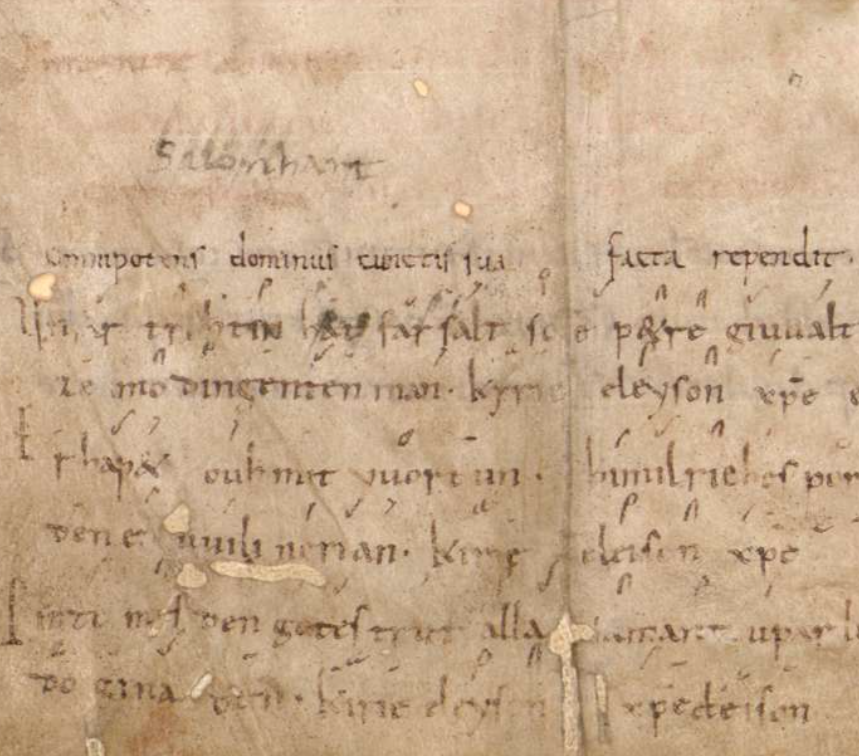
Detail from BSB MS Clm 6260, fol.158v
Read the text (PDF)
Introduction to the Text
The Song of Peter is the oldest surviving hymn in the German language. Hymns are a form of religious poetry sung in praise of God, often during religious ceremonies such as the Mass celebrated by medieval Christians. The tradition of Christian hymns was popularised in the West by Ambrose of Milan (c. 340–397 CE), who wrote hymns in Latin (though some claim that Hilary of Poitiers was the first composer of Latin hymns). Hymns in the “Ambrosian” style remained a very popular part of Christian worship until the Council of Trent (1545–63 CE), when most hymns were abolished from Catholic liturgical practice. The Song of Peter is transmitted with neumes, an early medieval form of musical notation, which suggests that it was supposed to be sung, possibly during religious processions.
Written down in the first third of the tenth century CE in a Bavarian dialect of the Old High German language, it is one of the earliest examples of end rhyme in a German text. This was a change from the Germanic alliterative verse which dominated earlier, where the same consonants were repeated within the same line. It is unknown whether the author of the Song of Peter was influenced by the end rhymes of Otfrid of Weißenburg’s Gospel Harmony (composed c. 870 CE) or whether the Song of Peter predates Otfrid’s work.
The song calls upon St. Peter the Apostle in three strophes of three lines. Each strophe ends with the refrain, “ Kyrie eleyson. Christe eleyson ”, which is Greek for “God, have mercy. Christ, have mercy.” The refrain points to Peter’s special role in the Christian faith as the overseer of admission into Heaven (see, for example, the Biblical passage Matthew 16:19: “I will give you the keys of the kingdom of heaven; whatever you bind on earth will be bound in heaven, and whatever you loose on earth will be loosed in heaven”).
Introduction to the Source
The song survives in only one manuscript, Bayerische Staatsbibliothek Clm 6260, now held in Munich. The manuscript originally stems from the Freising Cathedral library and was written in the second half of the ninth century CE. It contains discussions, in Latin, of religious texts. The Song of Peter was written down later, on the very last page below the end of Hrabanus’s Maurus Commentary on Genesis (f.158v).
Further Reading
Bostock, John Knight. A Handbook on Old High German Literature. 2nd ed. Clarendon. 1976.
Haug, Walter and Benedikt Konrad Vollmann. Frühe Deutsche Literatur und Lateinische Literatur in Deutschland 800-1150. Deutscher Klassiker Verlag, 1991.
- Old High German text and modern German translation (130-131); commentary and extensive bibliography (1117-1120).
Liberman, Anatoly. “Petruslied.” German Writers and Works of the Early Middle Ages: 800 – 1170, edited by Will Hasty and James Hardin. Gale Research, 1995, 252-254.
McLintock, David R. “Petruslied.” Dictionary of the Middle Ages, vol. 9, edited by Joseph Reese Strayer. Charles Scribners Sons, 1987, 546.
The Song of Peter | Petruslied
Unsar trohtin hat farsalt sancte petre giuualt daz er mac ginerian
ze imo dingenten man. kyrie eleyson christe eleyson.
Er hapet ouh mit vuortun himriches portun. dar in mach er skerian
den er uuili nerian. kirie eleison criste [eleyson]
5 Pittemes den gotes trut alla samant uparlut. daz er uns firtanen giuuer
do ginaden1. kirie eleyson criste eleyson
The Song of Peter
Our Lord gave Saint Peter the power to save
those entrusted to him. Kyrie eleison. Christe eleison.
With words, he also guards the gates of heaven through which he admits
those whom he wishes to save. Kyrie eleison. Christe eleison 2.
5 Let us entreat God’s disciple, loudly and in unison, so that he grants
mercy to us sinners. Kyrie eleison. Christe eleison.
Critical Notes
-
This verse can also be found in Otfrid’s Gospel Harmony (I7,28), but with the Frankish form ginadon which results in an assonance instead of a rhyme.
-
Peter’s words can possibly be understood as the key to the gates of Heaven. According to Haug (1991), p.1119, this idea is present in other Latin hymns.