To the tune “Always Encountering Joy”—“The moon shines so brightly” | 永遇樂 · 明月如霜
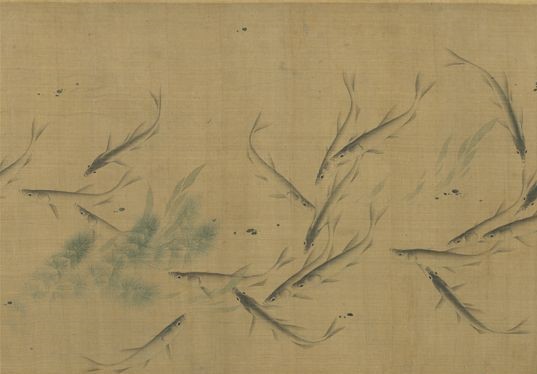
“Detail from 宋范安仁魚藻圖卷 (fish)”, 范安仁, National Palace Museum, Accession Number: K2A000998N000000000PAE [Public Domain]
Read the text (PDF)
Introduction to the Text
In 1078 CE, the poet was the Prefect of Xuzhou. The poem was written when he spent a night in the Swallow Tower, one of the five most famous towers in Xuzhou, and dreamt about Guan Panpan, a courtesan who dwelt in Swallow Tower during the Tang Dynasty (618-907 CE). Su Shi had an unfortunate political career, during which he was often exiled and reassigned. His feelings about this can be seen in the first three lines of the second stanza, in which the poet expresses his exhaustion from all the travelling required by his constant reassignments, as well as his longing for his hometown. This world-weariness spurs philosophical reflections on life, which he regards as dream-like and illusory. The sentiment that all lived experience is a dream strongly connotes Buddhist thought, specifically one of the Buddist classic texts, the Diamond Sutra.
The ci genre of Chinese poetry first emerged in the Sui dynasty (581-619), was further developed in the Tang dynasty (618-907) and matured in the Northern Song dynasty (960-1127). Ci is usually translated into English as “song lyrics”. This is because ci were composed by poets to fit pre-existing tunes. The number of lines, the line lengths, and the tonal and rhythmic patterns of ci vary with the tunes, which number in the hundreds. One common occasion for composing ci would be a banquet: song lyrics would be scribbled down by guests and then sung by musical performers as entertainment. Other occasions for composing and enjoying ci would be more casual: the poet might sing the lyrics to himself at home or while travelling (many ci poets were civil servants of the Imperial Court and often had to travel great distances to carry out their work). Sometimes the lyrics would be sung by ordinary people in the same way as folk songs. This oral and musical quality sets it apart from other genres of poetry in China during the same period, which were largely written texts with more elevated objectives. There are two main types of ci : wǎnyuē (婉 约, “graceful”) and háofàng (豪放, “bold”). The wǎnyuē subgenre primarily focuses on emotion and many of its lyrics are about courtship and love, while the háofàng subgenre often deals with themes that were considered more profound by contemporary audiences, such as ageing and mortality, or the rewards and disappointments of public service.
Su Shi 蘇軾 is one of the most popular Chinese poets of all time, and certainly one of the best-known poets of the Song Dynasty. Among his many roles—principled politician, esteemed poet, celebrated calligrapher—he was also a major reformer of the ci genre. Before Su Shi, the primary form of ci was wǎnyuē (婉 约, “graceful”). This was considered to be an inferior form of literature due to its thematic focus on love and desire and its association with the courtesans who usually performed it. Su Shi wrote lyrics on a broad range of non-traditional topics, often closely related to his own life experience. His compositions dealt with themes that were considered more profound by contemporary audiences, such as ageing and mortality, or the rewards and disappointments of public service. As a pioneer of the háofàng (豪放, “bold”) type of ci, he incorporated references to typically masculine pursuits, including frequent use of a hunting motif. He also frequently incorporated ideas from Buddhist philosophy and allusions to political events, which usually appeared only in more elevated forms of poetry.
Although Su Shi was a highly-regarded poet during his lifetime, his political career was consistently unfortunate. In 1066, he was forced to leave the Court when he openly opposed the chancellor’s socio-economic reforms, known as the New Policies. Over the next thirteen years, he was frequently demoted, serving as prefect or sub-prefect in Hangzhou, Mizhou, Xuzhou and Huzhou. Many of his ci reference these postings and the exhaustion of constant travel. A report about the troubling economic conditions of local people written while he was prefect of Huzhou landed him in prison for three months. He was finally sent back to Hangzhou and given a job with no salary. Although living in poverty, he grew fond of Hangzhou and wrote many of his most famous ci there.
Because of the occurrence of specific real names and locations in Su Shi’s lyrics, as well as the introductory notes he wrote to accompany many of them, his lyrics often invite a biographical reading. This differentiates him from other ci poets featured in this collection, whose writings did not usually reference their own lives in such a direct way. Yet although Su Shi’s lyrics evoke specific lived experiences, the enduring popularity of his poetry is due, in part, to the fact that diverse audiences can identify with the feelings he describes.
About this Edition
The original text of this ci is based on the edition by Tang Guizhang 唐圭璋 ( Quan Song Ci 全宋詞, vol 1. Beijing: Zhonghua shu ju, 1965). Punctuation follows the edition. Since ci poetry rarely includes personal pronouns, and gender-differentiated pronouns did not exist in Classical Chinese of this period, the gender of the speaker as well as their perspective (e.g. first-, second- or third-person) must often be deduced by the translator from context.
Further Reading
Chang, Kang-i Sun. The Evolution of Tz’u Poetry: from Late Tang to Northern Sung. Princeton UP, 1980.
- A standard survey of the early history of Chinese song lyrics (romanized as both ci and tz’u).
Egan, Ronald. “The Song Lyric”. The Cambridge History of Chinese Literature, vol. 1, edited by Stephen Owen, Cambridge UP, 2010, pp. 434-452.
- An overview of the genre.
Owen, Stephen. Just a Song: Chinese Lyrics from the Eleventh and Early Twelfth Centuries. Asia Center, Harvard UP, 2019.
- A recent new history of the genre.
Tang, Guizhang 唐圭璋, editor. Quan Song Ci 全宋詞. Zhonghua shu ju, 1965. 5 vols.
- A comprehensive edition of ci from the Song dynasty and the source text for the ci in this collection (introductions and annotations are in Chinese).
To the tune “Always Encountering Joy”—“The moon shines so brightly” | 永遇樂 · 明月如霜
永遇樂
彭城夜宿燕子樓
夢盼盼因作此詞
明月如霜,
好風如水,
清景無限。
曲港跳魚,
5 圓荷瀉露,
寂寞無人見。
紞如三鼓,
鏗然一葉,
黯黯夢雲驚斷。
10 夜茫茫,
重尋無處,
覺來小園行遍。
天涯倦客,
山中歸路,
15 望斷故園心眼。
燕子樓空,
佳人何在,
空鎖樓中燕。
古今如夢,
20 何曾夢覺,
但有舊歡新怨。
異時對,
黃樓夜景,
爲餘浩嘆。
To the tune “Always Encountering Joy”
Staying the night in the Swallow Tower in Pengcheng
and dreaming about Panpan, I composed this song1.
The moon shines so brightly that it looks like frost covers the ground,
the pleasant wind is cool like water,
the pure view is boundless.
In the winding pond2, fish jump;
5 dew drops fall from the round lotus leaves.
[They are] lonely, for no one sees.
Bum and brum, the drum of midnight,
loud and clear—a leaf falls3.
In the darkness, my dream of cloud4 is abruptly cut short.
10 The night is vast and obscure,
nowhere could I find the things [that I dreamt of] again.
Awoken, I walk around in the small garden.
I am an exhausted traveler at the edge of the world,
longing to return to the mountains.
15 I stare in the direction of my hometown yet it is so far away that my eyes wear out.
The Swallow Tower5 is empty.
Where is the fair one?
The swallow is locked in the empty tower.
The past and the present are like dreams;
20 when do we ever wake up from them?
There is just old love and new regrets.
In some future time,
In the night scene of the Yellow Tower6,
I hope that someone will utter a long sigh for me.
Critical Notes
-
Pengcheng was the name of a place near present-day Xuzhou, Jiangsu Province. Guan Panpan was a courtesan and became the concubine of a Tang Dynasty general. She swore to remain chaste for her lover and kept that promise for ten years after her lover’s death, until she herself passed away. The Swallow Tower was where she lived alone after her lover’s death.
-
This probably refers to a U-shaped pond.
-
The speaker uses hyperbole, comparing the sound of a leaf falling to the beat of a drum to emphasize the quietness of the night.
-
“Dream of cloud” alludes to a work by Song Yu 宋玉, who lived during the Warring States period (453–221 BCE). This work, the Song of Gao Tang (高唐赋), narrates a brief love affair between the Huai King of Chu 楚怀王
and a mountain fairy which takes place in the king’s dream; in this dream, the mountain fairy describes her residence after their lovemaking as “made from the cloud in the morning, but comprised of rain in the evening”. The imagery of cloud and rain is often used as a euphemism for sexual intercourse in Chinese poetry. Here, however, the context indicates that the “dream of cloud” simply refers to meeting a beautiful woman (Guan Panpan) in a dream. -
See first note, above.
-
Yellow Tower is another famous tower near present-day Xuzhou, Jiangsu Province. Su Shi renovated the Yellow Tower while he was posted in Pengcheng.