
Two or three days ago | Depuis deux ou trois jours enca
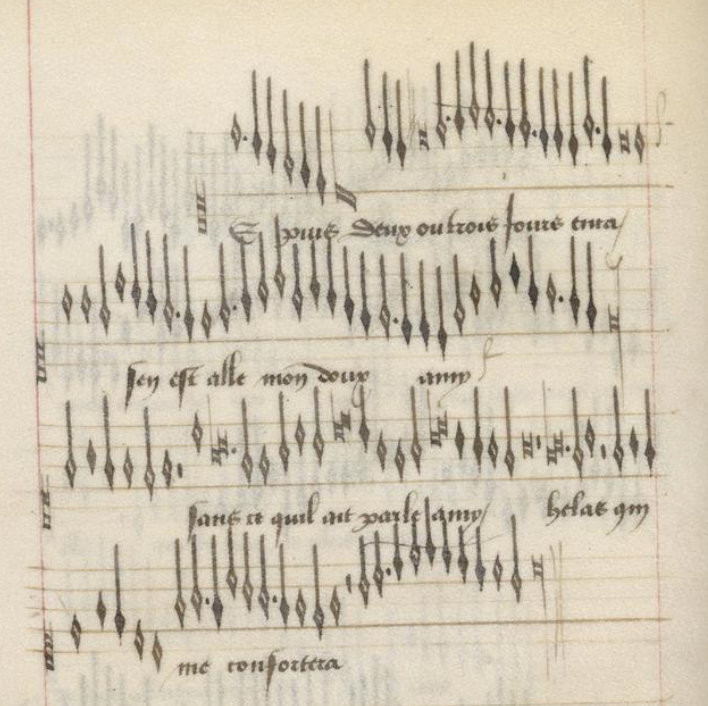
Dijon Chansonnier (Dijon, Bibliothèque Municipale, 517), f.127v (new f.130v).
Read the text (PDF)
Introduction to the Text
This anonymous love song comes from a large songbook (called a ‘chansonnier’), most likely compiled for a wealthy client between 1460 and 1470 CE. Although this song has no named composer, many of the other 160 songs do, and they show that this book sought to capture the latest trends in French songwriting. This song is a rondeau written for three voices, who were to sing their different parts simultaneously. The lyrical content—sorrow at separation from a lover—is typical for a medieval love song, but this song is somewhat unusual in that it adopts a woman’s perspective.
Introduction to the Source
The song can be found in the Dijon Chansonnier (Dijon, Bibliothèque Municipale, 517), ff.127v-128r (new foliation: 130v-131r). The manuscript is available to view at http://patrimoine.bm-dijon.fr/pleade/img-viewer/MS00517/viewer. html?ns=FR212316101_CITEAUX_MS00517_130_V.jpg.
Two or three days ago | Depuis deux ou trois jours enca
Depuis Deux ou trois jours enca /
Sen est alle mon doux ami
Sans ce quil ait parle a my /
helas quy me confortera
5 Ne scay se vuel retournera
Mais il ma mise en grant soussi
Demander le me conviendra
A ceulx quy sont amis de luy
Car par ma foi je vous dis
10 Quen temps mieulx con cuer ne lama
Two or three days ago
my sweet love went away
without saying anything to me.
Alas, who will comfort me?
5 I don’t know whether he wants to return
but he has made me very worried.
I will have to ask
those friends of his about it
because, truly, I say to you
10 that my heart never loved him better.