To the tune “Magpie Treads the Branch”—“Chrysanthemums by the railings wilt” | 鹊踏枝 · 檻菊愁煙蘭泣露
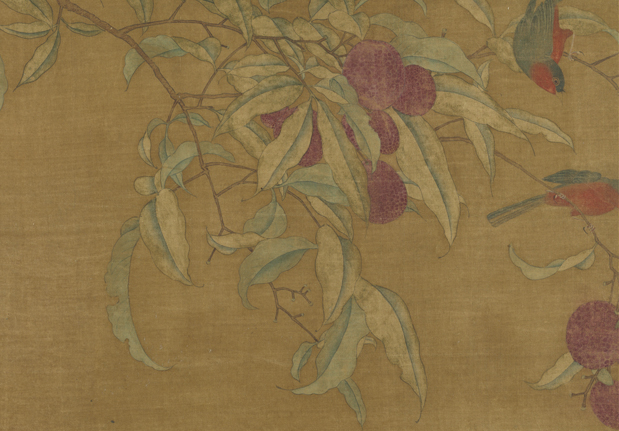
宋錢選荔枝圖(Lychee) 卷, 夏珪, National Palace Museum, Accession Number: K2A001487N000000000PAB [Public Domain]
Read the text (PDF)
Introduction to the Text
This song is written from the perspective of a woman reminiscing about her lover. This is one of the most famous examples of the ci genre, and one of the best-known works of Yan Shu. The song lyrics depict natural imagery which mirrors and amplifies the speaker’s feelings of loneliness.
The ci genre of Chinese poetry first emerged in the Sui dynasty (581-619), was further developed in the Tang dynasty (618-907) and matured in the Northern Song dynasty (960-1127). Ci is usually translated into English as “song lyrics”. This is because ci were composed by poets to fit pre-existing tunes. The number of lines, the line lengths, and the tonal and rhythmic patterns of ci vary with the tunes, which number in the hundreds. One common occasion for composing ci would be a banquet: song lyrics would be scribbled down by guests and then sung by musical performers as entertainment. Other occasions for composing and enjoying ci would be more casual: the poet might sing the lyrics to himself at home or while travelling (many ci poets were civil servants of the Imperial Court and often had to travel great distances to carry out their work). Sometimes the lyrics would be sung by ordinary people in the same way as folk songs. This oral and musical quality sets it apart from other genres of poetry in China during the same period, which were largely written texts with more elevated objectives. There are two main types of ci : wǎnyuē (婉 约, “graceful”) and háofàng (豪放, “bold”). The wǎnyuē subgenre primarily focuses on emotion and many of its lyrics are about courtship and love, while the háofàng subgenre often deals with themes that were considered more profound by contemporary audiences, such as ageing and mortality, or the rewards and disappointments of public service.
Yan Shu, a powerful statesman in the early Northern Song court, had a long and successful career both as an official and as a poet. Among his many literary achievements (which include poetry, song lyrics and prose), his ci compositions are best known. His lyrics are elegant in their choice of words, controlled in the emotions they express, and not as playful as the ci of other well-known poets. They often capture feelings of solitude and sorrow, creating a melancholic mood, but the poet is rarely explicit about what triggers the worry or sadness.
About this Edition
The original text of this ci is based on the edition by Tang Guizhang 唐圭璋 ( Quan Song Ci 全宋詞, vol 1. Beijing: Zhonghua shu ju, 1965). Punctuation follows the edition. Since ci poetry rarely includes personal pronouns, and gender-differentiated pronouns did not exist in Classical Chinese of this period, the gender of the speaker as well as their perspective (e.g. first-, second- or third-person) must often be deduced by the translator from context.
Further Reading
Chang, Kang-i Sun. The Evolution of Tz’u Poetry: from Late Tang to Northern Sung. Princeton UP, 1980.
- A standard survey of the early history of Chinese song lyrics (romanized as both ci and tz’u).
Egan, Ronald. “The Song Lyric”. The Cambridge History of Chinese Literature, vol. 1, edited by Stephen Owen, Cambridge UP, 2010, pp. 434-452.
- An overview of the genre.
Owen, Stephen. Just a Song: Chinese Lyrics from the Eleventh and Early Twelfth Centuries. Asia Center, Harvard UP, 2019.
- A recent new history of the genre.
Tang, Guizhang 唐圭璋, editor. Quan Song Ci 全宋詞. Zhonghua shu ju, 1965. 5 vols.
- A comprehensive edition of ci from the Song dynasty and the source text for the ci in this collection (introductions and annotations are in Chinese).
To the tune “Magpie Treads the Branch”—“Chrysanthemums by the railings wilt” | 鹊踏枝 · 檻菊愁煙蘭泣露
鹊踏枝
檻菊愁煙蘭泣露。
羅幕輕寒,
燕子雙飛去。
明月不諳離恨苦。
5 斜光到曉穿朱戶。
昨夜西風凋碧樹。
獨上高樓,
望盡天涯路。
欲寄彩箋兼尺素。
10 山長水闊知何處。
To the tune “Magpie Treads the Branch”
Chrysanthemums by the railings wilt in the mist, the orchids weep dew.
Inside the silken bed canopy, it is slightly cold;
Swallows fly away in pairs.
The bright moon does not know the bitterness of parting;
5 Its slanting light penetrates my painted window until daybreak.
Last night, the west wind withered the emerald tree.
Alone, I ascended the high tower,
To stare at the road that leads to the edge of the world.
I want to send letters on colored paper and white silk,
10 The mountains are wide, the rivers broad, how do I know where you are?
Critical Notes
Line 2: The “silken bed canopy” refers to a silk curtain over a bed, mostly found in wealthy households.
Line 7: The “high tower” refers to an ancient Chinese military tower, which would typically have had many floors. Once such towers were no longer in use, they often became gathering places for poets.
Line 9 “Colored paper” refers to the luxurious paper typically used for poems and songs.