
To the tune “Willows by the Mountain Pavilion”—“To a singer” | 山亭柳 · 贈歌者
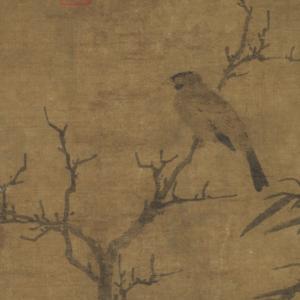
Detail from 宋人枯木竹石(Bird on Branch)軸, Anonymous, National Palace Museum, Accesion Number: K2A000155N000000000PAA [Public Domain]
Read the text (PDF)
Introduction to the Text
The subtitle of this ci suggests that it is supposed to be a gift for a particular singer, yet it also serves as a general depiction of a courtesan’s life during the Song Dynasty. One thing to be noted is the distinction between courtesans and singers. These two professions are often hard to discern in Song Dynasty ci. Even though they have similar names in Chinese, 妓 ( ji) for courtesans and 歌姬 ( ge ji) for singers, and their place of work is often similar, the singers’ work did not involve prostitution.
The two stanzas of this song are an example of antithesis. The first stanza is about how successful the singer was when she was younger, when she competed with the other “blossoms and willows” (i.e., courtesans) for men’s attention, and the second is about her troublesome and lonely life now that she is older and considered less desirable. This piece uses the example of one singer’s unfortunate fate to reflect on the lives of thousands of other singers: they were loved by affluent society when they were young, and cast aside when they were no longer valuable. At the same time, the song may have a secondary meaning as a reflection upon the poet’s own misfortune of not achieving the rank he wanted at the imperial court.
The ci genre of Chinese poetry first emerged in the Sui dynasty (581-619), was further developed in the Tang dynasty (618-907) and matured in the Northern Song dynasty (960-1127). Ci is usually translated into English as “song lyrics”. This is because ci were composed by poets to fit pre-existing tunes. The number of lines, the line lengths, and the tonal and rhythmic patterns of ci vary with the tunes, which number in the hundreds. One common occasion for composing ci would be a banquet: song lyrics would be scribbled down by guests and then sung by musical performers as entertainment. Other occasions for composing and enjoying ci would be more casual: the poet might sing the lyrics to himself at home or while travelling (many ci poets were civil servants of the Imperial Court and often had to travel great distances to carry out their work). Sometimes the lyrics would be sung by ordinary people in the same way as folk songs. This oral and musical quality sets it apart from other genres of poetry in China during the same period, which were largely written texts with more elevated objectives. There are two main types of ci : wǎnyuē (婉 约, “graceful”) and háofàng (豪放, “bold”). The wǎnyuē subgenre primarily focuses on emotion and many of its lyrics are about courtship and love, while the háofàng subgenre often deals with themes that were considered more profound by contemporary audiences, such as ageing and mortality, or the rewards and disappointments of public service.
Yan Shu, a powerful statesman in the early Northern Song court, had a long and successful career both as an official and as a poet. Among his many literary achievements (which include poetry, song lyrics and prose), his ci compositions are best known. His lyrics are elegant in their choice of words, controlled in the emotions they express, and not as playful as the ci of other well-known poets. They often capture feelings of solitude and sorrow, creating a melancholic mood, but the poet is rarely explicit about what triggers the worry or sadness.
About this Edition
The original text of this ci is based on the edition by Tang Guizhang 唐圭璋 ( Quan Song Ci 全宋詞, vol 1. Beijing: Zhonghua shu ju, 1965). Punctuation follows the edition. Since ci poetry rarely includes personal pronouns, and gender-differentiated pronouns did not exist in Classical Chinese of this period, the gender of the speaker as well as their perspective (e.g. first-, second- or third-person) must often be deduced by the translator from context.
Further Reading
Chang, Kang-i Sun. The Evolution of Tz’u Poetry: from Late Tang to Northern Sung. Princeton UP, 1980.
- A standard survey of the early history of Chinese song lyrics (romanized as both ci and tz’u).
Egan, Ronald. “The Song Lyric”. The Cambridge History of Chinese Literature, vol. 1, edited by Stephen Owen, Cambridge UP, 2010, pp. 434-452.
- An overview of the genre.
Owen, Stephen. Just a Song: Chinese Lyrics from the Eleventh and Early Twelfth Centuries. Asia Center, Harvard UP, 2019.
- A recent new history of the genre.
Tang, Guizhang 唐圭璋, editor. Quan Song Ci 全宋詞. Zhonghua shu ju, 1965. 5 vols.
- A comprehensive edition of ci from the Song dynasty and the source text for the ci in this collection (introductions and annotations are in Chinese).
To the tune “Willows by the Mountain Pavilion”—“To a singer” | 山亭柳 · 贈歌者
贈歌者
家住西秦。
賭博藝隨身。
花柳上、鬥尖新。
偶學念奴聲調,
5 有時高遏行雲。
蜀錦纏頭無數,
不負辛勤。
數年來往咸京道,
殘杯冷炙謾消魂。
10 衷腸事、託何人。
若有知音見採,
不辭遍唱陽春。
一曲當筵落淚,
重掩羅巾。
To a singer
My family lived in the west of Qin,
I lived by my skills and talent in dancing and song;
Among all the blossoms and willows, I vied to stand out.
Occasionally I imitated the tunes of Niannu,
5 My voice could halt floating clouds in their path.
I have countless Shu brocades and silks,
My efforts were well-rewarded.
For years now I have traveled between Xianyang and the capital;
Leftover wine and cold food consume my spirit.
10 To whom can I confide the things deep in my heart?
If a patron who appreciated me would choose me,
I would willingly sing every one of the finest songs.
Now, a single song at the banquet and my tears start to fall.
Once again, I hide my face with the silk kerchief.
Critical Notes
Line 3: “Blossoms and willows” is a euphemism for sexual relationships between men and women.
Line 4: Niannu is the name of a famous courtesan from the Tang dynasty, known for her singing.
Line 5: Brocades produced in the Shu area (in present Sichuan) were exquisite and expensive. They were given to singers and dancers as rewards. Singers and dancers would often wrap Shu brocades around their heads as a form of decoration.
Line 7: Singers often traveled from place to place to accommodate the needs of officials.