The Girl Who Wanted to Fly | La pucele qui vouloit voler
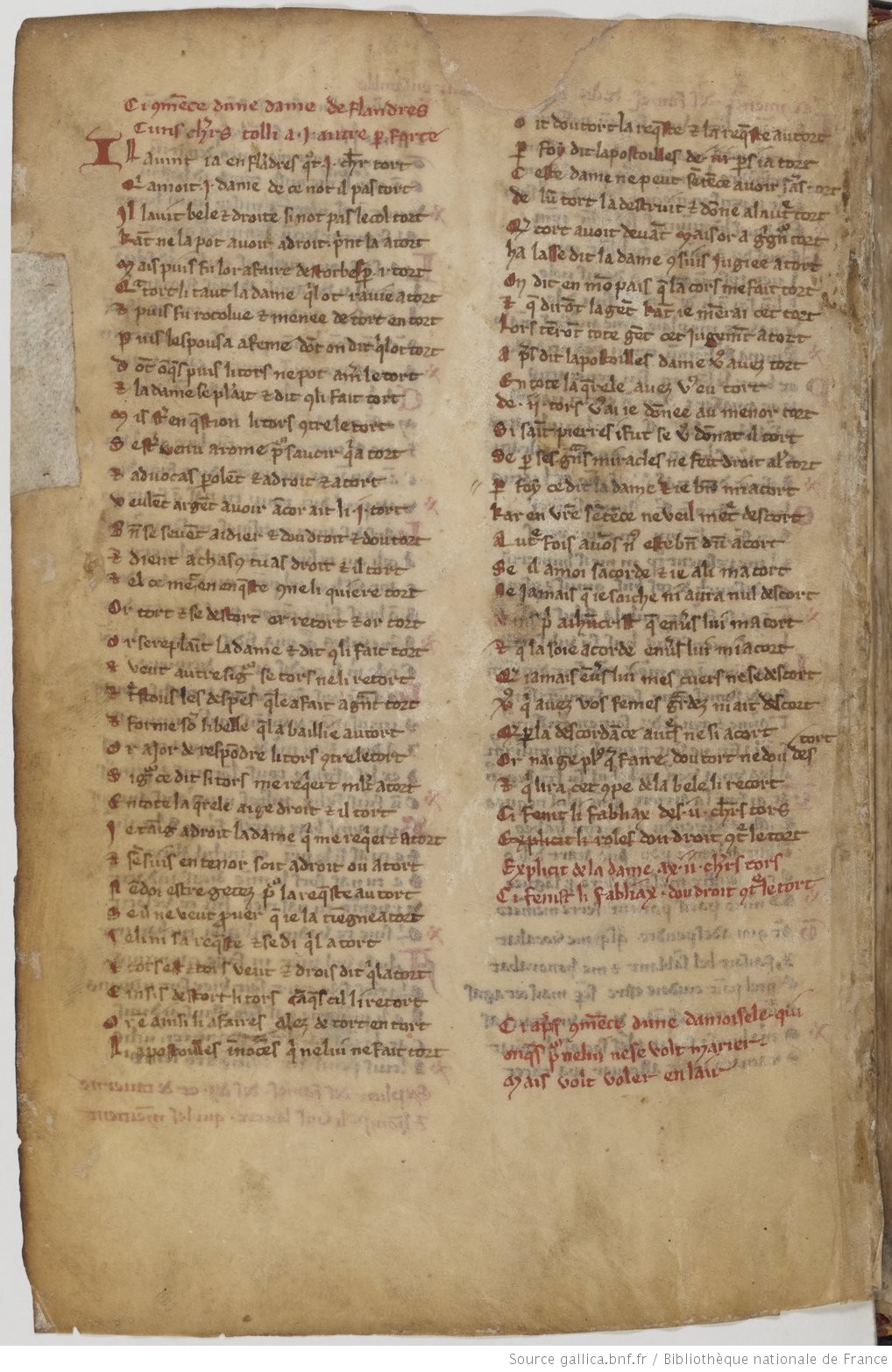
Bibliothèque nationale de France, Département des manuscrits, Français 25545
Read the text (PDF)
Introduction to the Text
Fabliaux are a genre of short tales in verse from late medieval France, which were written and performed by jongleurs, a type of minstrel. Joseph Bédier provides the classic definition of the genre as “contes à rire en vers” [stories in verse to laugh at]. The typical metrical form of the fabliau is octosyllabic rhymed couplets, the most common verse form in medieval French literature. Fabliaux are often obscene, full of scatological and sexual humor; many feature rape and other forms of sexual violence that can be quite graphic and disturbing. They also often express strong anticlerical and anti-nobility sentiments.
“La pucele qui voloit voler” (“The girl who wanted to fly”) is highly representative of the genre in its themes, plot, style, and characters. In this poem, a beautiful and courtly maiden (la pucele) is pursued by a group of suitors, all of whom she rejects. One day, she announces that she would like to be able to fly. Several young men construct wings for her, which do not work. One day, a cleric (li clers) convinces her that she needs a beak and a tail to fly, as all birds possess these things. He offers to make them for her, to which she readily assents. The two close themselves in a room and the clerk begins to kiss her “more than thirty times,” explaining that he is fashioning the beak. Then, he begins work on the tail, at which the lady expresses pleasure. Both the beak and the tail exemplify the use of euphemism and misnaming common in fabliaux. Norris J. Lacy writes that, in fabliaux, the “refusal to call things by their ordinary names will lead directly to the precise result, usually sexual intercourse, that the euphemisms were designed to preclude” (44). “La pucele” is no exception. When the lady in this tale learns that the clerk won’t be able to complete her tail in less than a year, she keeps him with her so she can achieve her goal of flying. Naturally, the lady becomes pregnant; she then complains that the clerk tricked her. He explains to her, however, that her pregnancy is entirely natural. It was her wish to fly that was unnatural. The lesson of the tale, then, is that people who have excessive or outrageous desires will pay the consequences.
Introduction to the Source
“La pucele” exists in three different manuscripts, each of which is a compilation of fabliaux and similar short verse tales. Each version of the tale is largely the same, but with some differences in details. The manuscripts are Bern, Burgerbibliothek 354, folio 43ra-44ra (Witness B); Paris, Bibliothèque nationale de France, fr. 1593, folio 187rb-188ra (Witness E); and Paris, Bibliothèque nationale de France, fr. 25545, folio 4vb-5vb (Witness I). This edition follows the witness naming conventions found in the Nouveau Recueil Complet des Fabliaux (NRCF). The longest of the three manuscripts is I, which has a 26 verse epilogue, compared to 7 verses in B and 9 in E. Each text shows evidence of divergences from what scholars assume to have been the (now lost) original text. The critical text, which we have drawn from the NRCF, tracks most closely with B, despite some omissions in B.
Of the three manuscripts, B is the most legible and most well-preserved, despite some holes in the parchment. E is nearly as legible as B. I is the least legible, showing signs of multiple repairs to the manuscript, irregularly lined columns, and multiple illegible sections due to faded or scraped ink. B has red and blue initials and rubrics in a pale red. E has spaces reserved for miniatures and other decorations that were never completed. I uses red ink for majuscules and rubrics. In all three manuscripts, the fabliau’s author is unnamed. The text is also difficult to date or locate with any precision. Each manuscript is believed to be from the late 13th or early 14th century. I has been dated most precisely as between the end of 1316 and April 3, 1317. As a result, the original date for the composition of “La pucele” is suspected to be sometime in the mid- to late 13th century.
About this Edition
The critical text and manuscript transcriptions are drawn from the NRCF (pp. 155–170). The translation is a new, diplomatic translation by Michael Widner that attempts to follow the critical text as faithfully as possible. All variants are linked to show where they share lines and where they diverge. Digital facsimiles of the manuscripts in which each variant appears are also included in the appropriate locations.
Further Reading
Bédier, Joseph. Les fabliaux: études de littérature populaire et d’histoire littéraire du Moyen Âge. E. Champion, 1925. Crocker, Holly A. Comic Provocations: Exposing the Corpus of Old French Fabliaux. Springer, 2006.
Crocker, Holly A. “Disfiguring Gender: Masculine Desire in the Old French Fabliau.” Exemplaria, vol. 23, no. 4, 2011, pp. 342-367.
DuVal, John, and Raymond Eichmann. Cuckolds, Clerics, & Countrymen: Medieval French Fabliaux. University of Arkansas Press, 1982.
“The Girl Who Wanted to Fly,” The Fabliaux: A New Verse Translation. Translated by Nathaniel E. Dubin. Liveright Publishing Corporation, 2013, pp. 339–344.
Lacy, Norris J. Reading Fabliaux. Routledge, 2013.
Noomen, Willem and Nico van den Boogaard. Nouveau Recueil Complet des Fabliaux, vol. 6, 1991, pp. 155–170. Parsons, Ben. “The English Fabliau in the 15th and 16th Centuries.” Literature Compass, vol. 10, no. 7, 2013, pp. 544-558. Parsons, Ben. “No Laughing Matter: Fraud, the Fabliau and Chaucer’s Franklin’s Tale.” Neophilologus vol. 96, no. 1, 2012, pp. 121-136.
Pearcy, Roy. Logic and Humour in the Fabliaux: An Essay in Applied Narratology. DS Brewer, 2007.
Perfetti, Lisa. “The Lewd and the Ludic: Female Pleasure in the Fabliaux.” Comic Provocations: Exposing the Corpus of Old French Fabliaux. Palgrave Macmillan, 2006, pp. 17-31.
“La pucele qui voloit voler.” ARLIMA, www.arlima.net/mp/pucele_qui_voloit_voler.html.
Schenck, Mary Jane Stearns. The Fabliaux: Tales of Wit and Deception. John Benjamins Publishing, 1987.
The Girl Who Wanted to Fly | La pucele qui vouloit voler
D’une damoisele vos voil
Conter c’onques ne virent oil
Si bele com ele estoit,
Et de biauté grant los avoit.
5 De riches clers, de chevaliers,
Et de borjois et d’escuiers
Estoit totes eures requise,
Mes ne voloit en nule guise
La priere a nul escouter.
10 Un jor dit qu’el voudroit voler.
Sachiez que plusors genz l’oïrent:
A mervelles s’en esbaïrent.
Eles li firent damoisel
De cire et de pennes d’oisel;
15 As braz et as costez li mistrent,
Et, ce sachiez, mout s’entremistrent
De li cointement acesmer:
Mais ainz por ce ne pot voler.
Uns clers li dist: “Ce ne valt rien,
20 Damoisele, ce sachiez bien!
Il vos convendra atorner
Autrement se volez voler:
Que bec vos convendra avoir
Et queue, ce sachiez de voir,
25 Que nus oisaus sanz ce ne vole.
- Je gree bien ceste parole,
Fait la pucele, et je l’otroi.
Qui fera ce? Dites lou moi!
— Damoisele, fet il, je sui!
30 Se vos commandez, encor hui
Vos cuit je fere plus bel bec
Et miaus fet que n’a nul espec;
Plus bele qeue vos ferai
Que poons, que ja n’i faudrai!”
35 A tant en une chanbre entrerent
En l’uis sor aus mout bien fermerent.
Li clers en un lit la cocha:
Plus de trente fois la besa.
Ele demande que c’estoit;
40 Il dit que lou bec li faisoit.
“Fet lo l’en donc en tel maniere?
- Oïl, tornez vos par derriere,
Que la coe i enterai.
Danz clers, fet ele, je ferai
45 Tot ce que vos m’ensaigneroiz,
Mes gardez que vos n’i failloiz!”
Cele se torne a estupons.
Il li enbat jusqu’as coillons
Lo vit el con, sanz contredit.
50 Et la damoisele li dit
Et demande comment ce vet:
Il dit que sa coe li fet.
“Danz clers, fait el, or esploitiez!
Botez parfont, si l’atachiez
55 Si fermement qu’ele ne chiee.
Je seré si aparrelliee,
Quant je vos departirai,
Bien cuit que je voler porrai.”
Et li clers bote adés en l’angle,
60 Cui il n’est gaires de sa jangle.
Quant ot de li fet son talant,
El lit s’asist demaintenant
Et la damoisele lez lui.
“Danz clers, fet ele, don n’iert hui
65 Ceste qeue tote parfete?
Fetes la tost, que mout me hete!”
La boche li bese et la face,
Et si li prie que il face
La qeue tost, se Dieus l’i salt.
70 “Do bec, fet ele, ne me chalt:
Ce puet assez metre en respit!”
De la queue li prie et dit
Que il la face sanz demore.
Li clers dist: “Se Dieus me secore,
75 El n’iert fete devant un an.
Dan clers, fet el, par saint Jehan,
Ja de moi ne departiroiz,
Devant que vos fete l’avroiz!”
Il remest o la damoisele,
80 Car la parole li fu bele,
Et de la queue s’entremist:
Chascun jor un petit en fist.
Tant l’empainst et tant i hurta
Que la damoisele engroissa.
85 ”Hé, dit, clers, vos m’avez gabee!
La queue m’est el cors germee:
Je cuit que je soie engroissiee.
Malement m’avez engingniee:
Je ne puis seulement aler!
90 Comment porroie je voler?
Empiriee sui durement:
Bien savez engignier la gent!”
Li clers li dist: “Par saint Amant,
Vos m’alez a grant tort blasmant,
95 Que, par la foi que je vos doi,
N’iestes pas descreüe en moi!
Se grosse iestes, ce est nature,
Mes ce estoit grant desmesure
Que par l’aire voliez voler:
100 Trop par en faites a blasmer,
De poi estes apesantie.”
En tel maniere l’a servie
Com vos poez ici oïr.
Et ce l’en doit bien avenir:
105 Qui otrage quiert il li vient!
Por ce de ceste me sovient
Qui trop estoit desmesuree:
Issi li fu la qeue entee.
The Girl Who Wanted to Fly
I want to tell you about
A lady; eyes have never seen
One as beautiful as she,
And she drew great praise for her beauty.
5 By clerks of great means, by knights,
And by bourgeois and squires
She was beseeched all the time,
But she did not in any way
Want to hear anyone’s prayers.
10 One day she said that she would like to fly.
You should know that several people heard her:
They were marvelously shocked by it.
Youngsters made her wings
With wax and bird feathers;
15 They put it on her flanks and arms,
And, mark this, they put great care
To arrange her gracefully:
But for all that she could not fly.
A clerk said to her: “This won’t work,
20 Lady, I assure you!
You’ll have to have it
Differently if you want to fly:
Because you need to have a beak
And a tail, for sure,
25 Because no bird flies without these.”
- “I like what you say,”
Said the girl, “and I agree to it.
Who will do it? Tell me!”
- “Lady, he said, I will!
30 If you ask, even today
I will make you the most beautiful beak
And better than any woodpecker’s;
I will make you a tail more beautiful
Than a peacock’s, I won’t disappoint!”
35 So they went into a room
And shut the door firmly behind them.
The clerk threw her on a bed:
And he kissed her more than thirty times.
She asked what this was;
40 He said that he was making her a beak.
“So is that how one does it?”
“Yes, turn your bottom around
So I can graft the tail.”
“Mister clerk,” she said, “I will do
45 Everything you tell me,
But be careful you do not fail me!”
She then got on her hands and knees.
He beat his cock in her cunt
Up to his balls, without objection.
50 And the lady spoke to him
And asked how this was happening:
He said he was making her tail.
“Mister clerk, she said, hurry up now!
Push it in deep, and attach it
55 So strongly that it won’t fall out.
I will be so adorned
When I leave you,
Methinks I will be able to fly.”
And the clerk immediately thrust in the angle,
60 And he didn’t care much about what she was saying.
When he had from her what he wanted,
He sat down on the bed
With the lady next to him.
“Mister clerk,” she said, “won’t the tail
65 Be completed today?
Complete it quickly, because I can’t wait!”
She kissed his mouth and face,
And so beseeched him to make
The tail quickly, God willing.
70 “The beak,” she said, “I don’t care about it:
That can wait!”
About the tail she begged him and said
That he should make it without delay.
The clerk said: “May God save me,
75 It won’t be done before a year.”
— “Mister clerk,” she said, “by Saint John,
You shall never leave me
Until you’ve completed it!”
He stayed with the lady,
80 Because her words pleased him,
And he busied himself with the tail:
Each day he made a little bit of it.
He thrust and banged there so much
That the lady got pregnant.
85 ”Alas,” she said, “clerk, you tricked me!
The tail germinated in my body:
I think I am pregnant.
So cruelly you tricked me:
I can barely walk!
90 How will I be able to fly?
I am much worse off:
You really know how to trick people!”
The clerk said to her: “By Saint Amand,
You blame me very wrongly,
95 Because, by the faith I owe you,
You did not mistrust me!
If you are pregnant, that was nature’s feat,
But it was very presumptuous
To want to fly through the air:
100 You’re acting very reprehensively,
Now you’re weighing down some.”
In this way he served her
As you can now hear.
And this is the outcome she deserves:
105 Who seeks too much will get it!
For this reason I remember this girl
Who was very presumptuous:
And thus had a tail grafted to her.
Critical Notes
Line 33: Witness I has numerous extra lines that are not attested to in other manuscripts. Here, eight lines are added that describe how the cleric will fashion a beak (bec), wings (eles), and a tail (coe). The editors of the NRCF note that the structure of the story is weakened by the addition of this detail because, apparently, the scribe forgot that the girl had already been given wings by another young man (p. 337).
Line 84: After this line, each manuscript diverges considerably. B and E stay near one another, but the order of verses is modified. I leaves out several passages that exist in B and E while adding several others that describe the situation of the pregnant girl. Because the transition in B and E from this line to the next seems rather abrupt, it’s possible that the additions in I contain an echo of some verses that existed in the original manuscript, but which were lost in B and E.